


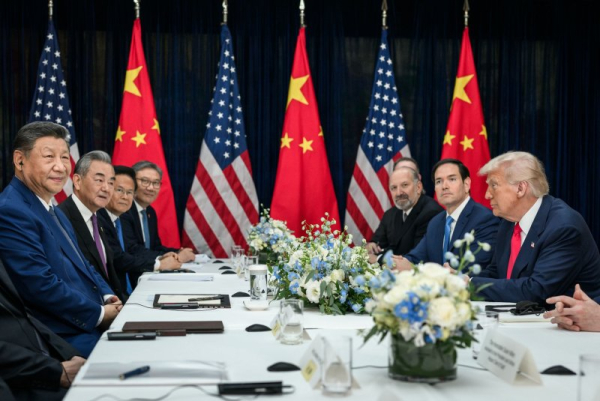
If the Iran cease-fire holds, the People’s Republic of China has already secured meaningful gains. It can present itself as a constructive diplomatic actor, reduce its exposure to high energy costs, and position its firms for reconstruction work across the region. File Photo by Daniel Torok/The White House/UPI | License Photo
Pakistan brokered the two-week U.S.-Iran cease-fire announced this week, with China playing a supporting diplomatic role. Beijing was hurt by the conflict’s higher oil prices and supply disruptions, yet it also gained diplomatic credit by encouraging a pause in the fighting.
Iran, however, has already sought to exploit the truce. Citing Israel’s continuing actions in Lebanon, it has continued to threaten passage through the Strait of Hormuz while adding maximalist demands such as war reparations and a U.S. military withdrawal from the region. As Washington negotiates with Tehran and considers whether military action may resume, it should keep a clear view of its principal geopolitical rival: if the war returns, China may emerge as its greatest strategic beneficiary.
No easy U.S. option
The United States has no good choices. Renewed fighting might impose additional military and economic pain on Iran, but even if most of its drones and missiles are destroyed, enough could survive to threaten Gulf shipping, pressure oil-importing economies, and unsettle the broader global economy. The present truce may also give Tehran time to regroup, possibly with help from Russia and China.
Continued conflict would raise the risk of Iranian strikes against the infrastructure of neighboring states, including refineries, power plants and water desalination facilities. The economic effects would extend well beyond the battlefield.
Further U.S. escalation against Iranian infrastructure, whatever its legality, could also damage America’s standing abroad and deepen political divisions at home.
Why Beijing still gains if peace holds
If the cease-fire holds, the People’s Republic of China has already secured meaningful gains. It can present itself as a constructive diplomatic actor, reduce its exposure to high energy costs, and position its firms for reconstruction work across the region.
That opportunity is not limited to Iran. China has long pursued infrastructure projects in the region, and it could also seek openings with Persian Gulf states that need to repair damaged systems and restore commercial confidence.
Why Beijing may gain more if war returns
Renewed conflict would deepen Beijing’s leverage over Iran and widen its influence across the region. China has become Tehran’s principal economic lifeline, purchasing a large share of its oil exports. A more isolated Iran would likely become even more dependent on Chinese trade, financing and diplomatic cover.
The conflict could also strain Western cohesion. Debates over how to secure Gulf shipping and respond to Iranian pressure would expose differences among U.S. allies, creating frictions that serve Beijing’s broader interest in a less unified West.
The Indo-Pacific cost
The Indo-Pacific dimension is equally serious. Sustained U.S. commitments in the Persian Gulf consume air defense missiles, precision munitions and naval attention that are not easily replaced. They also require Washington to devote military resources to the Middle East that might otherwise reinforce deterrence in Asia.
A prolonged conflict would therefore create a wider opening for China. It would not guarantee aggressive action by Beijing, but it could increase China’s room to maneuver around Taiwan and in other contested theaters.
There is also an intelligence advantage. Continued U.S. operations would give the People’s Liberation Army more opportunities to study American tactics, observe operational patterns and collect useful electronic signals from U.S. bases and deployed assets. Such information could prove valuable in any future confrontation in the Indo-Pacific.
Limits on China’s freedom of action
U.S. military operations against Iran have demonstrated both American reach and the unpredictability of U.S. decision-making. Those are cautionary signals for Chinese planners. China also faces serious domestic economic pressures, and a wider regional war that drives up energy prices and weakens global growth would impose real costs on Beijing.
Internal military politics may also encourage restraint. China’s recent purge of senior military figures, including the removal of Xi’s rival, General Zhang Youxia, has added uncertainty at the top of the system. That may make Beijing less inclined to take major external risks in the near term.
The war has also directly complicated U.S.-China relations. President Donald Trump is now scheduled to visit China on May 14-15 after an earlier plan was delayed by the Iran war. Washington has also sanctioned China-based firms for supporting Iran. Beijing has little reason to invite a sharper confrontation with the United States while those tensions remain active.
What Washington should avoid
None of this makes the U.S. position comfortable. Still, Washington should avoid letting the cease-fire harden into an arrangement that leaves Iran able to menace shipping through the Strait of Hormuz and continue threatening its neighbors.
Such an outcome would push countries in the region, along with states that depend on Gulf energy, toward uneasy accommodations with Tehran. That would weaken U.S. influence and preserve the very instability that China is well positioned to exploit.
A surviving Iranian leadership may also intensify its pursuit of a nuclear deterrent, whether to prevent future U.S. strikes or to strengthen its leverage in future crises.
A broader coalition
The present pause may be the right moment to build the broader coalition to contain Iran and strengthen regional security that has so far been missing. That means more serious burden-sharing with NATO partners and closer coordination with like-minded allies in Asia. It also means moving from improvised reaction toward a more coherent long-term strategy.
The objective should not be framed simply as punishing Iran or degrading selected military assets. It should be to create conditions in which Tehran finds terrorism, nuclear escalation and economic coercion less useful as tools of state power.
If pursued with real partners, such a strategy could yield benefits beyond the Gulf. It could strengthen alliance coordination, restore some U.S. credibility, and reduce the strategic gains that China might otherwise draw from a renewed war.
The cease-fire is not the end of the crisis. Yet used wisely, it could become the start of a more durable approach.
R. Evan Ellis is a senior non-resident associate at the Center for Strategic and International Studies. His latest book, China Engages Latin America: Distorting Development and Democracy, is published by Palgrave Macmillan. The views and opinions expressed in this commentary are solely those of the author.
