

The degradation of the democratic vote.


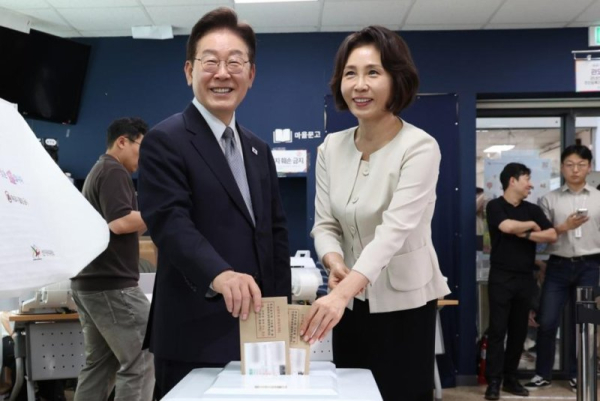
South Korean President Lee Jae Myung and first lady Kim Hye-kyung cast their early votes at a community center near Cheong Wa Dae in Seoul on Friday ahead of Wednesday’s local elections. Photo by Yonhap/EPA/Pool
The author prefers to use the lowercase “n” to challenge the Kim family regime’s legitimacy.
While opinions down partisan lines may clash regarding the recent controversy surrounding South Korean President Lee Jae Myung’s exposed ballot, we must look beyond immediate political squabbles.
This incident demands that we critically examine the very core of our electoral democracy. Had this been a reckless blunder by a minor politician, it would not have faced such fierce condemnation. Furthermore, one cannot help but ask, Had an ordinary citizen acted the exact same way, would the National Election Commission have dismissed it as a mere “mishap”?
The individual at the center of this controversy is none other than the chief executive of South Korea.
This local election marks the first nationwide vote since his inauguration, serving as a critical political stage where he has pledged a sweeping constitutional reform should his party prevail.
A state leader who vows to rewrite the supreme law of the land should, above all people, embody the most rigorous and sacred defense of the “secret ballot” – the very bedrock of that constitution. Yet, the scene witnessed at the polling station was deeply disappointing, according to reports covered by the Chosun Ilbo.
Article 167 of the South Korean Public Official Election Act strictly stipulates that “no voter shall disclose the content of their marked ballot.”
The rule of law cannot be suspended for a leader’s convenience or under the pretext of checking an ink stamp.
Knowing full well that press cameras and broadcast crews were waiting outside, the president chose to walk into the public space with an unfolded, exposed ballot rather than following standard procedure, which dictates quietly calling an election official inside the booth.
This is a clear breach of election law. Had an ordinary voter done this, they would have faced immediate detention or had their vote invalidated.
Once again, South Korea has demonstrated to the international community a bitter paradox: that the constitutional promise of equality before the law fluctuates depending on the magnitude of one’s power.
I speak on this matter with absolute conviction, rooted in a deeply personal and unique background. I was born in north Korea, a land where neither the “freedom” to vote nor the “secrecy” of the ballot exists.
Voting in north Korea is nothing more than a ritual of surveillance and coercion, where citizens are forced to cast a 99.9% approval rate for a single state-sanctioned candidate.
To express dissent, one must physically move to a separate ballot box in plain sight, making rejection an act of putting one’s life on the line. It is an orchestrated “show” designed solely to legitimize a totalitarian regime.
I will never forget the overwhelming emotion I felt when I escaped that totalitarian hell, arrived in the United Kingdom, became a British citizen and finally gained the right to cast my vote in total secrecy.
Moving further, I earned the nomination of my party and ran as a candidate in the British local elections, standing proudly to face the rigorous judgment of sovereign citizens.
At the center of this miraculous journey from a north Korean escapee to a British political candidate is the sacred privilege of the “strictly secret ballot,” which guarantees that every individual can vote according to their conscience, free from the intimidation of power, fear or capital.
However, as discussed in The Asia Business Daily report on election law complaints, I now witness the electoral culture of established democracies becoming deeply distorted with the rise of social media.
Many voters casually expose their marked ballots on SNS under the guise of an “I Voted” certification. Under the United Kingdon’s postal voting system, it has become commonplace for individuals to photograph and share their ballots online, treating it as a badge of political pride or freedom of expression.
To my own shame, before I fully grasped the profound weight of democratic elections, I, too, once committed the error of carelessly posting my ballot on social media out of a misguided sense of pride.
We must ask a fundamental question: Why does every democracy on Earth legally mandate the absolute secrecy of the ballot?
Historically, a secret ballot is not a “discretionary right” that a voter can waive at their own whim.
It is the ultimate shield, won through the blood and sacrifice of generations, to protect an individual’s true conscience from the pressures of power, capital, institutional coercion and social conformity.
Only when a legal safety net exists to completely conceal who you voted for can the socially vulnerable exercise their sovereignty without fearing the eyes of the powerful.
The casual culture of exposing votes done simply because “everyone else does it” or out of a desire to boast is quietly eroding the very foundations of the democratic privileges we enjoy.
This incident, where the chief executive of a nation completely disregarded election management protocols and flaunted a ballot in front of rolling cameras, must not be dismissed as a minor hiccup or a fleeting partisan talking point.
Through the eyes of someone who was once stripped of the right to vote under a dictatorship, watching a leader of a free democracy treat the strictness of election law so lightly is profoundly alarming.
While the president must face strict legal and political accountability for his inappropriate conduct, this moment must serve as a catalyst to restore discipline to electoral cultures worldwide.
Before Lee discusses tearing apart and rebuilding the Constitution, he must first become a mature leader of a liberal democracy who fully honors and protects the foundational principles already written within it.
Jihyun Park, a British Korean Conservative politician and regular contributor to the Korea Regional Review, is a North Korean escapee who fled twice from the country — in 1998, which resulted in a forced repatriation, and in 2008, which was successful. She is a senior fellow for human security at the Center for Asia Pacific Strategy.
