

War, deterrence, and the persistent illusion that rogue regimes can be negotiated into strategic transformation


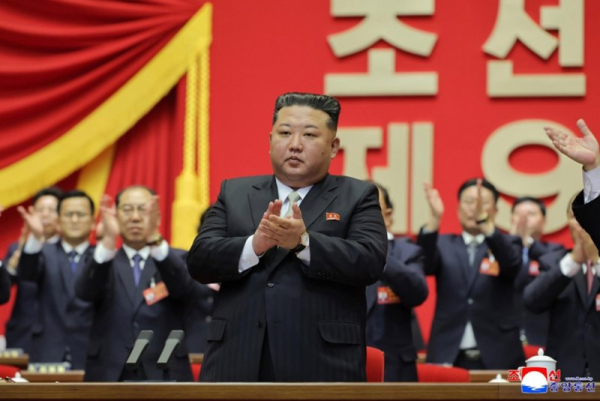
The war in Iran sends one clear message to Kim Jong Un: nuclear weapons remain the ultimate guarantee of regime survival, but they do not provide immunity from pressure, isolation, or attack. Photo by EPA/KCNA
The author prefers to use the lowercase “n” to challenge the Kim family regime’s legitimacy.
The Message to Pyongyang
The war in Iran sends one clear message to Kim Jong Un: nuclear weapons remain the ultimate guarantee of regime survival, but they do not provide immunity from pressure, isolation, or attack. Kim will not see this war as an argument for restraint. He will see it as evidence that a regime without a fully credible nuclear deterrent remains vulnerable to coercion by the United States and its allies.
That is the first and most important lesson for north Korea. Kim will study Iran’s vulnerability and conclude that Tehran was exposed because it had not yet achieved a survivable nuclear force. He will compare Iran’s position with his own. north Korea already has nuclear weapons, ballistic missiles, hardened facilities, underground infrastructure, cyber capabilities, and a political system built for endurance under pressure. Kim will believe that his father and grandfather made the right decision by pursuing nuclear weapons at almost any cost.
Nuclear Weapons Do Not End Risk
But there is a second lesson, and it is more complicated. The war also shows that nuclear ambition does not shield a regime from military action. It can invite it. The United States demonstrated that it may use force against a state it believes is crossing a strategic threshold. Kim will see the danger. He will not abandon his arsenal, but he may accelerate efforts to make it more survivable, more dispersed, and more difficult to neutralize. Expect north Korea to emphasize mobile launchers, solid-fuel missiles, hardened command-and-control, cyber disruption, special operations, and political warfare designed to fracture allied cohesion before a crisis begins.
The war also reinforces Pyongyang’s belief that diplomacy is a tool of strategy, not a path to genuine compromise. This is where north Korea and Iran are most similar. There will never be a successful agreement with either Iran or north Korea as long as the current regimes remain in power. The nature of the regimes, their objectives, and their strategies preclude them from making a good-faith agreement that will be enforceable or that they will truly honor. Any agreement they make will be tactical. It will buy time. It will relieve pressure. It will divide opponents. It will create space to gain advantage.
The Limits of Agreements
This does not mean diplomacy has no value. It means diplomacy must be understood correctly. Agreements with these regimes are not solutions. They are tests. They may freeze a problem, delay a crisis, or create temporary transparency. They may reduce the risk of immediate war. But they should never be mistaken for strategic transformation. Iran’s regime seeks survival, regional influence, ideological legitimacy, and coercive leverage. north Korea’s regime seeks survival, domination of the Korean Peninsula on its terms, recognition as a nuclear power, sanctions relief, and the weakening of the ROK-U.S. alliance and removal of U.S. troops. These objectives are not incidental. They are central to regime identity.
For Kim Jong Un, the reported cease-fire extension and prospective negotiations will carry another lesson. He may conclude that pressure can be endured and then converted into talks. He may also conclude that limited restraint, when paired with threats and escalation risk, can force Washington into negotiation. That would be a dangerous lesson. It could encourage north Korea to provoke, pause, demand concessions, and then repeat the cycle as it has done many times over seven decades.
Connected Strategic Theaters
The implications for the Asia-Indo-Pacific region are serious. The Middle East, the Korean Peninsula, and the Taiwan Strait are not separate problems. They are connected by American credibility, allied confidence, global energy flows, defense industrial capacity, and adversary learning. China, Russia, Iran, and north Korea watch one another. They study U.S. will. They test allied unity. They learn from sanctions, strikes, cease-fires, and negotiations. A war in Iran can shape risk calculations in Pyongyang and Beijing. A crisis in Korea can affect calculations in Tehran and Moscow.
What Allies Must Do
For South Korea and Japan, the lesson is direct. Deterrence cannot rest on declarations alone. It requires readiness, integrated missile defense, resilient command-and-control, civil defense, energy security, and political unity. It also requires a shared understanding that north Korea’s strategy is not merely military. It is political. Pyongyang seeks to weaken resolve before it fires a shot. It will use psychological warfare, cyber operations, nuclear threats, and peace offensives to create doubt inside the alliance.
The United States must therefore avoid two errors. The first is believing that force alone can solve the problem. The second is believing that negotiations alone can solve it. The better approach is integrated statecraft: pressure, deterrence, diplomacy, information and influence activities, alliance coordination, human rights, sanctions enforcement, and military readiness all working together. In short, a superior political warfare strategy supported by overwhelming military capability and capacity.
The Final Question and a Hard Lesson
The strategic question is not whether Kim Jong Un learned from Iran. He did. The question is whether the United States and its allies can learn faster. If they see the war as an isolated Middle East event, they will miss the point. If they see it as part of a larger contest with authoritarian regimes that use diplomacy as maneuver and nuclear programs as leverage, they will be better prepared.
The central lesson is hard but necessary. Agreements with Iran and north Korea may manage danger, but they will not end it. The regimes themselves are the problem. Until that is understood, every tactical pause will be mistaken for strategic progress.
Army Special Forces colonel who has spent more than 30 years in the Asia-Indo-Pacific region. He specializes in Northeast Asian security affairs and irregular, unconventional and political warfare. He is vice president of the Center for Asia Pacific Strategy and a senior fellow at the Global Peace Foundation, where he works on a free and unified Korea. After he retired, he became associate director of the Security Studies Program at Georgetown University. He is on the board of directors of the Committee for Human Rights in North Korea and the OSS Society and is the editor at large for the Small Wars Journal.
