



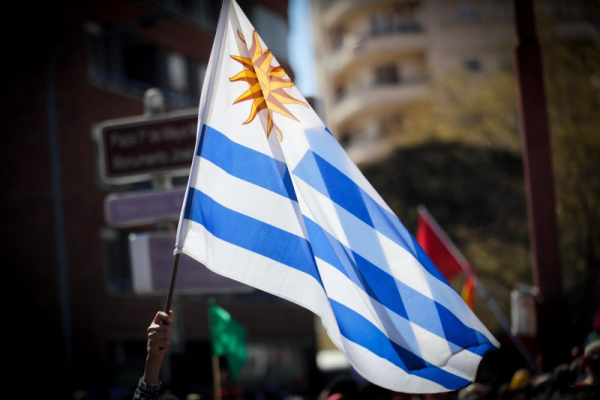
Recent polling by Uruguayan firm Equipos Consultores found something that would have seemed improbable not long ago: among Uruguayans between 18 and 29 years old, a group that historically leaned left, ideological identification has reached equilibrium between left and right for the first time in a generation. File Photo by Raul Martinez/EPA
Recent polling by Uruguayan firm Equipos Consultores found something that would have seemed improbable not long ago: among Uruguayans between 18 and 29 years old, a group that historically leaned left, ideological identification has reached equilibrium between left and right for the first time in a generation. The finding points to a broader shift underway across Latin America, one that is rewriting assumptions about youth politics in a region long associated with progressive movements.
A generation defined by frustration
Generation Z, generally defined as those born between 1997 and 2012, now accounts for roughly a quarter of Latin America’s population, according to regional market research. Together with Millennials, they represent nearly half of the region’s inhabitants. They are not a peripheral demographic. They are, increasingly, the political present.
These young people grew up during a period of rapid transformation: the expansion of digital communication, the weakening of traditional institutions, and the spread of new social expectations. Their expectations are high. Their frustrations are equally intense.
Across the region, many young people live in conditions of economic vulnerability. A large share remains in poverty. Many others are trying to move into the middle class, or to hold on to a foothold in a middle class that often feels precarious. Only a small minority enjoys the security of higher-income sectors. For millions of young Latin Americans, the future does not feel guaranteed.
It is against this backdrop that a striking ideological shift has begun to emerge. Only a few decades ago, youth politics in Latin America was associated almost automatically with the left. Today, that assumption no longer holds.
The roots of discontent
Several factors help explain the change.
Crime has become one of the most pressing concerns across the region, particularly for young men. It helps explain the appeal of security-focused leaders such as El Salvador’s Nayib Bukele, whose security policies have attracted admiration far beyond his own country. For a generation that often feels exposed and unprotected, order can become more persuasive than ideology.
Economic frustration plays an equally important role. Many young people have grown up in societies where the state is seen as powerful but inefficient. Rather than viewing it as a guarantor of opportunity, they see it as a barrier to personal development and social mobility. This perception has driven some toward political positions emphasizing individual initiative and reduced state intervention.
A third current, harder to quantify, is cultural. Among a meaningful segment of young men, there is growing impatience with what is commonly called the “woke” agenda. Many feel that cultural debates have crowded out urgent questions of housing and quality employment. Whether or not one shares that perception, it is clearly shaping the political imagination of many young voters.
These pressures have opened the door to political figures who present themselves as outsiders and alternatives to a discredited establishment. Many are positioned on the right, and their critics frequently describe them as far right. For many young supporters, the labels matter less than the promise to break with a system seen as stagnant and self-serving.
A regional signal
This shift has contributed to rightward electoral movements in Argentina, Ecuador, and El Salvador, while reshaping public debate across much of the region. Generation Z appears to be driving the change with particular force, while Millennials have moved in the same direction more gradually.
The findings from Equipos Consultores in Uruguay offer some of the clearest data available. Based on four survey waves conducted between February and August 2025, the firm found that among the youngest adult cohort, the long-standing predominance of left identification has given way to rough parity.
Separate data reported by the Montevideo newspaper El País, drawing on a longer historical series, put the shift in sharper relief: in 2000, 37 percent of young Uruguayans identified with the left, compared with 27 percent on the right. That gap widened further by 2010. But by 2025, the figures had inverted, with 29 percent on the right and 26 percent on the left.
Uruguay is significant precisely because its political culture made this shift seem unlikely. The country has long leaned toward social democracy, and the Broad Front has governed on several occasions since 2005. Youth activism in Uruguay was closely associated with progressive causes. The reversal is not simply a fluctuation.
This does not mean all young Uruguayans, or all young Latin Americans, are moving in a single direction. Many identify with the center, vote pragmatically, or reject ideological labels altogether. The landscape is more complex than any simple narrative. But the trend lines are real and cannot be dismissed.
A warning, not a verdict
Ideological polarization in Latin America is not only coming from political elites. It is rising from below, driven by younger generations impatient for results.
The decline of several left-wing projects has opened space on the right. But those who fill that space will face the same test. If they fail to deliver on security and economic progress, if they prove as distant from ordinary concerns as the establishments they replaced, they too will face the disillusionment now directed at the old political order.
Latin America’s youth are not simply updating their party preferences. They are sending a message. They want honest leadership and a future that feels within reach. Any political movement that ignores those demands, whether from the left or the right, will eventually pay the price.
Nibia Pizzo is a psychologist with a master’s degree in management and development of social impact projects. She specializes in severe pathologies and drug misuse. She is academic director and founder of “Legacy of the Americas,” a project of the Global Peace Foundation.
