


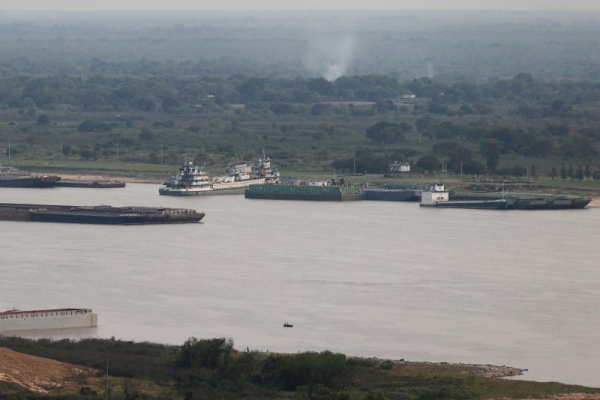
In a matter of weeks, workers on opposite banks of the Paraguay River are expected to guide the final sections of a new international bridge into place, closing the last gap in a structure that has taken years to build and decades to imagine. File Photo by Juan Pablo Pino/EPA
In a matter of weeks, workers on opposite banks of the Paraguay River are expected to guide the final sections of a new international bridge into place, closing the last gap in a structure that has taken years to build and decades to imagine. The moment will attract cameras, official speeches, and a tempting conclusion that one of South America’s most ambitious integration projects is finally complete.
That conclusion would be premature.
The bridge linking Porto Murtinho in Brazil’s Mato Grosso do Sul state with Carmelo Peralta in Paraguay’s Gran Chaco is the keystone of the Capricorn Bioceanic Corridor, a 2,400-kilometer road route meant to connect Brazil’s Atlantic interior with Pacific ports in northern Chile.
Its completion will be important. But the bridge alone will not open the corridor.
A long-planned route
The corridor traces back to the 2015 Asunción Declaration, signed by the presidents of Argentina, Brazil, Chile and Paraguay as a commitment to improve physical integration across the Southern Cone.
The route runs from the port of Santos on Brazil’s Atlantic coast west through the Brazilian interior, across Paraguay’s Chaco and northwestern Argentina, and onward to the Chilean ports of Antofagasta and Iquique.
Among the four countries, Paraguay has carried the heaviest construction burden. Argentina, Brazil and Chile have mainly upgraded existing roads. Paraguay has had to build its entire 530-kilometer section, much of it through sparsely populated and environmentally sensitive terrain. Investment on the Paraguayan side alone has reached roughly $1.1 billion, with the bridge financed by Paraguay’s share of Itaipú Binacional, the joint Paraguay-Brazil hydroelectric entity that operates the Itaipú dam.
The bridge itself is a major engineering work. It involves about 14,000 tons of steel and includes a central span supported by steel cables extending from two high towers, a design that preserves year-round river navigation. Full completion is projected for mid-2026.
The economic promise is real
Brazil is the world’s largest soy exporter, and China is its dominant customer. According to Chinese customs data, Brazil supplied 74% of China’s soy imports in the first 10 months of 2025.
Today, much of that cargo travels overland to Atlantic ports and then by sea to Asia, a route that can take 35 to 45 days. Supporters of the corridor argue that shipments routed through northern Chile could cut transit times to Asian markets by 10 to 15 days and reduce freight costs by roughly 30%.
For a country expected to harvest a record 177 million tons of soy in 2026, that logistical advantage is not trivial.
The missing pieces
On the Brazilian side, access roads to the bridge, contracted through the National Department of Transport Infrastructure, or DNIT, are not expected to be completed until late 2026.
On the Paraguayan side, the last paving segment in the western Chaco, where the route crosses into Argentina, is on a similar timeline, as are the mountain crossings in Argentina and Chile.
Taken together, those delays suggest that full freight operations are more likely in 2027 or even 2028 than in the immediate aftermath of the bridge’s completion.
More than an infrastructure project
The route passes through Paraguay, which maintains formal diplomatic relations with Taiwan and has no official ties with Beijing. That gives the corridor an unusual geopolitical dimension.
China is the most obvious long-term commercial beneficiary, since it is a leading destination for the commodities the route is designed to move. Yet because Paraguay recognizes Taiwan, Beijing cannot directly finance the Paraguayan section in the same way it has backed infrastructure elsewhere in Latin America.
That helps explain why other outside actors have shown growing interest.
At COP28 in Dubai in 2023, the United Arab Emirates joined Brazil, Paraguay, Argentina and Chile in signing a joint declaration aimed at promoting cooperation and investment linked to the corridor.
Chinese state-linked firms have also shown interest in logistics terminals, port concessions and highway-related opportunities on the Brazilian and Chilean ends of the route. The United States, which has watched Chinese infrastructure expansion in Latin America with increasing concern, is also paying attention.
In that sense, the corridor is not only a trade route. It is also part of a wider contest over finance and strategic presence in South America.
The environmental question
The Gran Chaco is South America’s second-largest forest after the Amazon. It stretches across Paraguay, Argentina, Bolivia and Brazil, though the Paraguayan Chaco itself remains sparsely populated. The broader region is home to millions of people, including Ayoreo communities, some of whom are the only people living in voluntary isolation in the Americas outside the Amazon basin.
NASA satellite analysis found that 27% of the Paraguayan Chaco disappeared between 1987 and 2012. Researchers have long warned that when new roads reduce transport costs from agricultural land to export markets, they often accelerate the expansion of the agricultural frontier.
Paraguay has pledged to include 14 wildlife crossings along its section of the route. Critics argue that this is not enough to offset the ecological pressure that greater connectivity may bring.
That means the environmental question cannot be treated as an afterthought. The corridor’s economic promise and environmental costs are intertwined, and much will depend on whether Paraguay and its partners enforce credible land-use and conservation rules as traffic grows.
A milestone, not the finish line
Former Paraguayan President Mario Abdo Benítez once called the Bioceanic Corridor “the small Panama Canal.” The comparison may be ambitious, but the logic behind it is easy to see.
For Paraguay, a landlocked country long dependent on river routes and overland links that favor neighboring economies, the corridor could open a new strategic role. In an April 2025 assessment, the Organization for Economic Cooperation and Development (OECD), said the project could help Paraguay become a logistics hub, deepen its participation in trade and strengthen territorial integration.
That potential will depend on choices still unsettled: customs alignment across four countries, expanded port capacity at Antofagasta and Iquique, and clear terms for outside investment.
The completion of the bridge span will be a milestone worth celebrating.
It should also be understood for what it is: a starting point, not an arrival. The corridor’s real test begins on the other side of the span.
Federico Sosa is a Paraguayan economist and international consultant with experience in foreign direct investment, industrial development, and trade policy. He is a member of the executive committee of Instituto Patria Soñada, a Paraguayan think tank. The views and opinions expressed in this commentary are solely those of the author.
