


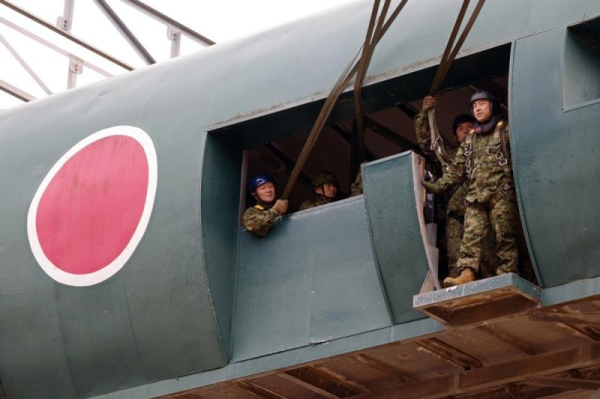
With a growing perception of the unreliability of the United States as a trustworthy ally, Japan is among the nations that are re-examining their defense posture. File Photo by Franck Robichon./EPA
As the war in Iran, not excursion, enters its second month and President Donald Trump has delayed his much publicized trip to Beijing, has the Indo-Pacific region sunk with little trace in terms of American policy priorities?
The region is massive in terms of geography and population stretching some 8,000 miles from India’s west coast to Pearl Harbor, Hawaii, and numbering about 4.6 billion souls, almost three-fifths of the global population.
And the region is suffering far greater than the United States and West from the shortages of oil, natural gas and fertilizer, among other commodities.
Yet, the geostrategic, political and economic issues are not lessening in consequence or complication.
While some in the United States believe that China, along with Russia, is the big winner so far from Operation Epic Fury and the combined U.S.-Israeli assault on Iran, that may be an oversimplification. China seeks and depends on stability and views volatility as very disruptive to advancing its interests.
Yes, a weakened America whose credibility and influence are in decline may be an advantage to China. But an America that is unpredictable, chaotic and wavering in its policy aims and has resorted to its seemingly only major advantage — military force — may prove too disruptive to China.
The international trading and economic system on which China is entirely dependent and vulnerable is suffering shocks from the semi-closure of the Strait of Hormuz in which tolls to Iran have allowed some passage.
Chinese political stability rests on its need for access to foreign markets and resources that includes the necessity of foreign trade and the $1 trillion trade surplus it is running to sustain the economy.
As both are restricted by the war, that is bad business for China. And being highly cautious and deliberate, China almost certainly will not enter the war by escorting tankers or forcing the opening of the strait. But does Trump understand any of this?
With a combination of the expired New START Strategic Arms Agreement and the growing perception of the unreliability of the United States as a trustworthy ally — made clear in the National Security and Defense Strategy documents that focus on the Western Hemisphere — regional powers including Japan and Korea are re-examining their defense postures. And both have the technical ability to develop nuclear weapons far more quickly than any Iran might or might not deploy.
What about India? The Indo-Pacific designation would seem to resemble a chicken-elephant stew in that initiatives toward India seem to lack urgency and priority. In part, that is due to geography. The United States must take care to balance India and China and India and Pakistan so as not to exacerbate the tensions and conflicts. That is far from easy.
Diplomacy may be ongoing between the United States and India, but as Winston Churchill reacted after being told that losing the 1946 election was a blessing in disguise, the great man retorted “that if indeed it were a blessing, it was highly disguised.”
One wonders if India falls into that category, given the formation of the so-called “Quad” or quadrilateral security dialogue consisting of the United States, India, Japan and Australia.
Then there is the vexing matter of Taiwan. As China’s military forces grow stronger, President Xi Jinping’s directive to “prepare” for a Taiwan contingency by 2027 remains a Damoclean sword.
While an invasion could be economically disastrous given Taiwan’s chip capacity, China has more effective options, such as possibly waiting for the Kuomingdong to assume power or a creating a blockade to force unification.
Despite having defined its national security priorities and with huge uncertainties looming over the war in Iran, the Indo-Pacific is too important a region to remain a backwater.
Bandwidth is very limited with Secretary of State Marco Rubio serving many positions at the same time, including as national security adviser. Worse, there appears to be an absence of any consistent national security process in a White House in which the president serves as his own confidant and counselor.
What to do? Dramatic times often demand dramatic action.
The White House would be well-advised to convene an interagency group on Indo-Pacific strategy oriented on and operating from the Indo-Pacific Command in Honolulu, manned with experts across the government’s national security community.
Removed from the politics of Washington and situated in theater, this may provide the president with the necessary strategic thinking to deal with this vitally important region.
Harlan Ullman is UPI’s Arnaud deBorchgrave Distinguished Columnist, senior adviser at Washington’s Atlantic Council, chairman of a private company and principal author of the doctrine of shock and awe. His next book, co-written with Field Marshal The Lord David Richards, former U.K. chief of defense and due out later this year, is Who Thinks Best Wins: How Decisive Strategic Thinking Will Prevent Global Chaos. The writer can be reached on X @harlankullman.
