



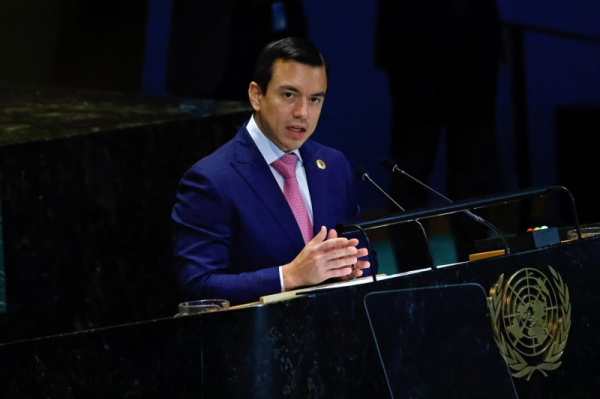
Daniel Noboa Azin, Constitutional President of the Republic of Ecuador, speaks at the ‘Summit of the Future’ during the U.N. General Assembly 79th session in New York in 2024. File Photo by Peter Foley/UPI | License Photo
When Ecuador’s Daniel Noboa won re-election on April 13 with nearly 56% of the vote, defeating a left-wing challenger for the second time in two years, it was more than a personal political triumph. It was another data point in a pattern that has been accumulating across much of the Western world: voters are shifting their priorities, and old assumptions about the political center are being revised.
A mood, not just a moment
This shift cannot be explained by ideology alone. It is also the product of accumulated frustration. Inflation, sluggish growth, migration pressures, and declining trust in institutions have led many voters to look beyond the traditional political script for alternatives that seem more likely to deliver results.
The leaders who have benefited from this mood — Donald Trump in the United States, Javier Milei in Argentina, Giorgia Meloni in Italy, Nayib Bukele in El Salvador — operate in very different national contexts and hold distinct policy positions. What they share is a promise: to revise the dominant approaches of recent decades and restore a focus on economic performance, security and a more demanding standard of accountability for the state.
Latin America as a testing ground
Latin America deserves particular attention in this process, not as a passive recipient of a Western political trend but as one of its most consequential testing grounds. For decades, the region has moved through cycles of growth and crisis, with persistent problems of low productivity, informality, and institutional fragility. In many countries, large sectors of the population have concluded that the prevailing models, whether center-left or center-right, have not delivered sustained improvements in daily life.
The result is growing openness to proposals that emphasize private investment, macroeconomic discipline and job creation. This does not mean the region has converged on a single formula. It means voters are becoming more pragmatic, asking less whether a policy sounds compassionate and more whether it works.
Argentina is among the most closely watched experiments. After years of inflation exceeding 100% annually, Javier Milei’s government launched a sweeping effort to reduce public spending and stabilize the economy. Whatever one concludes about its pace or social costs, Argentina’s reform program has reopened a debate that once seemed settled: whether market-oriented adjustment can be sustained through the ballot box.
El Salvador offers a different kind of evidence. Bukele’s security crackdown, controversial for its restrictions on civil liberties and mass detentions without trial, produced a dramatic reduction in violence. According to the Salvadoran government, in figures cited by the U.S. Congressional Research Service, the national homicide rate fell from 53.1 per 100,000 in 2018 to 1.9 per 100,000 in 2024. The lesson the region has drawn is uncomfortable but real: when democratic institutions fail to provide basic security, voters will reward leaders who promise order first and discuss the legal constraints later.
Noboa’s re-election in Ecuador points to the same underlying demand. His campaign centered on security and economic revitalization in a country experiencing an acute crisis of gang violence. He won by more than eleven percentage points against a well-organized left-wing opponent. The mandate was clear, even if the results remain far from guaranteed.
The test that follows
This political cycle is not without its own risks. Some of its leaders may mistake firmness for impunity. Others may pursue market reforms without building the institutional trust needed to sustain them. A pendulum corrects an imbalance, but it can also overshoot.
History suggests that changes in political cycles generate expectations that governing is poorly equipped to satisfy. The real measure of this moment will not be electoral. It is whether the new cycle can produce lower inflation, safer streets and more formal employment, concrete improvements that voters have made clear they are waiting for.
What is emerging may be something more durable than ordinary electoral alternation. It may represent a recalibration of what publics across the Western world expect from their governments: not larger or smaller states, but more effective ones.
For Latin America, this is an opening. If the new political cycle produces growth alongside stronger institutions, it could help the region break patterns that have constrained it for generations. If it produces only anger, slogans and a concentration of power, it will join a long list of disappointed promises.
The pendulum is moving. Whether it carries reform or merely resentment is a question that no election, by itself, can answer.
Jonathan Amarilla is a Paraguayan entrepreneur and economist-in-training with a focus on public policy and economic development. He is the founder of Quality Travel, a corporate travel and business solutions firm based in Asunción, and has served as a youth leader in international civic and leadership organizations, including Operation Smile and Legacy of the Americas
