


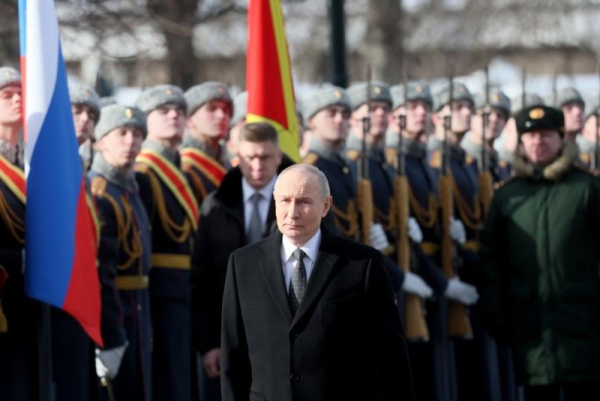
Given Russia’s staggering losses of over a million dead and wounded and the disheveled state of its military, reconstitution will never occur overnight or even in a decade or so. File Photo by Maxim Shipenkov/Pool/EPA
Having spent much of last week in London and now on the continent, glaring disconnects between both sides of the Atlantic and the Pacific have become more than obvious to me.
The first is the disconnect between Europe and the United States over the role of NATO, the threat and the war in Iran. The second is the disconnect between the United States and its “allies,” not only over the war, but about China and whether the alliance will endure.
While Donald Trump has become the catalyst in exposing these geostrategic, political and economic divides, they have been metastasizing like a lurking cancer for decades.
Way back when — a lifetime in politics — the Obama administration made its clumsy and ill-prepared declaration of a “pivot” to Asia, it did so without much of a preplanned strategy not to disrupt our allies or unnecessarily anger China.
To those of us who believed and still do that the geostrategic center of gravity for the United States is in Europe not the Pacific, that “pivot” was flawed from the start.
Yes, I understand that China is an economic and now military superpower that continues to expand both its conventional and military forces. Yes, I am fully aware of China’s long-standing intent of making Taiwan part of the People’s Republic of China.
Indeed, I have lectured at the People’s Liberation Army National Defense University in Beijing, taunting the admirals and generals on how China intended to get to that island given the enormity of what a large-scale invasion force would be required. And, by the way, never getting a good answer to that provocative challenge.
I am also very sensitive to the pleas, demands or orders by any number of presidents going back to John F. Kennedy for NATO to spend more on its defense. In that regard, Trump has been far from the first. He has been the most vocal.
But whether NATO or the United States will live up to the pledge of committing a total of 5% of gross domestic product to defense and to enhancing national security infrastructure, based on past performance, is far from a sure thing.
Regardless, the United States’ abrupt volte‑face toward the Indo‑Pacific, its failure to grasp the real strategic threat from Moscow, and now the war with Iran have widened the rifts between Washington and its European allies to levels not seen since the Suez crisis or the Vietnam era.
Let’s start with the threat from Moscow. At the London Defense Conference last week, it was clear that from most European perspectives, once the war in Ukraine was over, Russia is headed West.
Without much impact, I reminded the participants that after the United States withdrew the bulk of its military from Vietnam in 1973, it took 18 years for that military to vindicate itself and demonstrate its recovery in the 1991 Desert Storm operation that eviscerated one of the world’s largest standing armies in the sands of Kuwait.
Given Russia’s staggering losses of over a million dead and wounded and the disheveled state of its military, reconstitution will never occur overnight or even in a decade or so.
That said, however — and it is a big however — the real threat from Russia is what Lenin called “active measures.” In the current jargon it could be called “screwing around with us.” The band width of active measures is only limited by imagination of how, short of provoking war, Moscow can harass, influence, misinform, disinform and otherwise disrupt the West.
Standard operating procedures include cutting underwater cables that carry global data, voice, and video traffic; disrupting air and sea space with drones or unauthorized overflights; deploying digital tools and apps for propaganda; conducting targeted killings abroad; and using other tactics designed to undermine critical national infrastructure, from water systems to electrical power generation.
So why then is the West, especially the United States and NATO, seemingly incompetent in addressing these active measures. preferring instead to call for more spending on defense that will not yield counters to what Russia is really doing?
The absence of any sound answer is inexplicable. And, of course, the war in Iran — and in my view, excessive focus on China — only exacerbate these disconnects and illusions.
Hope springs in 2029 with a new American president who could grasp these issues. But Hope Springs is a small town in Arkansas, not a panacea.
Harlan Ullman is UPI’s Arnaud deBorchgrave Distinguished Columnist, senior adviser at Washington’s Atlantic Council, chairman of a private company and principal author of the doctrine of shock and awe. His next book, co-written with Field Marshal The Lord David Richards, former U.K. chief of defense and due out later this year, is Who Thinks Best Wins: How Decisive Strategic Thinking Will Prevent Global Chaos. The writer can be reached on X @harlankullman.
