


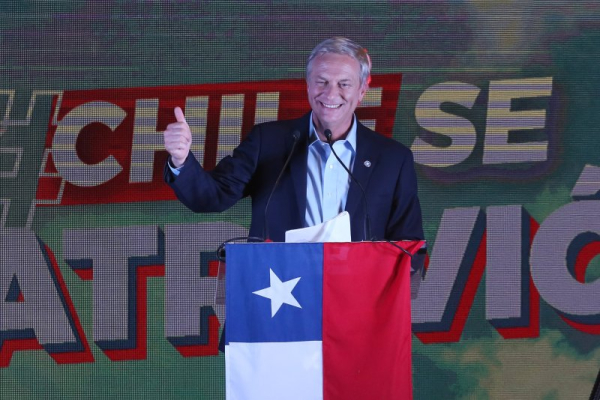
When Jose Antonio Kast was inaugurated as Chile’s president on March 11, he inherited a country under real strain. File Photo by Elvis Gonzalez/EPA
When Jose Antonio Kast was inaugurated as Chile’s president on March 11, he inherited a country under real strain. Crime and immigration have become flashpoints. Fiscal pressures are mounting. Social divisions remain sharp. Chile also faces a difficult external reality: deep economic dependence on China.
In Washington, attention to Chile has focused on what Kast’s arrival could mean for relations with the United States. That focus is understandable. His priorities on border control, immigration, organized crime, business policy and support for Israel align more naturally with the current U.S. administration than did Gabriel Boric’s outgoing government.
Yet to define Kast chiefly through his ties to Washington is to miss something important. His governing style, including his emphasis on decency and firmness, may matter just as much as ideology as Chile confronts a difficult set of domestic and strategic challenges.
A tone that surprised many
Kast has long been portrayed as an ultraconservative, a label that for many suggests a hard and exclusionary politics. His inaugural speech, however, struck a notably inclusive tone.
He argued that Chile’s real adversaries are not fellow citizens who simply think differently, and pledged to govern for all Chileans — including those who did not vote for him — and to restore security and opportunity for the country’s youth. His thanks to his family and embrace of his wife gave the moment an unexpected human warmth.
Whether Kast’s inaugural moderation reflects a genuine governing posture or tactical rebranding is one of the central questions of his presidency.
Security will define his early presidency
Kast began his term by declaring a “government of emergency” and issuing six executive decrees, most of which were focused on border security and immigration enforcement. That move reflected the issue that most helped carry him to office: public insecurity.
The northern border with Peru and Bolivia has become a growing channel for irregular migration, narcotics and other illicit flows, feeding public anxieties over crime and insecurity. Although Chile’s homicide rate remains relatively low by regional standards, the public sense of vulnerability has risen sharply.
A 2025 study by the Center for the Study of Organized Crime documented a major increase in organized criminal activity across the country, with human trafficking concentrated in the north. Among the best-known is Venezuela’s Tren de Aragua, implicated in the 2024 kidnapping and murder of Venezuelan dissident Ronald Ojeda. Peruvian gangs such as the Pulpos, Gallegos and del Callao, along with Colombian extortion networks running gota-a-gota (“drop-by-drop”) loan-sharking schemes, have also taken hold.
By the time Chileans went to the polls in 2025, insecurity had become the country’s leading concern. Kast’s focus on security was central to his decisive victory over Communist Party candidate Jeannette Jara.
His government has already moved aggressively. Kast declared the most vulnerable stretches of Chile’s 1,100-kilometer northern border a military zone, giving the armed forces expanded authority there. He appointed Alberto Soto as special presidential commissioner to oversee a stronger interagency border effort. The government has also begun work on what it calls the “Northern Shield,” including a trench along the Chilean side of the border and a broader physical barrier.
Kast’s approach has drawn comparisons to El Salvador’s Nayib Bukele, whose campaign against gangs has attracted attention across the region, though Kast has not adopted the Salvadoran model wholesale.
Audits, austerity and business reform
Beyond crime, Kast has moved quickly to assess the state he has inherited. He has announced government-wide audits to clarify the fiscal and administrative condition of Chile’s ministries, citing what he describes as a lack of transparency under Boric.
In the fiscal arena, his government has signaled a mix of budget cutting and market-oriented reform. Kast has announced plans to reduce the federal budget by 3% to address a larger-than-expected fiscal deficit. He has also floated cuts in social spending, including the possible elimination of free college tuition for people over 30 and a temporary block on new universities entering the publicly subsidized system.
At the same time, he has proposed measures meant to stimulate business, including reducing the corporate tax rate from 27% to 23%, eliminating capital gains taxes and temporarily suspending the value-added tax on housing. He has also indicated that he wants to roll back his predecessor’s lithium nationalization policies and possibly reform the state mining firm CODELCO.
This agenda is likely to deepen resistance from the Chilean left, which retains significant congressional strength, and could intensify protest in an already polarized country.
The China dilemma
For all the importance of crime and fiscal reform, the biggest long-term dilemma confronting Kast may be how to manage Chile’s growing dependence on China while preserving strong ties with the United States.
In 2025, China bought 40% of Chile’s exports, including three-quarters of its copper and lithium exports and 90% of its cherries. Chinese companies control 57% of electricity distribution in Chile and are deeply present in telecommunications and other digital sectors.
That places limits on any geopolitical reorientation. Kast may want closer ties with Washington, but Chile’s economic structure gives Beijing enormous weight. The dilemma is further complicated by the fact that the previous Boric government had already expanded certain forms of defense cooperation with China, even as it halted Chinese construction of the Ventarrones space facility in the Atacama Desert amid concerns about its possible strategic use.
A meaningful test
During his inauguration, Kast said he was assuming control of a country in worse condition than he had imagined. He has already begun moving quickly on his promise to retake Chile’s streets and institutions.
It matters for Chile and the wider region whether his government succeeds. The coming months will show whether the Border Shield delivers results, whether the audits uncover real mismanagement or merely political theater, and whether Kast can manage Beijing’s economic weight without weakening the Washington alignment he is counting on. Above all, the question is whether the governing style he projected on inauguration day will hold up in practice.
Evan Ellis is a senior non-resident associate at the Center for Strategic and International Studies (CSIS). His latest book, “China Engages Latin America: Distorting Development and Democracy,” is published by Palgrave Macmillan. The views and opinions expressed in this commentary are solely those of the author.
