


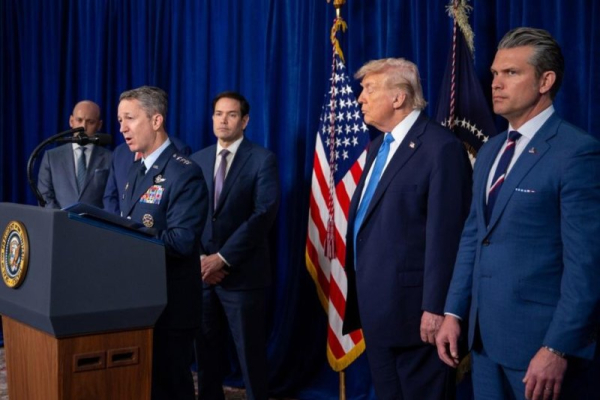
Chairman of the Joint Chiefs of Staff John D. Caine (2-L) speaks during a news conference at the Mar-a-Lago Club in Palm Beach, Fla., on Saturday after Venezuelan President Nicolas Maduro was captured and flown out of his country to face trial in the United States. Photo by Nicole Combeau/EPA/Pool
OK, he did it. After veiled warnings followed by threats and military actions to intimidate Nikolas Maduro, Donald Trump finally pressed the presidential finger on the button.
It was anchors aweigh. Or, in this case, it was Delta Force in what appeared to be a flawless combined military-law enforcement mission to capture and arrest two Maduros, both now awaiting trial in a Brooklyn, N.Y., jail.
Of the oceans worth of questions about the raid, its legality and many others, three sets stand out. First, why did Trump do it? Why did he believe that such an operation was vital? And why will the Maduros’ removal lead to a better life for Venezuelans and the region?
Second, suppose we rewind the tapes to a year ago on Jan. 3, 2025, and President Joe Biden had launched the raid. What might have been the reactions of both political parties and the president-elect, and would that have changed any of Trump’s thinking that went into his National Security Strategy released in late 2025?
Third, instead of asking what lies ahead for Venezuela and the region, a more useful question is what could go wrong? After all, the administration has not revealed any plan for a post-Maduro Venezuela. And after just a few days of uncertainty, it is unclear who is in charge in Venezuela and who will fill this role.
Democrats, who immediately criticized the mission as unconstitutional and a violation of international law, asserted that this was about oil. Venezuela has the world’s largest proven reserves of oil, admittedly sulfur heavy and harder to refine.
Venezuela currently pumps about 1 million barrels a day. Its infrastructure is in disrepair. One U.S. bank estimates it will take about $15 billion to $20 billion and a decade or so to achieve a daily pumping rate of 3 million barrels.
While Trump may be interested in oil, that will take a long time to gain traction. If the regime in Caracas is not fully changed, who would invest in Venezuela and risk its capital? Probably no one.
Removing external interference in the Western Hemisphere from China, Cuba, Iran, Russia and extremist groups certainly could be one reason for the mission. But the presence of these players is not limited only to Venezuela.
While it is possible that Trump really believes that the Western Hemisphere is a vital U.S. interest that transcends Europe or Asia in which his tariffs represent his policy, it is hard to identify a truly existential or even dangerous threat to the United States posed south of its border. That then leaves the answer as to why Trump did it.
Trump authorized the raid because he could. As commander-in-chief, Trump has the military at his beck and call. So he used it. The signal is unmissable. Trump speaks loudly and carries a big stick. After this operation, it is crystal clear Trump has and will employ his military at a time and place of his choosing.
Imagine again if this occurred under the Biden presidency. Republicans would be taking the Democratic cries of alarm and amplifying them many times over. Trump would be accusing Biden of starting another endless war and doing so without the consent of Congress. The cynicism and hypocrisy of U.S. politics would be in full display.
What could go wrong? As in Afghanistan and Iraq after they were invaded, the answer is everything. While Maduro is gone, his regime is not. The important defense, interior and law enforcement agencies are run by Maduro’s people. Who will remove them and who will replace them? There are no answers.
It is impossible to evaluate a plan for what-next when no such plan exists. Will the post-operation period still require a large offshore U.S. military presence? Not only is that expensive, but it also will require a drawdown of U.S. forces from areas that are indeed more important in protecting U.S. and allied interests.
How will Congress respond? Republicans will not challenge the president on the legality of the operation. But will they vote for more funds to support the Western Hemisphere priority? And, given unclassified reports from the National Intelligence and the Congressional Research services linking Maduro to the Trente de Agua gangs and the drug trade may prove more difficult.
Unlike the trial of Panamanian strongman Manuel Noriega, suppose Maduro is acquitted on one or more charges. The brilliance of the military attack brought euphoria. What follows over the coming months could bring quite the opposite.
Harlan Ullman is UPI’s Arnaud de Borchgrave Distinguished Columnist, senior adviser at Washington’s Atlantic Council, chairman of a private company and principal author of the doctrine of shock and awe. His next book, co-written with Field Marshal The Lord David Richards, former U.K. chief of defense and due out next year, is Who Thinks Best Wins: Preventing Strategic Catastrophe. The writer can be reached on X @harlankullman.
