


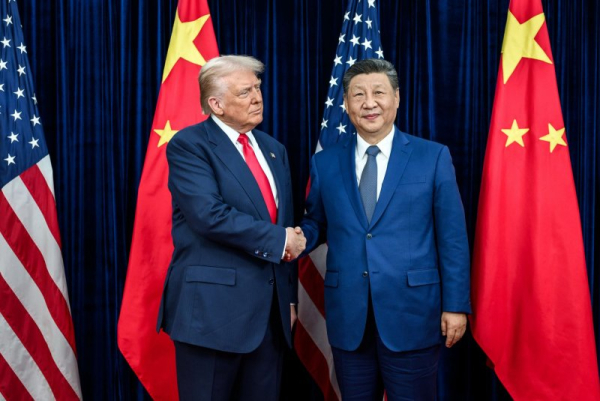
President Donald Trump greets Chinese President Xi Jinping before a bilateral meeting at the Gimhae International Airport terminal in Busan, South Korea, in October 2025. File Photo by Daniel Torok/The White House/UPI | License Photo
Geopolitics examines how geography, in its physical and human dimensions, shapes power and state behavior within the international system.
In today’s interconnected world, marked by competition for influence and resources, geopolitics has regained prominence as a tool for understanding the most consequential global dynamics.
At the center of this landscape stands the evolving rivalry between the United States and the People’s Republic of China, a relationship that is reshaping the international order in the 21st century.
This rivalry blends military competition with deep economic interdependence and an accelerating contest for technological advantage, all unfolding within an increasingly fragmented global system defined by competing blocs and political models.
Diplomatic engagement between the two powers began with Henry Kissinger’s secret visit to Beijing in 1971, followed by President Richard Nixon’s historic trip. The normalization of relations in 1979 set the stage for decades of engagement.
For years, Washington supported China’s integration into the global economy, assuming that economic openness would gradually lead to political liberalization. China’s accession to the World Trade Organization in 2001 represented the high point of that strategy.
Those expectations, however, did not materialize. While China experienced extraordinary economic growth and modernization, political liberalization did not follow. Instead, the Chinese Communist Party consolidated control while expanding the country’s global economic and military reach.
Today, China is the world’s second-largest economy and a leading trade partner for dozens of countries. Economic ties between China and the United States remain deeply intertwined through global supply chains and investment flows, alongside large-scale bilateral trade.
At the same time, Washington has raised persistent concerns about Chinese economic practices, including state subsidies and forced technology transfers. These concerns contributed to the trade conflict that began in 2018, marked by tariffs and tighter controls on investment and strategic exports.
The use of tariffs during the Trump administration, and the uncertainty they introduced into global trade relations, further intensified these dynamics. For many countries, especially middle and emerging economies, tariff pressures reinforced incentives to diversify export markets and seek alternative economic partners, accelerating the fragmentation of global trade patterns.
Technology has since become the central arena of competition. Semiconductors and artificial intelligence, along with next-generation communications and clean energy technologies, now lie at the heart of strategic rivalry. The United States seeks to preserve its technological leadership through export controls and closer coordination with allies.
In response, China has intensified efforts to achieve technological self-sufficiency through initiatives such as “Made in China 2025” and its “dual circulation” strategy, aimed at reducing dependence on foreign inputs while strengthening domestic innovation.
The military dimension of the rivalry is most visible in the Indo-Pacific. China’s naval expansion and its actions in the South China Sea, together with growing pressure on Taiwan, have heightened regional tensions. The United States maintains alliances with Japan and South Korea, as well as partnerships with Australia, India and the Philippines, alongside multilateral initiatives such as the Quad and AUKUS.
Taiwan remains the most sensitive and potentially dangerous issue in U.S.-China relations. It combines strategic importance with technological and symbolic significance, and carries a persistent risk of military escalation. The Taiwan Strait and surrounding areas are widely viewed as the most likely flashpoints for direct confrontation.
While the United States maintains formal diplomatic relations with Beijing, it sustains robust unofficial economic and security ties with Taiwan. China continues to conduct military exercises near the island and has reiterated its goal of reunification, raising concerns about miscalculation.
Beyond material power, the rivalry reflects a deeper competition between governance models. The United States promotes a rules-based international order grounded in liberal democracy and human rights, while China emphasizes state sovereignty and economic development without political liberalization.
This rivalry is increasingly visible beyond the Indo-Pacific, including in Latin America and the Caribbean. There, China has expanded its economic and diplomatic presence, positioning itself as an alternative partner to the United States. For many governments, engagement with Beijing reflects pragmatic economic calculations rather than ideological alignment, yet it also illustrates how U.S.-China competition now shapes strategic choices far from Asia.
These competing visions also shape global institutions. The United States remains influential within the G7 and NATO, as well as major financial institutions such as the International Monetary Fund and World Bank. China plays a leading role within BRICS and regional frameworks such as the Regional Comprehensive Economic Partnership.
The result has been growing institutional paralysis in bodies such as the United Nations and the World Trade Organization, along with increasing pressure on third countries to align with one side or the other.
The systemic consequences are already visible. Supply chains are fragmenting, multilateral norms are weakening, and geopolitical volatility is increasing. Many countries, particularly in the Global South, seek to navigate this rivalry without becoming entangled in great-power competition.
The U.S.-China relationship is therefore not merely a bilateral dispute but a structural force reshaping the global system. Its future trajectory will depend on whether both powers can manage competition without crossing into direct conflict, and whether the international community can adapt to a more divided and uncertain order.
Periods of tension have alternated with limited dialogue in recent years, underscoring the complexity of the relationship. While communication channels remain open, the underlying strategic rivalry is likely to persist.
How this competition is managed will shape not only U.S.-China relations but also the stability of the international system for decades to come.
Óscar Álvarez Araya is a political scientist and former Costa Rican ambassador to Taiwan. The views and opinions expressed in this commentary are solely those of the author.
