


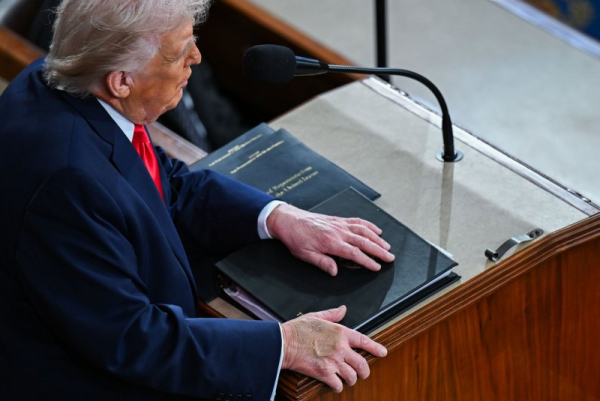
President Donald Trump delivers his State of the Union address during a joint session of Congress in the House Chamber at the U.S. Capitol in Washington, D.C., on Tuesday. Photo by Annabelle Gordon/UPI | License Photo
President Donald Trump delivered the longest State of the Union address on record, stretching close to two hours. Yet his most important signal to the hemisphere was surprisingly concise: Washington is returning to a familiar playbook of border enforcement and narcotics pressure, paired with a hard-nosed, deal-focused diplomacy.
The speech mixed celebration and confrontation. It showcased medals and made-for-television moments, while Democrats withheld applause and the partisan divide was on full display on the House floor.
For Latin America, the key question is not whether Trump can fill the chamber with applause lines. It is whether the policies behind those lines can be sustained legally at home, credibly abroad, and in an economy where China still shapes supply chains even when it goes unmentioned.
A domestic story with hemispheric consequences
Trump placed “kitchen-table” economics at the center of his address, touching housing, healthcare, utility bills, crime, and retirement, while presenting a broadly upbeat picture of inflation, investment, and jobs.
Yet Reuters reported a tension between that narrative and what voters encounter in daily life, including ongoing anxiety about prices and polling showing more disapproval than approval of Trump’s economic policies.
That matters to the Americas because U.S. domestic pressure often travels outward as policy. When costs remain high and midterm elections approach, administrations tend to reach for visible levers: tougher border enforcement, more prominent counternarcotics actions, and trade measures framed as protecting American workers.
Cartels, fentanyl, and the temptation of symbolism
On security, Trump leaned heavily into the cartel and fentanyl narrative, casting narcotics groups as a national-security threat rather than merely a criminal one. The approach is designed to resonate with U.S. voters, but it also pulls neighboring countries into Washington’s domestic political calendar.
The reported killing of CJNG leader Nemesio Oseguera Cervantes, known as “El Mencho,” just days before the address underscored how quickly violence and misinformation can spread after a major strike. Press reports described the Feb. 22 action as a Mexican Army operation that benefited from U.S. intelligence support. Even when operations succeed, the aftermath can complicate governance for Mexico and unsettle cross-border stability.
For partners in the region, the practical question is what follows. Will there be sustained intelligence cooperation and financial targeting of criminal networks, or a cycle of headline operations that deliver short-term political gain at the cost of long-term institutional strain? Cartels adapt quickly. States adapt more slowly.
Venezuela: leverage, legitimacy, and oil
Trump also highlighted the operation that captured Nicolás Maduro, including a medal ceremony during the address. The moment was a reminder that the administration is framing Venezuela not only as a foreign policy success but also as domestic political proof of strength.
Here, Latin America faces a double bind. Many governments want a more stable Venezuela and relief from the outward migration pressure caused by Maduro’s rule. At the same time, the region will watch closely to see what kind of transition follows and how sanctions, oil arrangements, and political legitimacy are managed. The Council on Foreign Relations’ conflict tracker has treated the Jan. 3 capture as a major inflection point with broad regional spillovers.
If Venezuela becomes primarily a highlight reel for U.S. politics, the risk is policy whiplash. If it becomes a sustained diplomatic project, it could set a precedent for how Washington manages future crises closer to home.
Trade after the Supreme Court: tariffs constrained, pressure remains
The most consequential part of the speech may have been what it implied about trade power. Trump argued the tariffs struck down by the Supreme Court were already generating revenue and would be restored under a different legal authority.
Legal analysts note that tariffs imposed under the International Emergency Economic Powers Act were found unlawful, forcing the administration to seek other statutory paths.
For Latin America, this is not a lawyer’s footnote. It is a reminder that U.S. protectionism may be limited by courts, but it is not disappearing. The tools may change. The incentives do not. Companies planning nearshoring bets across Mexico, Central America, and parts of South America should expect continued volatility in trade policy, even when the headline is “restored.”
The quiet China signal
One of the most revealing details, reported by Reuters, is that China received no mention in this year’s address after being referenced repeatedly last year, as Trump prepares for a planned state visit.
That silence should not be mistaken for absence. If anything, it suggests tactical sequencing: de-escalate rhetorically while keeping economic pressure available through tariffs, industrial policy, and supply-chain reshoring.
For Latin America, the implication is straightforward. The region’s strategic value rises when Washington is navigating both competition and accommodation with Beijing. That can bring investment and attention. It can also bring demands.
What Latin America should do now
The region should not respond to Trump’s agenda with speeches of its own. It should respond with bargaining power.
Governments that can offer credible security cooperation, transparent investment conditions, and reliable infrastructure will be better positioned to convert U.S. attention into concrete gains. Those who cannot, will experience the downside: pressure without partnership and headlines without capacity-building.
Trump’s speech was long. The message to Latin America was shorter. Security comes first. Deal-making follows. Everything is filtered through U.S. political time. The hemisphere should plan accordingly.
Óscar Álvarez Araya is a political scientist and former Costa Rican ambassador to Taiwan. The views and opinions expressed in this commentary are solely those of the author.
