



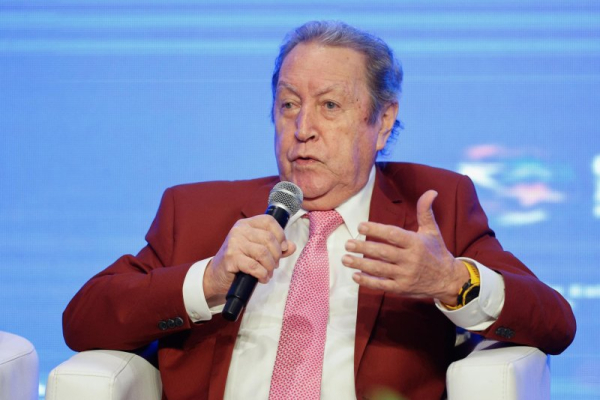
former Guatemalan President Vinicio Cerezo, a signatory of the Esquipulas peace accords, demonstrated how leadership can expand political space by prioritizing dialogue and regional peace over permanent confrontation. File Photo by Juan Pablo Pino/EPA
Latin America is moving through an intense electoral cycle, with major presidential contests underway or still ahead in 2026. That alone would make this a consequential year for the region. More troubling is the atmosphere in which those choices are being made.
Across much of the democratic world, and especially in Latin America, politics has grown harsher and more tribal. According to the United Nations Development Program, the region has experienced one of the sharpest rises in political polarization anywhere in the world over the past two decades. A regional survey found that trust in public institutions has fallen to roughly 20 percent, meaning only one in five citizens now expresses confidence in their government. Together, those trends make sound democratic judgment harder precisely when it is needed most.
Political tribalism begins when citizens stop asking whether a proposal is sound or workable and start asking only who proposed it. Opponents are no longer treated as fellow citizens with competing ideas. They become enemies whose arguments can be dismissed before they are heard. Political scientists call part of this pattern “affective polarization,” but most voters recognize it without the label.
Once that mindset takes hold, public life becomes harder to govern. Governments are praised or condemned by reflex. Institutional abuse is denounced under one administration and excused under the next. Corruption becomes intolerable when committed by rivals but somehow manageable when committed by allies. Standards shift with political identity, and public trust falls further.
This matters because serious national problems cannot be solved in a climate of blind loyalty. Poverty, insecurity and institutional decline do not yield to slogans. They require evidence, honesty and the willingness to admit that one’s own side can be wrong. A mature democracy depends on citizens who can recognize a bad idea in their own camp and a useful one on the other side.
History offers both warning and example
Democratic norms rarely collapse all at once. More often, they erode gradually as citizens begin to excuse what they once would have condemned. Yet history also shows another path. Nelson Mandela emerged from 27 years in prison without surrendering to vengeance, and helped guide South Africa away from a darker future by choosing reconciliation over tribal retaliation.
In Central America, former Guatemalan President Vinicio Cerezo, a signatory of the Esquipulas peace accords, demonstrated how leadership can expand political space by prioritizing dialogue and regional peace over permanent confrontation.
These examples do not prove that goodwill alone resolves every conflict. They do show that leadership matters most when it refuses to treat politics as permanent warfare.
What democracies can do
First, political leaders should lower the temperature. Strong convictions are not the problem. Demonization is. Once opponents are portrayed as enemies rather than rivals, institutions themselves begin to lose legitimacy in the eyes of the public.
Second, parties and governments should pursue agreements on issues that shape daily life, such as public security, education and basic services. Citizens do not expect unanimity. They do expect proof that democratic politics can still produce results. Even modest agreements can help rebuild trust.
Third, voters, journalists and civic organizations should insist on one discipline above all: judge arguments by their content, not by the camp from which they come. A democracy grows healthier when citizens can reject a bad idea from their own side and recognize a good one from the other. That is not naïve idealism. It is one of the few real checks on permanent polarization.
Latin America’s current electoral season will test more than parties and candidates. It will test whether enough citizens can step back from reflexive partisanship and recover the habits of democratic judgment. If politics remains trapped in the question of who said it rather than what was said, progress will remain elusive.
Democracies need citizens and leaders mature enough to face reality honestly and support what serves the nation, even when it comes from the other side. That is not weakness. It is democratic responsibility.
Jorge Raul Cruz Villagran is a Guatemalan lawyer, political analyst and civic leader. He is a founding member of Legacy of the Americas, a values-based movement for ethical and civic renewal across the Americas.
