



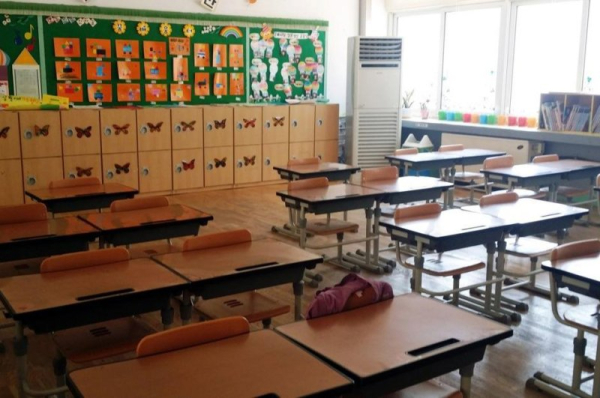
In many educational systems, such language would be associated with progressive, practice-based learning. File Photo by Yonhap/EPA
The author prefers to use the lowercase “n” to challenge the Kim family regime’s legitimacy.
This essay examines the relationship between education, labor-related practices and human security in the context of the north Korea.
Drawing on the human security framework developed by the United Nations Development Program and subsequent educational interpretations by United Nations Educational, Scientific and Cultural Organization, it explores how education may function either as a mechanism for capability formation or as a structure embedded within broader systems of mobilization.
At first glance Monday, north Korea media reports appear to present a familiar narrative. Official sources describe the introduction of “new teaching methods,” in which students engage with factories, enterprises and applied experimental design. These practices are framed as fostering “creative” and “practical” competencies.
In many educational systems, such language would be associated with progressive, practice-based learning. Yet, the meaning of such approaches depends not on terminology, but on institutional context.
Education has long been recognized in development and security literature as a foundational element of individual capability and social stability. While traditional security paradigms prioritized state-centric concerns, human security frameworks have shifted attention toward the expansion of individual agency.
From this perspective, education is not simply a policy sector, but also a structural condition that enables individuals to interpret information, make decisions and shape their own trajectories.
This raises an important analytical question: How is educational participation structured, and under what conditions does it expand or constrain individual agency?
A useful point of comparison can be found in the United Kingdom, where secondary education often includes structured work experience placements. Students spend short periods in workplaces such as hospitals, businesses or public institutions.
However, these programs are defined by several key features: Participation is voluntary or semi-voluntary, the primary objective is educational and there is a clear separation between learning activities and productive labor. Safeguarding frameworks further ensure that students are positioned as learners rather than contributors to economic production.
This distinction is critical. It reflects not only a pedagogical approach, but also a broader understanding of education as a space for exploration rather than obligation.
By contrast, north Korea educational narratives describing “field-based learning” invite closer examination. While such practices may outwardly resemble experiential learning, their institutional meaning cannot be assumed to be equivalent.
Available descriptions are largely centered on schools in Pyongyang, suggesting a highly selective representation of educational practice. At the same time, independently verifiable data on conditions in other regions remain limited.
Some external reporting, including that of Radio Free Asia, has suggested that in certain contexts educational participation may be shaped by economic constraints, with students engaging in productive activities alongside or in place of formal schooling.
Such accounts are varied and should be interpreted cautiously. Nevertheless, they point to the possibility of structural variation within the system.
It is within this gap between official representation and external observation that a more fundamental issue emerges: the boundary between education and labor.
Experiential learning is a recognized pedagogical model across many contexts. However, its meaning is contingent upon conditions such as voluntariness, agency and institutional safeguards. Where these are limited, the distinction between learning and labor may become blurred.
Under such conditions, educational participation may function less as an expansion of capability and more as a structured form of participation within broader economic or social systems.
This has direct implications for human security. Within this framework, education is understood as a key mechanism through which individuals develop the capacity to interpret information, exercise judgement and make autonomous decisions.
Where educational environments expand cognitive autonomy, they contribute to multiple dimensions of human security. Where they restrict access to information or limit interpretive freedom, they may constrain the development of individual capability.
Education, in this sense, is not simply an outcome of human security but also one of its foundational conditions.
The divergence between official educational narratives and externally reported observations therefore warrants careful consideration. Rather than treating education as a uniform institutional category, it is necessary to examine how it is structured, experienced and embedded within broader systems.
This essay does not seek to draw definitive conclusions in the absence of comprehensive data. However, it suggests that the relationship between education, labor-related practices,and human security in north Korea context is more complex than official narratives alone might indicate.
At its core, the issue returns to a simple but fundamental question: Does education expand the capacity to choose, or does it structure participation within predefined roles?
The answer to this question is not merely educational. It is central to how human security itself is understood.
Jihyun Park, a British Korean Conservative politician and regular contributor to the Korea Regional Review, is a North Korean escapee who fled twice from the country — in 1998, which resulted in a forced repatriation, and in 2008, which was successful. She is a senior fellow for human security at the Center for Asia Pacific Strategy.
