

Part 1 of a series on Latin America’s Economic Saga: From the Low-Growth Trap to the Opportunities of the 21st Century


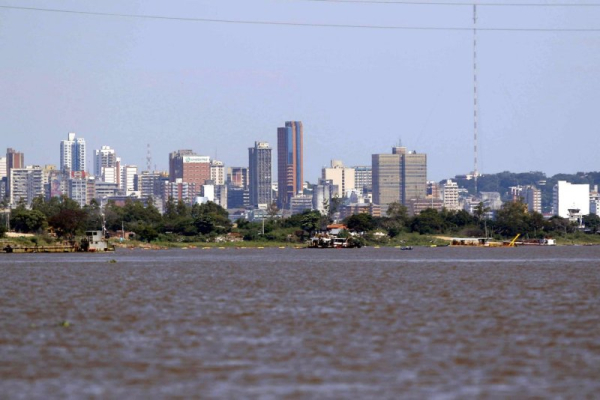
A view of the city skyline is seen from the Paraguay River in Asuncion, Paraguay, in 2017. File Photo by Andres Cristaldo/EPA
Latin America has long lived with a frustrating paradox. The region has abundant natural resources and a young population. Its economies, however, have grown at disappointing rates for decades.
This is not a historical footnote. The Economic Commission for Latin America and the Caribbean revised its 2026 regional growth forecast down to 2.2% in April, citing tighter financial conditions and slowing global trade.
If that estimate holds, the region will have logged four consecutive years of growth near 2.3%, a run ECLAC itself has called a “persistent pattern of low growth capacity.”
The World Bank’s April 2026 update cites the same constraints, though it notes pockets of dynamism among smaller economies integrating into nearshoring supply chains.
The pattern has deep roots.
From commodity exports to domestic industry
Following independence in the 19th century, most Latin American countries entered the global economy as commodity exporters: coffee, sugar, copper, beef and grains.
This brought foreign investment and prosperity, but left economies exposed to swings in international prices set abroad. When the Great Depression struck in 1929 and global trade collapsed, governments across the region turned to import-substitution industrialization (ISI).
Argentina, Brazil, and Mexico protected domestic producers and built state-owned enterprises to manufacture goods that had previously been imported.
The model produced real gains. Latin America developed manufacturing capacity and a larger urban middle class. But protection became permanent rather than temporary. Industries shielded from competition had little incentive to raise productivity, and governments leaned on public spending and subsidized credit to sustain growth.
The result was recurring “stop-and-go” cycles: expansion until foreign-exchange shortages forced painful corrections.
East Asia took a different path, pairing investment in education and infrastructure with land reform and capable state institutions while forcing domestic firms to compete abroad rather than remain sheltered at home. The contrast between the two regions widened over time.
The debt crisis and its aftermath
Latin America’s growth in the 1970s was financed partly by cheap international credit, and governments and companies built up large foreign debts. When U.S. interest rates rose in the early 1980s and commodity prices weakened, Mexico announced it could no longer meet its obligations. The crisis spread quickly through the region.
The 1980s became Latin America’s “lost decade.” Growth collapsed, real incomes fell and several countries suffered hyperinflation. The crisis exposed what import substitution had failed to deliver: export competitiveness backed by real institutional strength. Governments spent the decade stabilizing economies and restructuring debt.
The 1990s brought reform. Most countries reduced inflation, opened their economies and privatized state companies. The 2000s brought a further lift as China’s expansion drove global demand for minerals and farm products, according to World Bank trade data.
But the commodities boom masked structural weaknesses that reform had not fixed, as governments used the windfall to expand consumption rather than raise productivity or diversify exports. When commodity prices weakened after 2014, growth slowed again.
Latin America’s central problem today is not a shortage of resources. It is an inability to convert those resources into sustained productivity gains. Private investment remains low, according to the IMF’s April 2026 World Economic Outlook, and educational systems often fail to produce the skills modern industries need.
Complex regulation and slow courts raise the cost of doing business, and the region trades relatively little with itself despite sharing language and borders.
New opportunities, old requirements
The changing global economy offers opportunities the region has not had before.
Geopolitical tensions over supply chains are pushing companies to move production closer to their end markets, and Mexico is well positioned given its proximity to the United States.
Other countries can compete for this investment too, but geography alone will not decide the outcome. Reliable electricity and legal certainty matter as much as location.
The global energy transition is a second opening. Latin America holds major copper and lithium reserves alongside strong renewable energy resources that could support cleaner manufacturing and green hydrogen production.
The World Bank’s April 2026 review notes that translating these endowments into quality jobs, rather than raw exports, depends on investment in skills and local suppliers.
What separates the region’s faster movers
The current slowdown shows what has long divided Latin America’s better performers from the rest. Paraguay is forecast to grow 4.2% in 2026, among the region’s fastest rates, while Mexico is projected at roughly 1.5%, held back by tariff exposure and policy uncertainty, per IMF and World Bank estimates.
Argentina’s disinflation program has cut monthly inflation from double digits to low single digits since 2023, a shift the IMF credits with restoring investor confidence even as growth moderates.
What separates these trajectories is not resource endowment but institutional durability: commercial disputes that resolve quickly, permitting systems that function predictably, and infrastructure investment selected on economic merit rather than political convenience.
Regional integration remains thin by comparison with other trading blocs, and the fragmentation itself functions as a tax on cross-border commerce.
Macroeconomic stability plays a similar role. Countries with predictable inflation and stable rules have attracted longer-term investment even during periods of weak regional growth, as the divergence between Argentina’s rebound and Mexico’s stagnation shows.
Latin America’s history shows that external shocks tend to expose internal weaknesses rather than create them. It also shows a region with real resilience and resources that it has not converted into sustained growth.
That opportunity is present now, in the current cycle of nearshoring and mineral demand. Whether the region seizes it will depend less on the next commodity cycle than on the institutional foundations ECLAC and the World Bank both identify as the missing piece.
César Addario Soljancic (www.cesaraddario.com) is an economist specializing in public finance, with decades of experience advising governments and institutions across Latin America and the Caribbean. Over his career, he has led 69 capital-market issuances across 13 countries, totaling nearly $49 billion. The views expressed are solely those of the author.
