


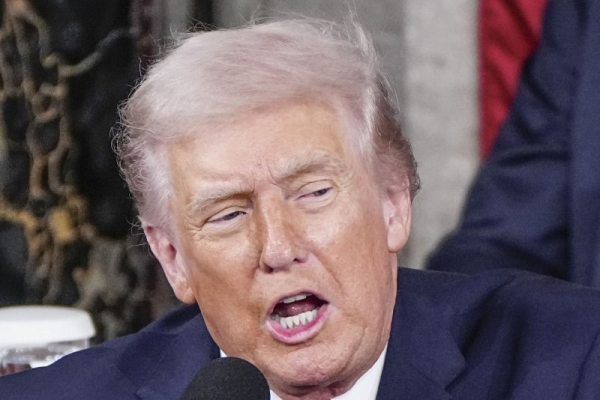
Iran loomed large over President Donald Trump’s State of the Union speech Tuesday night, given the U.S. military buildup in the area and uncertainty about whether he might authorize a strike. Photo by Bonnie Cash/UPI | License Photo
The Trump administration hadn’t launched a pre-emptive strike on Iran in time for the State of the Union address, but the White House would be well-advised to consider this: Iranians are Persians, too.
The legacy and culture of Persia is manifested in a proud and defiant people no matter how much the ruling clericocracy has attempted to repress and exorcise that history.
The last time I was in Iran was in early 1979 just as Reza Pahlavi was fleeing. I spent a number of months in the Persian Gulf in 1981 commanding a U.S. destroyer, playing cat and mouse with an Iranian military that had been armed with U.S. weapons, including F-4 Phantom jets. But before that, two anecdotal experiences were very meaningful.
On exchange with the Royal Navy from late 1969 to 1971, for the last five months, I was assigned to the Britannia Naval College in Dartmouth in the south of England, the Royal Navy’s equivalent of the U.S. Naval Academy at Annapolis.
It was a beautiful summer’s day. I had been playing tennis on the lovely grass courts that then existed next to the main building. With a Pimm’s Cup in hand, I meandered to the college entrance as, in the distance, an XKE Jaguar was driving at high speed up the drive.
The car did not slow when it hit the many brick speed bumps on the half-mile journey. It came to a screeching halt a few yards in front of us. The officer of the day was next to me. Curious, he approached the convertible. The driver was Persian and was joining the college as a cadet.
He rolled down the window, and throwing the keys to the officer of the day, pleasantly said, “Please park it.” It turned out that the soon-to-be-cadet would be in my division. And he was a quick learner.
Before I left the college to return to America, the cadet thanked me for being his division officer and presented me with a jewel encrusted dagger that probably cost many times my yearly pay. Unfortunately, I could not keep it.
The second event occurred in 1974, when I was executive officer of a destroyer stationed in Norfolk, Va. On one of the piers assigned to destroyers and submarines, there was a watering hole called the “DesSub Pub,” a low-rent but convenient version of an officers’ club, where during Friday night happy hours martinis were about a nickel apiece. On that occasion, about 30 or 40 officers and guests were present.
An Iranian destroyer that had served in the Royal Navy in World War II and had been transferred to Iran was in a lengthy refit in Norfolk. The ship was in disrepair and had become something of a laughingstock when compared with the more modern U.S. Navy. The skipper of IIS Artemis was at the DesSub Pub sitting alone at the bar.
He was an obvious weightlifter at no more than 5-foot-6 in height and a very muscular 250 pounds. He was bald and wore a nylon skull cap that attracted attention. The junior officers made no effort to conceal their disdain for the Iranian ship and the peculiar build of the commanding officer. Knowing that telling the junior officers to pipe down would be fruitless, I went over to the Iranian captain and offered my apologies.
The junior officers took that as license to amplify their heckling, which could have led to a nasty incident, as no one in their right mind would want to take on this Persian Charles Atlas. He smiled at me and took out a $100 bill. Forty years ago, that was a great deal of money.
He told the bartender in a voice loud enough to be heard throughout the pub, “A round for everyone.” And even louder he said, “And keep the change.” That probably amounted to $90 or $95.
That was an exceptional putdown, as well as an expression of character. And it was purely Persian.
Two anecdotal incidents are insufficient to draw broader conclusions. However, if the administration chooses to attack Iran, it should be understood this may not be Venezuela and Maduro or Midnight Hammer.
Harlan Ullman is senior adviser at Washington’s Atlantic Council, chairman of a private company, and principal author of the doctrine of shock and awe. His next book, co-written with Field Marshal The Lord David Richards, former U.K. chief of defense and due out next year, is Who Thinks Best Wins: How Decisive Strategic Thinking Will Prevent Global Chaos. The writer can be reached on X @harlankullman.
