


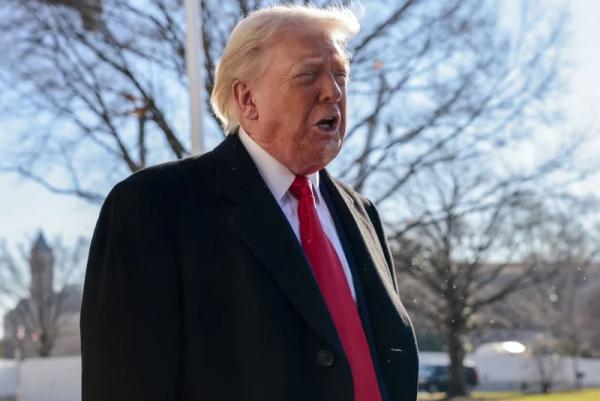
U.S. President Donald J. Trump is the “unitary executive,” bypassing and superseding the other two branches of government. Photo by Shawn Thew/UPI | License Photo
There have been 100-year wars and 30-year wars. The June 1973 Arab-Israeli War lasted six days. Twenty-eight years later, after a lengthy bombing campaign, Saddam Hussein’s army was driven from Kuwait and obliterated in 100 hours. And it took 79 days in 1999 for NATO to compel Slobodan Milosevic to end the Kosovo slaughter.
But, never in modern history has there ever been a one day war. That was until Donald Trump ordered a relatively small commando force into Caracas to seize and detain Nicolas Maduro and his wife Jan. 3.
Yes, a large naval armada lay off the Venezuelan coast. Still, for the time being — and that could change — this fait accompli seemed to be a dramatic success.
The acting president, Delcy Rodriguez, appeared compliant and willing to accept American dominance without a single pair of U.S. boots on the ground. Venezuela permitted the appropriation or theft of 50 million barrels of its oil by the United States worth about $2.5 billion. And, discussions over formal recognition are reportedly underway.
How can this be? The United States spent fortunes in blood and treasure in Vietnam and with allies in Afghanistan and Iraq attempting to make successful regime changes. All failed.
Yet, with a single bold operation and no American losses, Trump may have indeed imposed a successful regime change in Venezuela, even if Maduro’s successors are all his handpicked men and women acolytes.
Ironically, Trump validated the principle of “shock and awe,” discredited in the second Iraq war. The aims were to “affect, influence and control the will and perception of an adversary” to obtain the behavior and outcome we seek with the minimum use of force. Trump did that. And, if Venezuela does become a freer, more open society, more power to Trump.
The implications are tectonic. Under certain circumstances, will the removal of a state’s leader have the same effect as in Venezuela? Suppose at the Alaskan Summit last August, the United States seized Russian President Vladimir Putin — a once ludicrous idea tempered by the Maduro raid. What then? And should China’s Xi Jinping be concerned when he next meets Trump?
Both the USSR/Russia and China have survived regime changes, although the election of Mikhail Gorbachev as the USSR’s president led to its dissolution. Perhaps less stable dictatorships may be more susceptible to succumbing to such dramatic action and the discrete use of force. Iran could be atop Trump’s list.
The United States failed in its 1980 rescue raid to free U.S. hostages held in the U.S. Embassy in Tehran. U.S. military forces are far more capable today. And while snatching the Ayatollah Khomeini may or may not have a similar outcome of ending the Iranian regime as in Venezuela, there is no doubt that option has been raised in Washington, especially with the current riots on Iran.
And, given the uncertainty of succession among the mullahs, could a Tomahawk decapitation strike have the same effect as in Venezuela?
Fortunately, democracies are more impervious to a cataclysmic regime change. If United Kingdom Prime Minister Sir Keir Starmer or French President Emmanuel Macron were kidnapped or eliminated, the continuity of government would be maintained.
Similarly, in the United States, whether a president dies of natural causes, such as FDR, or is assassinated, such as JFK, a new leader is installed. The test is determining or guessing which government will not survive after losing its leader. Perhaps North Korea is also on that list.
Then, no doubt buoyed by the Caracas coup, Trump has become even more determined about acquiring Greenland from Denmark. Whether by force, gift or outright sale, is this a serious overture? And, if so, do Trump and others understand the implications including dystopic consequences for NATO?
Were this column written a month ago, it would have been dismissed as pure nonsense — and rightly so. However, consider the massive disruptions Trump already has imposed in American and in international politics.
Trump is the “unitary executive,” bypassing and superseding the other two branches of government. Congress and the Supreme Court have become constitutional vestiges in which Trump has amassed the greatest power of any president, including Lincoln during the Civil War.
Internationally, Trump has ended the U.S. system of fair and free trade with his tariff regime. With the Venezuelan coup, and perhaps Greenland next, thinking the unthinkable is now no longer foolish. If this is truly a transformational moment in international politics, what could lie ahead? That should worry us all.
Harlan Ullman is senior adviser at Washington’s Atlantic Council, chairman of a private company and principal author of the doctrine of shock and awe. His next book, co-written with Field Marshal The Lord David Richards, former U.K. chief of defense and due out next year, is Who Thinks Best Wins: How Decisive Strategic Thinking Will Prevent Global Chaos. The writer can be reached on X @harlankullman.
