



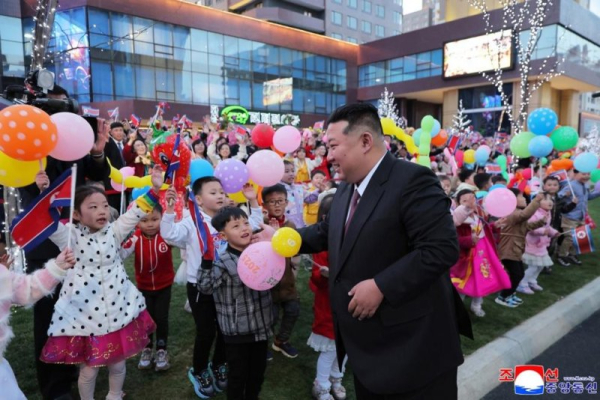
Banners in the street and the broadcasts at home in North Korea repeat the same message. That is not merely propaganda. It was an education that defines reality itself. File Photo by Korea Central News Agency/EPA
Why don’t North Koreans resist? Since I began working on North Korean human rights, this is the question I have been asked most often. But I now want to ask a more fundamental one: Why have we grown so accustomed to it?
It is not only dictatorship that confines North Koreans. Our own indifference — the moment we begin consuming their suffering as one more recurring news item — becomes a second barrier. Dictatorship makes people fall silent. Familiarity makes people stop acting.
I lived in North Korea for 23. People there are not born rejecting freedom. They simply live in a world where freedom does not exist as an option. Many interpret North Koreans’ compliance as loyalty. But in the North Korea I knew, compliance was not loyalty. It was survival. Dictatorship is not sustained by guns alone. It is strongest when it convinces people that it is simply the way things are.
People believe the first world they encounter is the normal one. We do not wake up each morning asking why white is white. For North Koreans, dictatorship is that kind of presence.
From about the age of 2, in nursery and kindergarten, I learned songs praising the leader. At school I memorized the glorified life stories of the Kim family and recited my loyalty. The banners in the street and the broadcasts at home repeated the same message. That was not merely propaganda. It was an education that defined reality itself.
Taught that way, I did not push back against anything the authorities did to me. I had never learned what unjust treatment was, or that resistance was even a category of action.
The memory that stays with me most clearly is a diary. I spent more than a year filling it — drawings I liked, small things that happened during the day, sentences I wanted to keep. That notebook was the only place I could exist entirely as myself.
One day, it was inspected and taken. The same thing happened to the clothes I loved most. I did not get angry. It did not even occur to me that I had been wronged. I had been taught that it was natural for the state to decide what people wore and how they cut their hair and to read the diary of a girl barely into her teens. I assumed that was simply how the world worked.
In 2014, the U.N. Commission of Inquiry concluded that North Korea’s widespread and systematic violations — including this apparatus of control — amounted to crimes against humanity. North Koreans had no way of knowing this. Where all information is cut off, people live not because they trust the state, but because they have never been taught how to doubt it.
Fear then hardens that familiarity. In North Korea, punishment is not carried out quietly. Residents are summoned to public executions and made to watch. It is not law enforcement; it is instruction. And the person condemned is rarely the only one who pays. When a political crime is established, a spouse, children, and parents can disappear into the camps, as well.
People do not learn this from legal texts. They learn it when the house next door empties overnight. North Koreans do not refrain from resisting because they lack courage. They refrain because they understand the price of resistance more precisely than anyone.
That does not mean North Korea is frozen. After the state rationing system collapsed, the jangmadang — the informal markets — became the ground on which countless livelihoods rested. Foreign dramas and films circulated there on USB drives and SD cards. The outside information that entered this way showed people another world — one the state could not explain away.
I was one of them. Watching foreign media, I came to understand how abnormal and violent my society was, and I decided to leave. People ask who would risk their life to watch a film. But foreign media was not entertainment to me. It was an air hole. Watching it, again and again, cracked an indoctrination that had seemed unbreakable, until I resolved to leave even if it cost me everything I had.
The regime understands exactly what those cracks mean. The Reactionary Thought and Culture Rejection Act, adopted in December 2020, provides for life imprisonment or death for bringing in or distributing South Korean films and recordings; organizing a group viewing can carry the death penalty outright.
A youth education law and a law protecting “Pyongyang cultural language” followed, extending enforcement to how young people speak, dress and address one another. Reports of executions for watching South Korean media have surfaced repeatedly since.
This looks like grounds for despair. I read it the opposite way. No government executes people over something harmless. The regime goes this far precisely because outside information — and outside attention — genuinely threatens it.
What worries me now is the posture of the outside world. Because North Korean human rights has been on the agenda so long, many have come to treat it as a problem that never changes. It is not.
After the Commission of Inquiry report and the sustained international pressure that followed, North Korea ratified the Convention on the Rights of Persons with Disabilities in 2016 and, in 2017, allowed the U.N. Special Rapporteur on the rights of persons with disabilities to visit — the first time it permitted a thematic U.N. rapporteur into the country.
That same year it engaged, within limits, with the committees on children’s rights and on discrimination against women. It still refuses to cooperate with the Special Rapporteur on North Korean human rights, so none of this amounts to reform. But it demonstrates something important: When the international community names what is happening and keeps a record, North Korea responds.
Having lived through this, the word I am most wary of is familiarity. North Koreans are opening small cracks in a terrifying system. Meanwhile, those of us who have freedom treat their situation as a story we have heard too often, and I find myself asking whether we have quietly stopped acting.
The most dangerous indifference does not begin with malice. It begins the moment we have looked at something so long that it no longer surprises us.
What we can do is not grand. Follow the U.N. resolutions and the work of the Special Rapporteur. Support the organizations that get information into the country and help escapees rebuild their lives. Listen to defector testimony directly, so the record does not disappear. And treat the North Koreans you meet as neighbors, rather than objects of pity. Any one of these can begin today.
North Korean human rights may be an old issue. But an old problem and a finished problem are not the same thing. Today, again, someone is enduring violence and someone loses their life while dreaming of freedom. The North Koreans working to change their society need supporters. They need friends.
It is not only dictatorship that imprisons them. Our indifference, grown used to their suffering, can become another set of walls. Your attention makes those walls thinner. That is what we can do — and what we should.
Yoonseo Chae is a graduate student at Dongguk University, a North Korean human rights advocate and a regular contributor to NK News. Born during North Korea’s devastating famine of the 1990s, she grew up under constant surveillance and discrimination as the daughter of a North Korean defector. Before escaping from the country in 2019, she worked as a nurse, but was repeatedly denied educational and career opportunities because of her family’s political background.
After a year of secretly preparing her escape, Yoonseo crossed four international borders through China, Vietnam, Laos, and Thailand before reaching freedom in South Korea. Since resettling, she has earned a bachelor’s degree in business administration from Dongguk University and has worked with South Korea’s Ministry of Unification and leading civil society organizations to advance North Korean human rights and unification education. She serves as a unification education instructor while pursuing graduate studies.
Drawing on both her lived experience and public advocacy, Yoonseo writes about North Korea, authoritarianism and human dignity. She hopes to continue using education, research and public engagement to amplify the voices of North Koreans who remain unable to speak freely.
