



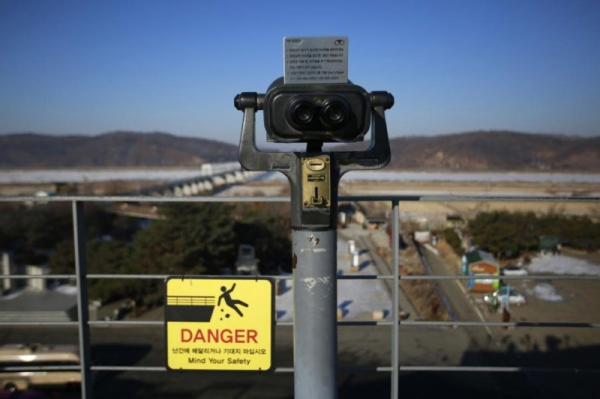
A binoculars stand is seen overlooking the Freedom Bridge to the North Korean side of the border at Imjingak Park, near the Demilitarized Zone in Paju, Gyeonggi province, South Korea. The bridge is a former railroad bridge used by prisoners of war or soldiers repatriated from the north. File Photo by How Hwee Young/EPA
I crossed four national borders illegally, evading the guns behind me and the soldiers and police watching for people like me. I tumbled down mountainsides. I nearly capsized on a river whose depth I could not guess.
There were moments when I was close to fainting from hunger and could not ask a single person for help, because I had entered each of those countries without a passport.
This is an experience possible only for people from a country where most citizens will never hold a passport in their lives, and where leaving is, in nearly every form, a crime.
Until a few years ago, that was where I lived — a place where every life runs along a track laid out in advance, where the content of your education is decided before you are born, where what you wear, what you listen to and what you may say are all determined for you. And even inside that society, I carried a particular status. I was the daughter of a traitor.
I was born in the late 1990s, during the years when the most North Koreans starved to death. No reliable figures have ever been released, but researchers estimate that somewhere between several hundred thousand and a million people died.
My family, who had believed in the state and served it more faithfully than most, were especially exposed when the rations simply stopped. To save her mother, who had collapsed from malnutrition, and her young daughter, my mother crossed the border into China. Many people in the border regions did the same, for the same reason.
Those who crossed in those years were not pursuing anything as grand as freedom or anything as comfortable as wealth. Their thinking was simpler: if sacrificing myself brings back a little food, and if that food keeps my child and my aging parents alive, then it is worth it.
The state declared such people traitors, and it surveilled, discriminated against and punished the families they left behind for the rest of their lives.
After my mother left, it was my grandmother who raised me. She told me the same things over and over. Say less when you are outside. Stand a step behind everyone else. If something unjust happens to you, do not let it show on your face.
I found it tiresome. These were adults who accepted the money my mother sent from South Korea and then donated part of it to a fund honoring Kim Jong Il. I could not understand it. I decided that the elders in my family were simply dull people who had never managed to escape their indoctrination.
It was only in high school, as I began to understand more, that I learned how closely I had been watched, and how long my family had been punished. Their excessive honesty, their demonstrations of loyalty, their control over me — none of it came from ignorance. It was the only method available to them for keeping me safe from a merciless state. What I had been calling foolishness was, in fact, love.
Once I understood that, I decided to raise my own status. Eleven years of compulsory education had taught me that if I worked hard and lived as society demanded, the mark my mother had left on me could be lifted.
I applied to a teachers’ college. My scores were high enough, but the authorities said no; I was the family member of a defector. I applied to the post office. I applied to the trade bureau. I liked working with numbers, and I thought I could be good at keeping accounts.
The answers came back nearly identical. The only work available to me was manual labor, or whatever I could do with skills I already had. Every position that might allow me to influence other people was closed.
The education I had absorbed for 11 years — that even with a family’s guilt on your record, your own effort could earn the Party’s trust — turned out to be fiction. Each time I was rejected, I listened to the reason and could not accept it. Eventually, I decided to leave.
After I first told my mother in South Korea what I intended to do, a year of preparation followed. I could not tell my family or my friends –not my cousins, who used to ask me to take them along if I ever went to find my mother, and not the people who had loved me most.
It was not that I distrusted them. It was that the security apparatus around me would have read the grief of parting on their faces, and then all of us would have been taken, interrogated and punished. Through my family’s experience, I knew what the state security bureau and the labor camps were, and I had decided that if I were caught, I would take my own life rather than be arrested.
On the morning I left, I said goodbye to my grandmother the way I did every other day. She did not know it was the last time.
After a frightening, lonely year, I escaped. It was the moment I left behind a system that had tormented and exploited me, the moment I set down years of wondering whether I would be shot or seized by a soldier. And I felt no elation at all.
The instant I crossed the Tumen River and set foot on Chinese soil, a pain went through my chest as though something had collapsed and I sank to the ground. Everything that had been my entire life until then — everything I loved and everything that had loved me — was behind me, and I was walking toward a place I could never return from.
Have you ever climbed mountain paths for more than 12 hours a day and then crossed a river of unknown depth on a raft that looked like a few planks nailed together? I swallowed my grief and traveled through China, Vietnam, Laos and Thailand until I reached South Korea.
Looking back now, the hardest part of that journey does not register as difficult or frightening, probably because I was submerged in a loss more intense than any of it.
After arriving, I began to study. For the first time in my life, I chose what I wanted to learn. I chose accounting: the work I had been drawn to since the days I knocked on the door of the trade bureau, and which that society never allowed me. Numbers do not ask about your family background. A ledger does not care whose daughter you are. That fact has been a comfort to me for a long time.
But the more I enjoyed studying, the more I missed the people still inside the place from which I had escaped, and the more my own happiness began to feel like selfishness. If someone ever asks me what I did for them, I want to be able to say that I did as much as I loved them. That is why I began human rights work.
Working with public institutions and non-governmental organizations, I have ended up speaking on platforms abroad. What I saw in that process was that a surprising number of people spend their time on behalf of strangers they will never meet. Nothing obliged them to. They said the names of North Koreans, anyway, and they kept records. Watching them, I came to feel more urgently that for someone like me, this work is not a choice, but an obligation.
I intend to keep studying accounting and to practice it, and to continue human rights work at the same time. Living well while doing what I want to do, and working on behalf of North Koreans, are both my way of loving the people who raised me and loved me. As my grandmother showed me, love often wears a face that does not look like love at the time.
You who are reading this do not have to lose your family, your hometown and your friends to be free. You do not have to carry a longing that will ache for the rest of your life, or dreams in which you are being chased. You were born in a place where freedom already exists. And for the sake of the ordinary day you may find tedious or exhausting, someone right now is staking everything they have.
People say that freedom is not free. I know the weight of that sentence, because I have paid. But I pray that for my friends still in North Korea, freedom will one day arrive at no cost at all — with the plain, unremarkable face of an ordinary day.
Yoonseo Chae is a graduate student at Dongguk University, a North Korean human rights advocate and a regular contributor to NK News. Born during North Korea’s devastating famine of the 1990s, she grew up under constant surveillance and discrimination as the daughter of a North Korean defector. Before escaping from the country in 2019, she worked as a nurse, but was repeatedly denied educational and career opportunities because of her family’s political background.
After a year of secretly preparing her escape, Yoonseo crossed four international borders through China, Vietnam, Laos and Thailand before reaching freedom in South Korea. Since resettling, she has earned a bachelor’s degree in business administration from Dongguk University and has worked with South Korea’s Ministry of Unification and leading civil society organizations to advance North Korean human rights and unification education. She serves as a unification education instructor while pursuing graduate studies.
Drawing on her lived experience and public advocacy, Yoonseo writes about North Korea, authoritarianism and human dignity. She hopes to continue using education, research and public engagement to amplify the voices of North Koreans who remain unable to speak freely.
