


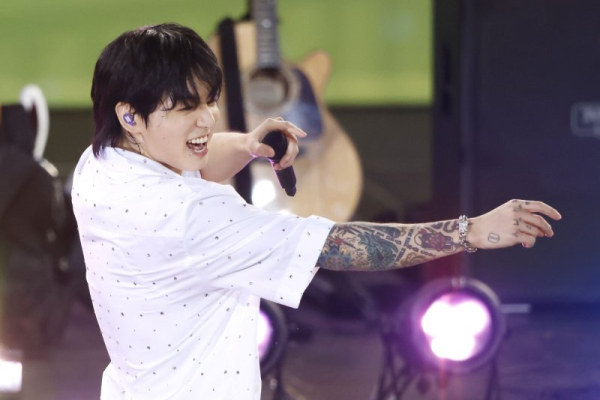
Jung Kook of BTS performs on “Good Morning America”‘s 2023 Summer Concert Series at the Rumsey Playfield/SummerStage in Central Park in New York City. File Photo by John Angelillo/UPI. | License Photo
As the world prepares for the BTS World Tour this April, the atmosphere surrounding the event is less like a concert series and more akin to a high-stakes diplomatic summit. The journey begins with a two-night stint at the Tokyo Dome on April 17 and 18, marking the first of 82 performances across 34 cities worldwide. The moment the schedule was announced, every ticket for every venue was instantly sold out, leaving a global “ARMY” in collective lamentation. The intensity of the tour is such that heads of state have personally intervened to officially request performance extensions, while desperate fans, styling themselves as “BangTan Refugees,” prepare to migrate to neighboring countries in a quest for tickets that vanished in seconds.
Leading this wave of diplomatic enthusiasm is Mexican President Claudia Sheinbaum. During a briefing last month, she revealed that tickets for the three-day engagement in Mexico City sold out in a mere 37 minutes. Faced with a million distraught fans, President Sheinbaum took the extraordinary step of sending a formal letter to President Lee Jae Myung, requesting additional tour dates or, at the very least, official permission for live theater screenings. Such a formal petition from a head of state for a musical act is unprecedented in the history of the performing arts; it has transformed a concert tour into a diplomatic dialogue between nations.
The European leg, slated for June and July, is similarly carving out a remarkable chapter in the history of music tourism. Le Figaro reported a 550% surge in Paris accommodation searches upon the announcement, while London –hosting the group before Paris — witnessed a 145% explosion in interest, a vivid illustration of how the tour is driving the tourism industry. This phenomenon was mirrored in South America, where travel searches for São Paulo leaped more than 600-fold. This tidal wave of interest reached a crescendo in South Korea; when a performance was announced for Busan on June 13 to mark the group’s debut anniversary, international travel searches for the city skyrocketed by 2,375%. As lodging prices hit a staggering 900,000 KRW ($620) per night, the Busan municipal government was forced into the farcical position of conducting emergency inspections to curb price gouging. Much of this digital traffic likely originated from neighboring Japan, Taiwan, Southeast Asia and even China.
In every corner of the globe, the ARMY moves according to the BTS calendar, and sovereign states find themselves scrambling to keep pace with their citizens. In Mexico, even the head of the federal consumer protection agency has vowed to monitor scalpers and illegal hoarding, acutely aware of the massive economic multiplier effect at stake. One financial services firm predicts that for every dollar spent on a ticket, at least three dollars of additional local consumption will follow — a return on investment that no government can afford to ignore.
The most provocative developments, however, are emerging from China. Excluded from the tour itinerary, the Chinese ARMY community has expressed a level of disappointment that has rapidly evolved into a rare public critique of Beijing’s “Hallyu Ban” (Han-han-ryeong). On platforms like Weibo, Bilibili, and Xiaohongshu, the rhetoric is increasingly defiant: “While other fans practice their cheers, we spend our nights researching how to cross the border.” Some have even threatened a form of “cultural asylum,” vowing to take their currency abroad to witness the show and warning that “not even the Great Wall” will stop these “BangTan Refugees.” This groundswell of resentment has left Chinese authorities visibly uneasy.
This is not confined to China. The global ARMY community — bound by a deep affection for South Korea and an ironclad internal solidarity — is expected to unleash a whirlwind of civilian diplomacy over the coming year. This outcome was perhaps predictable when BTS selected “Arirang” — the definitive anthem of the Korean soul — as their tour theme. By returning as a full septet for the first time in four years following their military service, they have already demonstrated the profound ability of Korean soft power to link a fractured world through the universal language of melody.
While the exact scale of the ARMY remains difficult to quantify, experts suggest its numbers likely exceed the entire population of South Korea. The digital footprint is staggering: as of early 2022, the group’s YouTube channel, “BANGTANTV,” boasted 62.7 million subscribers, while their official Instagram and Twitter accounts followed with 58.3 million and 43 million, respectively. This demographic force transcends age, gender, race, and language — a borderless constituency that represents a new global power.
As this powerful force begins its global march, the world’s legacy media are taking note. We are waiting for a new round of assessments from those who have already marveled at the phenomenon: The Washington Post, which noted “fans are already in a frenzy”; The New York Times, which once urged the world to “see where the K-pop stars have been”; and the BBC, which enviously predicted that this $1 billion (1.5 trillion KRW) comeback will be one for the history books. BTS is not just returning to the stage. They are demonstrating the profound ability of Korean civilian diplomacy to link a fractured world through the universal language of melody.
Nohsok Choi is the former chief editor of the Kyunghyang Shinmun and former Paris correspondent. He currently serves as president of the Kyunghyang Shinmun Alumni Association, President of the Korean Media & Culture Forum, and CEO of the YouTube channel One World TV. The views and opinions expressed in this commentary are solely those of the author.
