


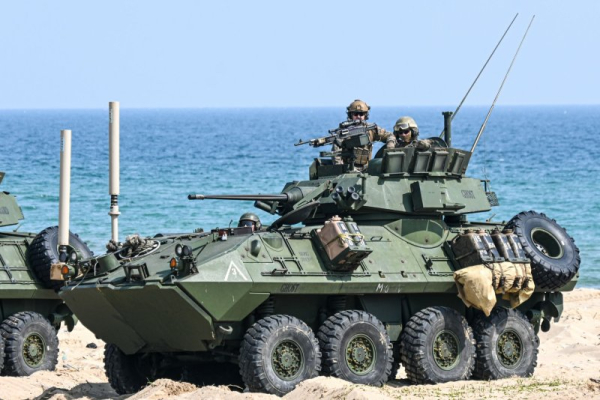
Marines have already warned that with total personnel costs of about 48% of the budget, the service branch could become insolvent if these grow to 50% or more. File Photo by Thomas Maresca/UPI | License Photo
This may sound like a rather ludicrous either-or question. But it raises a vital, if not the most vital, question pertaining to national security. How dominant is the priority of defense of the homeland over defense of U.S. international interests and commitments?
The current National Security Strategy and National Defense Strategy have been criticized in some quarters by downgrading or eliminating the threats posed by China and Russia.
Prior strategies have consistently defined China as the “pacing” threat, meaning that urgency was required to counter it. Russia was the “acute” threat after its 2022 invasion of Ukraine.
Now, the National Security Strategy and National Defense Strategy can be inferred to be taking a less hostile perspective of China and even Russia. The imperative of allies assuming greater burdens for their defense could be seen as a corollary meaning that the United States could diminish its responsibilities.
Even when President Ronald Reagan believed that his Strategic Defense Initiative, known as “Star Wars,” was critical to protecting the United States, a major defense buildup was underway to respond with what was seen as the USSR’s growing military power.
Homeland defense was essential just after the United States had passed its Constitution and the 13 colonies became the 13 original states in 1789. President Thomas Jefferson believed in the U.S. Navy defending the coasts. Forts were established to defend seaports.
But, as the United States expanded in size with the Louisiana and other purchases and moved West as its population soared, America became more powerful. The threat of external intervention or invasion subsided. By the mid-19th century, the United States had a modest Army and Navy. That, of course, changed dramatically with the 1898 Spanish-American War and then the First World War.
Revulsion to that war led the United States to become “isolationist.” It withdrew from active participation in international relations beginning with the Senate’s rejection of the Versailles Treaty and President Woodrow Wilson’s plea for a League of Nations to prevent future war. There were disarmament conferences in the early 1920’s. However, the Great Depression of 1929 led to greater isolationism exacerbated by the Smoot-Hawley tariffs.
As fascism was spouting in Germany, Italy and Japan in the 1930s, it would take Franklin Roosevelt to prepare for what would be World War II as international conditions become more dire. Hitler ascended to power in 1933; Benito Mussolini invaded Ethiopia in 1935 and Japan invaded China in 1937.
Presaging the future, Congress passed two naval shipbuilding bills in 1934 and 1938 named for their sponsors, Sen. Park Trammell of Florida and Rep. Carl Vinson of Georgia. These formed the backbone for the future U.S. Navy that helped win World War II.
After that war, while the United States did not return to isolationism, it conducted a massive demobilization, shedding millions from the 11 million-strong military. The Navy was cut from nearly 6,500 ships of all types to fewer than than 900, and the Army Air Force from 80,000 aircraft to fewer than 30,000, with many in storage.
It took Stalin’s seizing control of much of Eastern Europe and then provoking the Berlin blockade of 1948-49 for the United States to react, setting the foundations for 70 years of national security policy.
To what degree has the Trump administration returned to this past internationalism, with emphasis on defending the homeland and the Western Hemisphere and its Golden Dome to protect the nation from all forms of air attack? Here is the question that puts these tensions into perspective: Is the U.S. Marine Corps or the Department of Homeland Security more important to homeland defense?
DHS has about 260,000 employees. Next year’s budget has been escalated to $178 billion. The Marine Corps has an authorized end strength of 172,400 and a $53 billion budget. Marines have already warned that with total personnel costs of about 48% of the budget, the service branch could become insolvent if these grow to 50% or more.
With 88,000 employees more than the Marine Corps has marines, DHS has more than three times the budget. The Marines, no doubt, draw on other department assets to cover expenses. But is this the best use of critical resources?
Interestingly, Homeland and Western Hemispheric defense could apply to the Marines, who had a history of engagement south of the border to Haiti and countries in Latin America. But, more importantly, with a global reach as the nation’s “911 force,” is the nation shortchanging the Marines?
Harlan Ullman is senior adviser at Washington’s Atlantic Council, chairman of a private company, and principal author of the doctrine of shock and awe. His next book, co-written with Field Marshal The Lord David Richards, former U.K. chief of defense and due out next year, is Who Thinks Best Wins: How Decisive Strategic Thinking Will Prevent Global Chaos. The writer can be reached on X @harlankullman.
