



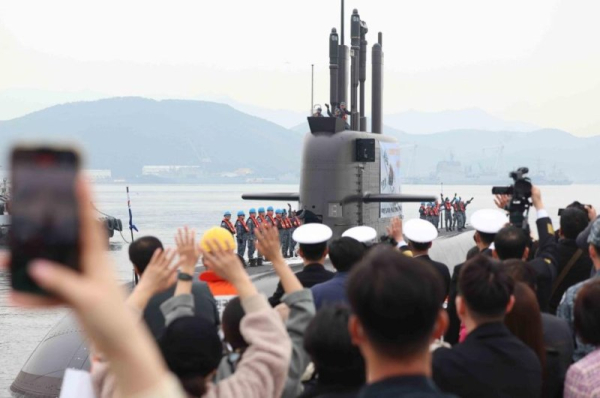
Family members bid farewell to sailors boarding the ROKS Dosan Ahn Chang-ho, a 3,000-ton South Korean naval submarine, at a port in Changwon, South Gyeongsang Province,in, late March. The submarine departing across the Pacific for the first time to participate in joint drills with Canada in June aimed at bolstering maritime security and defense industry cooperation. Photo by Yonhap/EPA
There is a Korean idiom, cheongchul eoram, that translates roughly as “blue dye drawn from indigo, yet bluer than the plant itself.” A companion expression, bingchul eossu, captures the same idea from a different angle: Ice, made from water, is colder than water itself.
Together, they describe the student who not only learns from the master, but surpasses him entirely. South Korea is now attempting exactly that — in one of the world’s most consequential defense contests.
At stake is the Canadian Patrol Submarine Project — up to 12 diesel-electric submarines, valued at roughly $60 billion (Canadian), to replace Canada’s aging Victoria-class fleet.
Those four British-built boats are scheduled for retirement in the mid-2030s, leaving the Royal Canadian Navy facing a capability gap at a moment when Arctic sovereignty and Indo-Pacific commitments are pressing harder than ever.
Two finalists remain — Germany’s ThyssenKrupp Marine Systems, offering the Type 212CD, and South Korea’s Hanwha Ocean partnered with HD Hyundai Heavy Industries, offering the KSS-III. Ottawa’s decision is expected within weeks.
The irony runs deep. South Korea’s submarine program was born in German hands. In the late 1980s, Seoul acquired technology from Germany’s HDW — now TKMS — to build its first Jangbogo-class submarines.
The lead vessel was constructed in Germany. From the second hull onward, construction shifted to domestic shipyards, establishing Korea’s first indigenous submarine infrastructure.
Encouraged by that success, Seoul returned to Germany a second time, acquiring air-independent propulsion technology for its next-generation boats. Germany was, in every meaningful sense, Korea’s submarine school.
Now, four decades later, the student is challenging the teacher for the same client. Of all the rivalries in global defense procurement, few can match this one for dramatic irony and for sheer entertainment value. Even the detached observer would be hard-pressed to find a better spectacle.
Korea’s bid rests on demonstrated capability, not promises. The KSS-III is the world’s first diesel submarine that combines AIP and lithium-ion batteries, reducing acoustic signature while dramatically extending submerged endurance.
Its advanced low-noise design makes detection significantly more difficult in contested waters. Its combat systems include vertical launch tubes and the Hyunmoo 4-4 submarine-launched ballistic missile, giving it a strategic strike capability rare among conventional submarines.
Critically, this is a proven, in-service platform actively deployed by the Republic of Korea Navy and one that Seoul insists can be delivered on Canada’s timeline. Germany’s Type 212CD, by contrast, exists so far only on paper.
Korea has gone further still. In March, the Dosan Ahn Chang-ho — lead vessel of the KSS-III class — departed Jinhae Naval Base and sailed 8,700 miles via Guam and Hawaii to Esquimalt, British Columbia, completing the first trans-Pacific voyage in Korean submarine history.
Passing through typhoon conditions near Guam without significant incident, the vessel proved habitability and reliability under sustained operational stress. In Hawaii, Canadian naval personnel boarded for the final leg — a calculated stroke that brought the evaluation out of the conference room and onto the open ocean.
The deployment also verified interoperability with NATO tactical data links, a critical credential for any operator within the western alliance.
Germany’s bid is not without merit. The Type 212CD carries genuine advantages for Arctic under-ice operations, a key Canadian requirement. And TKMS has made an aggressive counter-move on delivery, proposing to reprioritize production slots currently allocated to Germany and Norway, and offering Canada first position on the line to meet Ottawa’s 2035 deadline.
That directly addressed what had been considered Berlin’s principal vulnerability since the Ukraine conflict exposed European defense production bottlenecks.
Both sides also have launched sweeping industrial offset campaigns. Hanwha Ocean has formed technology alliances with more than 70 Canadian partners, including CAE and MDA Space, and proposed establishing the Hanwha Arctic Defense Innovation Center for joint research and development.
It has further announced plans to produce armored vehicles entirely in Canada through a partnership with the Automotive Parts Manufacturers’ Association, procuring local steel and aluminum.
TKMS has integrated its bid with a broad German-Norwegian investment package that spans critical minerals, artificial intelligence and automotive battery production.
This contest reflects something larger than a single procurement, and the submarine sector can be no exception to a pattern Korea has repeated across every industry it has entered.
In the 1970s, a shipyard rose from bare earth, financed with British capital and guided by Norwegian engineers. Korea had never built a vessel above 5,000 tons, yet simultaneously launched ships exceeding 200,000 tons.
The sweat and tears of that era survive today in the LNG carriers Korean yards build for a global market they now lead.
POSCO was constructed with Japanese reparations funds and technical guidance from Japan’s leading steelmakers, and eventually surpassed every one of its teachers.
Samsung entered semiconductors in the late 1980s when Japan controlled roughly half of the global market, and then deliberately skipped an entire product generation — developing third-generation chips while Japan remained committed to the second — and drove Japan from the field. Korea holds that dominance in high-bandwidth memory to this day.
The KSS-III, designed and built entirely without German assistance, is the latest expression of that same national DNA. The submarine sector can be no exception. Whether Seoul completes the arc, surpassing the very country that first taught it to build submarines, will be decided in Ottawa, and very shortly.
Nohsok Choi is the former chief editor of the Kyunghyang Shinmun and former Paris correspondent. He serves as president of the Kyunghyang Shinmun Alumni Association, president of the Korean Media & Culture Forum and CEO of the YouTube channel One World TV. The views expressed in this commentary are his own.
