



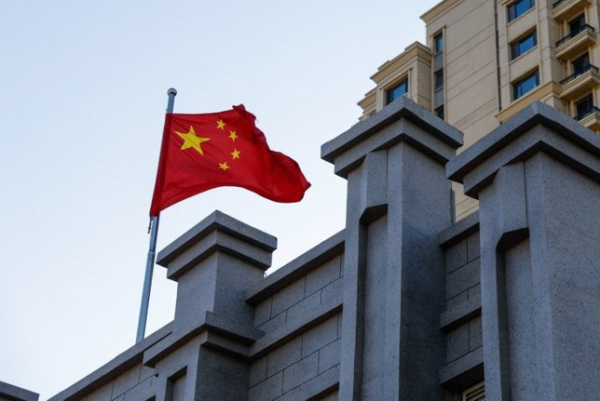
Bolivia’s turmoil points to a larger question facing Latin America: how should nations engage China without weakening their own institutions? File Photo by Mark R. Christino/EPA
Bolivia’s political crisis is often described as a domestic struggle over economic hardship and the future of former President Evo Morales’ movement. All of that is true. But Bolivia’s turmoil also points to a larger question facing much of Latin America: how should nations engage China without weakening their own institutions in the process?
In a piece published this week in The Diplomat, Latin America scholar Dr. R. Evan Ellis, drawing on a May 2026 visit to Bolivia and extensive interviews across its political and business communities, explains why Bolivia’s experience with China has become so contentious.
That question matters far beyond La Paz. Across the developing world, governments need infrastructure and access to capital and markets. China has often arrived with capital and momentum. For countries with weak public finances, that can be tempting. Yet Bolivia’s experience suggests that foreign investment, when managed through opaque agreements and inadequate oversight, can leave behind more mistrust than development.
For years, Bolivia appeared to be one of China’s more promising partners in South America. Under the governments of Evo Morales and later Luis Arce, the country welcomed Chinese companies into strategic sectors: infrastructure, energy and mining. The political logic was clear. Bolivia wanted development without excessive dependence on Washington or traditional Western institutions. China offered an alternative source of financing, technology and political symbolism.
Yet the results were mixed at best. Projects associated with Chinese companies drew complaints over delays, quality problems, labor disputes and corruption allegations. In a country already marked by deep regional and ethnic divisions, these controversies deepened public suspicion. Instead of becoming a symbol of national modernization, China’s role increasingly became part of a broader debate over who controls Bolivia’s natural wealth and on whose terms.
The lithium issue is especially revealing. Bolivia holds some of the world’s largest lithium reserves, essential for electric vehicles and the global energy transition. In theory, that should give Bolivia enormous strategic leverage. In practice, the country has struggled to convert its reserves into broad-based prosperity.
Deals involving Chinese and Russian firms have sparked political resistance, especially in Potosí, where many fear that outside companies will extract value while leaving environmental damage and limited local benefit. Concerns about water use and environmental review are not peripheral details. They go to the heart of whether Bolivia’s lithium will become a foundation for national development or another chapter in the country’s long history of exporting raw materials, while others capture the greater value.
The problem is not that Bolivia should refuse Chinese investment. That would be unrealistic and probably unwise. China is a major global actor, a central trading partner for many Latin American economies and an important source of capital. No serious development strategy can pretend otherwise.
The real problem is the absence of clear rules and strong oversight. When contracts are negotiated behind closed doors, citizens assume the worst. When environmental concerns are dismissed, local communities resist. When strategic projects are tied to political favoritism, a change of government can turn yesterday’s investment plan into today’s national controversy. In such an environment, even potentially useful foreign partnerships become politically toxic.
Bolivia’s current crisis illustrates how quickly economic frustration can become a test of state authority.
Roadblocks have isolated major cities and disrupted access to food and medicine. The government is trying to restore order while facing pressure from unions, Indigenous groups, teachers and supporters of Morales. The behavior of Beijing’s representatives has been revealing: as Ellis notes, while protesters threw dynamite at police and blocked supply routes into La Paz, China’s ambassador Wang Liang held an economic forum in the southern department of Tarija, titled, with no apparent irony, “Bolivia, into the world with China.” These debates over China are closely linked to the country’s instability. They form part of a larger struggle over public trust.
That is why Bolivia’s experience should matter well beyond Washington. Too often, outside powers view China’s rise in Latin America through the lens of geopolitical competition. They ask whether China is gaining influence, whether the United States is losing ground, or whether a particular government is pro-China or pro-West. Those questions are not irrelevant, but they are incomplete.
The more important question is whether Latin American countries have the institutional strength to negotiate with any major power on terms that serve their people. A weak state can be exploited by China, but also by Western corporations or local elites of any ideology. A strong state can engage China, the United States and Europe without surrendering transparency or public accountability.
For Bolivia, the path forward cannot be a swing from one dependency to another. A new government cannot simply replace Chinese influence with U.S. influence and call that reform. Nor can it revive slogans about sovereignty while signing opaque contracts that citizens cannot examine. Bolivia needs a development strategy rooted in open competition, public scrutiny and environmental responsibility.
For the United States and its democratic partners, the lesson is equally clear. Complaining about China is not a strategy. If Washington wants to regain credibility in countries like Bolivia, it must offer practical alternatives: investment that takes institutional capacity seriously and respects national dignity. Latin Americans are not looking for lectures. They want partners who help build capacity and leave institutions stronger than before.
Bolivia’s troubled path with China is therefore not only a warning about Beijing’s methods. It is a warning about the fragility of states that lack the institutional strength to manage powerful outside actors. The issue is not whether Bolivia should engage the world. It must. The issue is whether it can do so without selling the future in pieces.
If Bolivia learns that lesson, its lithium and strategic location could still become assets for national renewal. If it does not, foreign investment will continue to arrive wrapped in promises, only to deepen the grievances already tearing the country apart.
Gustavo Nakamura is Regional Director in Peru for CEFAS CEU (Ibero-American Center for University Studies), where he focuses on geopolitical analysis and institutional development in Latin America. The views expressed are solely those of the author.
