


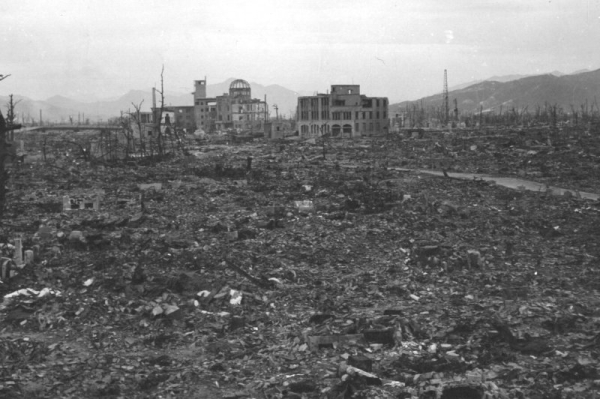
The first and only time nuclear weapons were used came in August 1945 on Japan. Photo courtesy of National Archives
The expiration of the New START treaty last week — long the framework limiting the United States and Russia to 1,550 warheads in 700 launchers — has renewed fears of an emerging nuclear arms race.
China’s seemingly rapid program to develop a powerful nuclear strike force, the Trump administration’s fixation on the Western Hemisphere and China and its extrication from Europe, European fears of a resurgent Russia, and Moscow’s modernization of its nuclear arsenal are among the drivers of possible nuclear proliferation.
Britain and France are discussing a European deterrent to replace the diminishing of U.S. commitment. And Poland is talking seriously about developing its nuclear weapons program.
All this could spread to the Pacific. As China enlarges its nuclear weapons and the credibility of the U.S. defense commitment to the region is questioned, Australia, Japan, South Korea and Taiwan have the technical skills to develop nuclear weapons, as do other states.
The harder question is how to keep renewed nuclear proliferation from destabilizing the global security system — and the answer may not be encouraging.
China has not agreed to enter into strategic arms negotiations. The likely reason is that China does not intend to negotiate away any limits until after it has deployed a certain number of nuclear weapons and launchers.
Yet, that is shortsighted. China still could enter into an agreement in which it has headroom to increase its nuclear weapons to whatever the agreed-upon level is.
For now, China and Russia are allies, but that is not necessarily permanent. Russia is by far the junior partner. And their “no-limits” strategic partnership may be more fragile than the term implies.
As far as a European nuclear deterrent, the counter-argument is that Russia will be compelled to respond in kind, leading to an arms race. Yet, the Reagan administration purposely deployed Pershing 2 intermediate-range missiles to counter Soviet SS-20’s. The ploy led to the Intermediate Nuclear Forces treaty. The threat of a European deterrent could indeed hasten some agreement.
How would this be accomplished? To placate Russian concerns over a NATO treaty after the Soviet Union ceased to exist in 1991, the NATO-Russian Council was formed. Since Ukraine, that council has become inactive. It must be re-energized.
Britain has about 220 nuclear warheads embarked in its Trident nuclear ballistic submarines. France has about 290, most at sea and the remainder that can be air-launched. The other possible nuclear states in Europe — Germany, Sweden and even Ukraine — could agree not to develop these weapons in exchange for treaty limits.
Ideally, the United States and China could be party to this arrangement. Hence, the NATO-Russia Council could be further expanded or renamed to include China, the United States and possibly other Asian states with nuclear ability to reach a universal or comprehensive treaty-imposed limits.
To accomplish this, a catalyst is needed. That can come from Europe playing off the talks between British Prime Minister Keith Starmer and French President Emmanuel Macron.
Of course, President Donald Trump could be encouraged to use his Board of Peace that is meant to end the various wars starting in Gaza. Still, preventing nuclear war is not a bad aim. Perhaps Trump might consider expanding his board.
At some past stage, the United Nations would have been an appropriate forum to oversee nuclear arms limits and the prevention of nuclear proliferation. Three of its other members are nuclear weapons states — India, Israel and Pakistan — and each might be persuaded to participate in such agreements. Certainly, since Israel does not admit to possessing these weapons, such an initiative may stall without clever incentives.
Here is the crucial point: People have forgotten the immense, threatening power of these weapons. Their strength is measured in kilotons or thousands of tons of explosive power equivalent to equal weights of TNT. Thermonuclear weapons are measured in megatons or millions of tons of equivalent TNT explosive power — 1,000 times greater.
The first and only time nuclear weapons were used came in August 1945 on Japan. Had thermonuclear bombs been dropped, imagine if the explosions over Hiroshima and Nagasaki were two orders of magnitude more destructive. That is why arms limitations and control are so vital.
Harlan Ullman is senior adviser at Washington’s Atlantic Council, chairman of a private company and principal author of the doctrine of shock and awe. His next book, co-written with Field Marshal The Lord David Richards, former U.K. chief of defense and due out next year, is Who Thinks Best Wins: How Decisive Strategic Thinking Will Prevent Global Chaos. The writer can be reached on X @harlankullman.
