


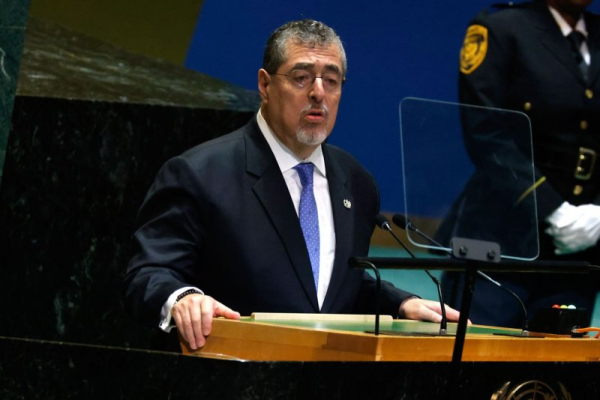
President of Guatemala Bernardo Arevalo speaks at the UN General Assembly 79th session General Debate in UN General Assembly Hall at the United Nations Headquarters on Tuesday, September 24, 2024 in New York City. Photo by Peter Foley/UPI | License Photo
In June 2025, Guatemalan President Bernardo Arévalo traveled to Taipei for a five-day state visit. It was his first trip to Taiwan since serving as deputy foreign minister more than three decades ago. He met with President Lai Ching-te, signed a letter of intent on semiconductor cooperation, visited TSMC and the Hsinchu Science Park, and described the bilateral relationship as one between “brotherly peoples.” The visit was a powerful reaffirmation of a diplomatic bond dating back to 1934.
Yet even as Arévalo was cementing ties with Taipei, the forces pulling Guatemala in the opposite direction were intensifying. Guatemala, the largest of Taiwan’s 12 remaining diplomatic allies worldwide and its most significant partner in Central America, has become a focal point in the broader strategic competition between China and democratic states for influence in the Western Hemisphere. The choices made in Guatemala’s halls of power over the coming years are likely to reverberate far beyond its borders.
The scale of Chinese commercial penetration
China’s economic presence in Guatemala is already substantial and growing fast. Chinese exports to Guatemala reached nearly $5 billion in 2024, according to U.N. COMTRADE data, making China a major source of Guatemalan imports. By contrast, Guatemala’s exports to China totaled just $45 million that same year, reflecting a massively lopsided trade relationship. Chinese telecommunications and security firms, including Huawei, ZTE, Xiaomi, Honor, and Hikvision, several of which have been banned from U.S. government systems due to national security concerns, have expanded their presence in Guatemala’s telecommunications, retail, and public safety sectors.
Chinese companies have also pursued strategic infrastructure opportunities. In previous administrations, China-based firms unsuccessfully sought to acquire land on both the Atlantic and Pacific coasts for port facilities. Chinese-manufactured ZPMC cranes, scanners, and other digital equipment are reportedly used by private port operators in Guatemala. These commercial footholds give Beijing leverage that extends well beyond simple trade.
Political influence beyond formal diplomacy
Because Guatemala recognizes Taiwan rather than the People’s Republic of China, Beijing has no embassy in the country. But this has not prevented China from building influence networks through creative diplomatic workarounds. China’s observer status in the Central American Parliament (PARLACEN), headquartered in Guatemala City, provides its ambassador in Costa Rica a platform for regular visits and direct engagement with Guatemalan politicians, local officials and business leaders.
These interactions frequently include sponsored trips to China for lawmakers across party lines. A 2025 trip reportedly included legislators from multiple Guatemalan parties, and another delegation is reportedly being planned for the first half of 2026. In the media sphere, Chinese agents have cultivated journalists and prominent bloggers, sponsoring visits to China that have produced more Beijing-friendly public commentary. These informal channels contribute to the gradual normalization of engagement between Chinese interests and Guatemalan elites, thereby creating a constituency for a diplomatic realignment even before any formal policy shift.
Taiwan’s tangible partnership
Taiwan has sought to counter these dynamics by being a consistently reliable partner across multiple domains. Over the past three decades, Taiwan has imported approximately $1 billion in Guatemalan products, including $90 million in sugar in the past year, along with coffee and other goods. Taiwan’s International Cooperation and Development Fund currently operates eight active projects in Guatemala, spanning infrastructure, education, healthcare, agriculture and disaster preparedness, and builds on 24 previously completed initiatives.
The tangible results are visible. Taiwan built a hospital in Chimaltenango, inaugurated in February 2023, and a neonatal facility in San Juan de Dios, Guatemala City, completed in April 2024. In August 2025, Taiwan donated 252 motorcycles to the Guatemalan police and 50 vehicles to the Social Development Ministry. In education, Taiwan has provided 600 scholarships to Guatemalans over the past two decades, including 66 in 2025. And in September 2025, Taiwan’s Ministry of Foreign Affairs pledged over $32 million in additional Latin American assistance projects for infrastructure and professional training, support that has become increasingly critical following the elimination of USAID under the second Trump administration.
The semiconductor cooperation agreement signed during Arévalo’s June visit represents a potential step change in the relationship. Guatemala sent 28 university engineers and private-sector professionals to Taiwan for intensive semiconductor training in May 2025, and the two governments are exploring whether Guatemala could support semiconductor packaging operations, a move that would link Guatemala’s development trajectory to Taiwan’s most strategically significant industry.
The cybersecurity dimension
The competition extends into the digital domain. In April 2025, a joint cybersecurity review conducted by the Guatemalan government and U.S. Southern Command identified APT-15, also known as Vixen Panda or Nylon Typhoon, within Guatemalan government systems. The China-linked espionage group had infiltrated the Foreign Ministry’s computer systems from September 2022 through February 2025, according to Guatemala’s foreign ministry. While Guatemalan officials characterized the incident as an older security lapse, President Arévalo acknowledged the threat directly, stating that the exercise revealed “hostile attempts by hacker groups located in the People’s Republic of China to penetrate the national cyber system.”
Guatemala was not alone. In the weeks surrounding the discovery, similar China-linked intrusions were identified in the government systems of both Paraguay — Taiwan’s last ally in South America — and Costa Rica, suggesting a coordinated campaign targeting countries of strategic interest to Beijing in the hemisphere.
Washington’s growing stake
For the United States, Guatemala’s trajectory is strategically consequential. In February 2025, Secretary of State Marco Rubio visited Guatemala City and explicitly praised Guatemala’s relationship with Taiwan, pledging that Washington would “do all we can to facilitate more Taiwanese investment in the economy of Guatemala.” The visit placed the Taiwan question alongside migration enforcement and counternarcotics as a pillar of the bilateral agenda, signaling that the Trump administration views Guatemala’s diplomatic alignment as a priority.
The stakes are not merely symbolic. A Guatemalan shift in recognition from Taipei to Beijing would reduce Taiwan’s already diminished roster of formal diplomatic partners, undermine U.S. efforts to maintain democratic solidarity in the hemisphere, and confer a significant strategic and symbolic victory on Beijing in a region Washington regards as its near abroad.
The road to 2027
Nearly all informed observers believe President Arévalo will maintain Guatemala’s relationship with Taiwan through the remainder of his term. But attention is already turning to Guatemala’s July 2027 national elections, with a new government set to take office in early 2028. Leaders from virtually all of Guatemala’s principal political parties have been courted by China, and the outcome of those elections could fundamentally alter the country’s foreign policy orientation.
The contrast between the two competing models is sharp. China offers commercial scale and political flexibility, but its engagement comes with cybersecurity risks, opaque influence operations, and infrastructure deals that have proven problematic elsewhere. Taiwan offers partnership rooted in democratic values and sustained development cooperation, including semiconductor collaboration, but operates on a smaller scale.
For Washington and its allies, the imperative is clear: the period between now and Guatemala’s next election represents a critical window. Concrete steps to deepen trade access, accelerate infrastructure investment, and expand the economic dividends of Guatemala’s Taiwan relationship would do more to secure the country’s alignment than diplomatic statements alone. The most effective counter to Chinese influence is not rhetoric about democratic values but demonstrating that democratic partnerships deliver tangible results for the Guatemalan people.
Evan Ellis is a senior non-resident associate at the Center for Strategic and International Studies (CSIS). His latest book, “China Engages Latin America: Distorting Development and Democracy,” is published by Palgrave Macmillan. The views and opinions expressed in this commentary are solely those of the author.
