


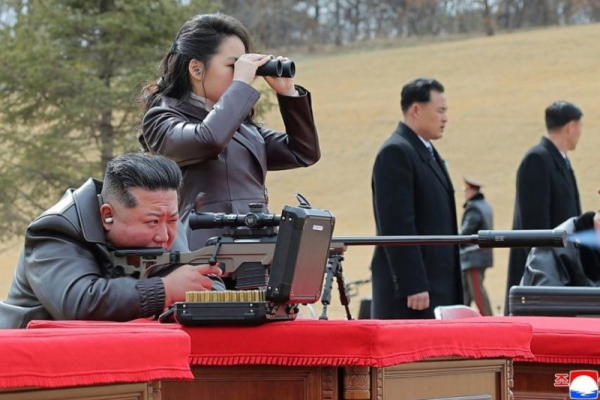
Kim Jong Un (L) fires a new-type sniper rifle while his daughter, Kim Ju Ae, looks through binoculars at an undisclosed shooting range in North Korea on February 27. Photo by North Korean Central News Agency/EPA
On March 1, the day after U.S. airstrikes eliminated Iranian Supreme Leader Ali Khamenei, North Korean state media broadcast images of Kim Jong Un touring the Sangwon Cement Complex.
Cigarette dangling from his lips, he appeared relaxed, issuing directives with studied nonchalance. But, composure performed in the face of catastrophe is not strength. It is the desperate bravado of a man gripped by a fear he cannot afford to show.
The North Korean Foreign Ministry condemned the U.S. strike on Khamenei as “hegemonic gangsterism.” Then, in virtually the same breath, added that it had fallen “within the predictable range of events.”
A regime that genuinely viewed the death of an allied leader as predictable would feel no need to say so. That disclaimer was a confession — an admission that Kim Jong Un could be next. What followed in the next 72 hours speaks more honestly than any diplomatic statement.
The bunker imperative
Kim’s visit to a cement factory was not coincidental. Watching Khamenei’s fate on Feb. 28, he almost certainly measured, in the same instant, the vulnerability of his own underground world:
Compound No. 15 (also known as House No. 15), his command offices, the classified wartime command bunker beneath Daesong Mountain, and the private underground facilities constructed for his exclusive use beneath Myohyang Mountain and Paektu Mountain.
The dimensions of that subterranean architecture were exposed years ago by Lee Han-young, the nephew of Kim Jong Il’s wife, in his memoir.
From the leader’s residence, an elevator descends roughly 100 meters to tunnels 4 to 5 meters wide, connecting directly to his office. From that office, descending more than 100 meters further, a vast labyrinth stretches some 10 kilometers to the galleries beneath Daesong Mountain — the wartime supreme command headquarters.
I heard these details repeatedly from senior Korean Workers’ Party officials in Pyongyang. The city’s subway system, built more than 100 meters below street level, is woven into this web — civilian infrastructure designed in wartime to serve as an integrated military tunnel network. I rode those trains countless times.
The sniper signal
On Tuesday, Kim attended a sniper marksmanship competition — an unusual event for a head of state to observe directly. The timing is telling. Three days earlier, Khamenei had been struck from the air and eliminated.
And on the morning of Jan. 3, an event without parallel in modern political history had unfolded: Venezuelan President Nicolás Maduro and his wife, Cilia Flores, were seized by U.S. Delta Force operators from a fortified safe house in Caracas.
The 32 Cuban soldiers tasked with protecting them were killed. The world’s press reported it in unison. The pattern was unmistakable. Strongmen who had seemed impregnable were being removed, one by one.
Kim’s attendance at the sniper competition had nothing to do with military readiness. It was about his own survival. Having witnessed Maduro’s fate, Kim moved to personally direct the construction of a layered defense — multiple rings of elite day-and-night sniper positions extending 1,000 meters outward from his office and residence.
The calculation was precise: Sharpshooters positioned at every critical approach would form a human shield capable of neutralizing what the regime calls an American “decapitation operation” before it could reach him. Behind the placid exterior lay a fear meticulously calibrated for survival.
The nuclear navy gambit
On Tuesday and Wednesday, Kim boarded the soon-to-be-commissioned destroyer Choe Hyon to observe a test launch of sea-to-ground ballistic missiles, proclaiming the “nuclear arming of the navy” with conspicuous theatrics. He also ordered the construction of two destroyers annually — a pace that strains North Korea’s industrial capacity to its limits.
This is the cry of a frightened man. Concluding that fixed land-based assets are no longer safe against American precision strikes, Kim is loading nuclear warheads onto warships that move across open water — a new deterrent card he can play from the sea.
The message is blunt: Touch me and nuclear weapons will fly. But this is not a projection of power. It is the last threat of a man thrashing to stay alive.
On Tuesday, President Donald Trump told a White House energy roundtable: “When maniacs have nuclear weapons, bad things happen.” He referenced prior U.S. strikes on Iranian nuclear facilities using B-2 stealth bombers, adding that without those strikes, Iran would now possess nuclear weapons.
In 2017, Trump used nearly identical language about Kim Jong Un himself, calling him “obviously a madman.” That echo has almost certainly reached Pyongyang.
Geometry of fear
The more Kim reinforces his underground redoubts and fixates on seaborne nuclear platforms, the more transparently his anxiety is revealed. The high-strength concrete bunker complexes buried deep within mountain ranges are themselves a form of data – signals readable by reconnaissance satellites and signals intelligence, disclosing precisely where Kim believes the threat originates and how he intends to survive it.
The man who stood at the Sangwon Cement Complex with a cigarette at his lips, projecting ease, is at this very moment dispatching trainloads of cement to pour over his own head.
That is not equanimity. That is the survival fear of a man who happens to possess nuclear weapons. A fortified bunker does not protect the man who hides inside it. It merely defines him — as a dictator imprisoned by his own dread.
Ri Jong-ho is a former senior North Korean economic official who served under all three leaders of the Kim family regime. His most recent role was based in Dalian, China, where he headed the Korea Daehung Trading Corp., overseen by the clandestine Office 39 under the direct control of the ruling Kim family. Before his assignment in Dalian, Jong-ho held pivotal positions, including president of the Daehung Shipping Co. and executive director of the Daehung General Bureau of the North Korean Workers’ Party, a role equivalent to vice-minister rank in the North Korean party-state. Subsequently, he was appointed chairman of the Korea Kumgang Economic Development Group under the North Korean Defense Committee by Kim Jong Il. Jong-ho is a recipient of the Hero of Labor Award, the highest civilian honor in North Korea. After a series of brutal purges by Kim Jong Un, he defected with his family to South Korea in late 2014. He resides in the greater Washington D.C., area.
