



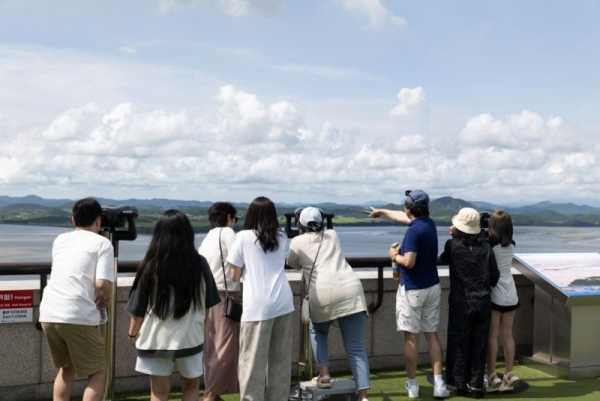
Through faint flows crossing borders, informal distribution channels and limited technological contact, people in North Korea still become aware that another world exists. File Photo by Jeon Heon-kyun/EPA
The author prefers to use the lowercase “n” to challenge the Kim family regime’s legitimacy.
“The marriage between Nazi propaganda and the radio.” (from How to Win an Information War)
I paused for a long time on this single sentence in the book. It is short, but it contains an entire era compressed within it. Technology often appears to be a neutral tool, yet depending on whose hands it is in and what purpose it is bound to, it takes on a completely different face.
The radio was not simply a means of communication. It was the first mass medium capable of delivering the same message, the same emotion, to millions of people almost in real time.
And propaganda operated at its most powerful precisely on that structure — repetition, a single voice, a world in which only selected information exists. That combination did not merely describe reality; it began to construct it.
Reading this sentence again in the context of today’s world raises another layer of questions.
We already live inside a digital platform and algorithm-driven information environment. Information is overabundant, yet at the same time it is filtered and arranged, and the way it reaches individuals is becoming increasingly structured.
The medium has shifted from radio to digital networks, and the speed is incomparably faster. But the essential fact remains unchanged: When information merges with power, it reshapes reality.
At the same time, in another part of the world, there still exist systems where digital transformation has not fully expanded, and where information itself is structurally controlled. In such places, information is not freely flowing data, but a resource delivered only in approved and selected forms.
north Korea’s information system operates within a deliberately designed “closed ecosystem,” cut off from direct connection to external networks. Its control is not simply about “preventing access.” It forms a multilayered and highly engineered web.
First is the physical locking of hardware. Radios and televisions distributed in north Korea are manufactured with frequencies fixed only to official state channels. The very possibility of tuning channels is removed, and any attempt to modify them is strictly monitored and punished.
Second is digital containment through technology. Instead of the global Internet, only a closed national intranet known as Kwangmyong is allowed. With the spread of smartphones, the “Red Star” OS further strengthens a digital signature system that blocks any unauthorized files or external media from running.
Third, there is legal and institutional fear. The recently strengthened “Law on Rejecting Reactionary Ideology and Culture defines the viewing and distribution of foreign media content as ideological infiltration, punishable even by the highest penalties. It effectively turns citizens into self-censors.
In such an environment, the question of information is no longer about “accessibility,” but about “permission.” The key is not what one can know, but what one is allowed to know.
Information control, in this sense, does not stop at external restriction. It becomes a mechanism that shapes human perception itself.
And yet, information can never be fully sealed off. Through faint flows crossing borders, informal distribution channels, and limited technological contact, people still become aware that another world exists.
And those small cracks do not remain mere curiosity, they become the realization that another kind of life might be possible.
This is the point that repeatedly appears in testimonies from north Korean escapees.
Even within a restricted information environment, encountering the outside world was not just an expansion of knowledge, it was a shift in perception itself.
It was the moment they realized the reality they were living in was not the only possible world, and that realization became a decisive trigger for leaving.
Even the recent testimonies on north Korean human rights discussed in the U.S. Congress ultimately connect to this same issue. It was not simply political criticism, but a question of how access to information shapes human perception and choice.
Blocking information is not merely severing contact with the outside world. It is the removal of a “mirror of comparison” through which individuals can objectively understand their own lives.
Just as the radio in the Nazi era bound the masses together through a single shared emotion, today’s tightly controlled information system confines north Korean people within a manufactured reality.
Yet, paradoxically, the small fragments of information that seep through those rigid walls, whether a drama, a song or anything else, plant a seed of doubt — that the reality they have been given may not be the whole of what exists.
Ultimately, when technology and power attempt to monopolize reality, the only force that resists it comes from a deeply human instinct: the right to know.
Because the flow of information is not merely the transmission of data. For someone, it is the beginning of human rights, the moment they begin to perceive the boundaries of the world they inhabit, and to sense their own reality as an individual.
No human being is meant to remain trapped under the shadow of technology. Every person has the right to define their own life, grounded in truth.
Jihyun Park, a British Korean Conservative politician and regular contributor to the Korea Regional Review, is a North Korean escapee who fled twice from the country — in 1998, which resulted in a forced repatriation, and in 2008, which was successful. She is a senior fellow for human security at the Center for Asia Pacific Strategy.
