

Where does solidarity begin?


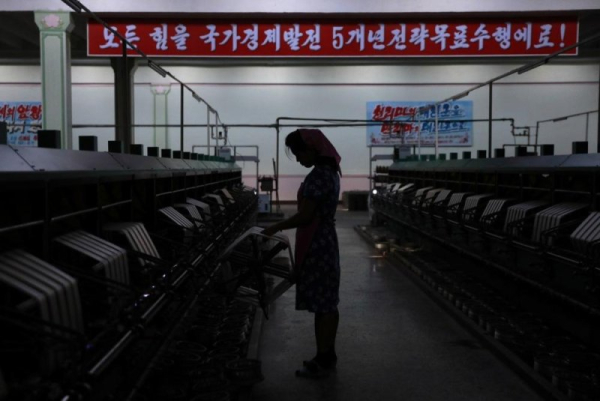
North Korea’s ability to avoid total collapse and maintain a baseline of social continuity was owed entirely to the informal economic activities of its women.File Photo by How Hwee Young/EPA
The author prefers to use the lowercase “n” to challenge the Kim family regime’s legitimacy.
In Feminist Theory and Social Solidarity, Nathan Rochelle DuFord categorizes modern feminism into four distinct currents: identity-based, Marxist/postcolonial, intersectional and neoliberal feminism.
In doing so, DuFord poses a fundamental question: “Which form of feminism truly strengthens mutual responsibility and social solidarity in a fragmented society?”
DuFord’s primary critique targets what has now become the mainstream: neoliberal, or capitalist, feminism.
According to DuFord, capitalist feminism does not entirely abandon the value of equality. Instead, it reduces equality to a mere matter of “participation and inclusion within the existing system.”
It diagnoses the root cause of inequality not as the inherent contradictions of the capitalist order, but rather as women’s lack of market participation or underrepresentation in leadership.
From this perspective, shattering the glass ceiling and shoving more women into executive suites or boardrooms is equated with liberation and feminist progress. However, DuFord sharply exposes this phenomenon as a byproduct of “asymmetric inclusion” within capitalist institutions.
Rather than demanding a structural overhaul, capitalist feminism redefines liberation as individual success and integration into a winner-take-all competitive system.
Consequently, feminism loses its radical edge as a movement for social transformation and shrinks into a form of “adjusted inclusion” tailored to serve the capitalist order.
Here, DuFord flips the question: Does increasing the institutional inclusion of women genuinely foster social solidarity? Or does it merely push women into the market logic of relentless competition, further fracturing society into hyper-individualized units?
Paradoxically, this piercing question finds its most dramatic expansion in the lived experiences of women in north Korea, one of the most closed societies on Earth.
As early as 1946, north Korea proclaimed legal gender equality through the Law on Sex Equality. This was a core ideological mechanism designed to dismantle the feudal family order and legitimize the construction of a socialist state.
Yet, this “legal equality” was quickly co-opted by a state-driven mobilization system. Women were not liberated as autonomous individuals; they were simply organized as instruments of labor and revolution.
What is crucial to understand is that the position of north Korean women defies the simplistic dichotomy of “state oppression versus legal liberation.”
The equality promised by the regime existed only as a hollow institutional facade. In reality, women had to bear a double burden-sustaining both patriarchal domestic life and state-mandated forced labor. It was a classic manifestation of the limits of state-driven, asymmetric inclusion.
This deceptive structure collapsed decisively during the Massive Genocide of the 1990s, known as the “Arduous March.”
As the state rationing system broke down completely, the responsibility for survival shifted abruptly from the state to individuals and families and specifically to women. Bound to formal state and military organizations, men were left economically paralyzed.
It was the women who stepped into the frontlines of survival, creating the Jangmadang (informal market) economy outside the official planned economy. Food trade, small-scale cross-border smuggling and the flow of information were all sustained through the informal labor and networks of these women.
Ironically, north Korea’s ability to avoid total collapse and maintain a baseline of social continuity was owed entirely to the informal economic activities of its women. When the state could no longer guarantee survival, women were the quickest to embrace the market and forge alternative survival structures.
This phenomenon is fundamentally different from the “successful integration into an existing system” championed by capitalist feminism. The marketization by north Korean women exposed the impotence of the regime and carved out an alternative community for collective survival outside the official order.
The Jangmadang networks — where women hid goods for one another and shared vital information under the nose of state inspectors — demonstrate a primal, resilient form of “social solidarity” that neoliberalism has largely erased.
This autonomous agency becomes even more visible in the process of defection. The fact that the vast majority of north Korean defectors are women is not a mere demographic coincidence; it is a structural outcome.
Having already accumulated market experience and survival strategies under ruthless state crackdowns, these women tend to adapt relatively quickly to new societies. For them, migrating to a free society is not a rupture, but rather an extension of the economic autonomy and agency they began to forge back home.
They are not passive “human rights victims” or “refugees’; they are “sovereign survivors” who calculated the risks of crossing borders and actively designed their own destinies.
In this context, the framework of human security offers a vital theoretical lens. Human security shifts the focus away from state-centric military security toward the survival, freedom of movement, economic sustainability and dignity of the individual.
Viewed through this lens, north Korean women are far from helpless victims of a totalitarian regime. They are dynamic actors who created an alternative economic order in the vacuum of state failure and who won and realized human security for themselves through perilous migration.
Ultimately, the clue to DuFord’s question, “Which form of feminism strengthens social solidarity?” can be found in the narratives of north Korean women.
Capitalist feminism, which defines liberation solely as shattering the glass ceiling to enter the structures of power, inevitably breeds atomized competition. In contrast, the lives of North Korean women, who propped up one another’s survival to build alternatives under the harshest structural oppression, point toward a new horizon of solidarity.
Genuine feminist solidarity is not measured by how many women get to sit in the chairs of the ruling class. It begins when those pushed to the absolute margins of a system hold hands and expand the space for mutual survival.
Jihyun Park, a British Korean Conservative politician and regular contributor to the Korea Regional Review, is a North Korean escapee who fled twice from the country — in 1998, which resulted in a forced repatriation, and in 2008, which was successful. She is a senior fellow for human security at the Center for Asia Pacific Strategy.
