



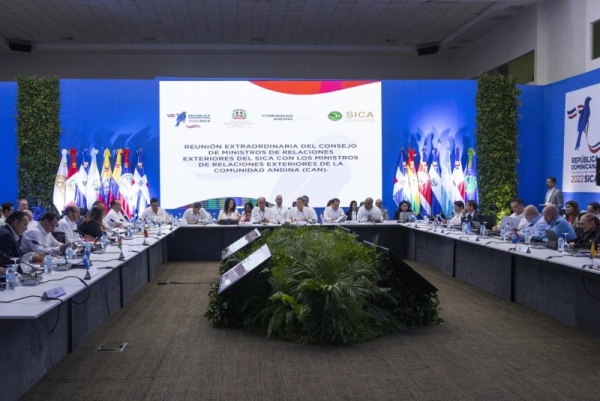
The meeting of foreign ministers of the Andean Community, in Santo Domingo, Dominican Republic, in 2022. File Photo by Orlando Barria/EPA
Central America does not suffer from a lack of regional challenges. It suffers from a shortage of regional decisions.
That distinction matters. For decades, the countries of Central America and the Dominican Republic have spoken the language of integration. They have created institutions, held summits, issued declarations and built a dense network of regional bodies. Yet the region’s most urgent problems rarely wait for slow procedures, incomplete consensus or institutional fatigue.
These problems cross borders. They move faster than governments. Criminal networks exploit gaps between national systems. Migratory pressures flow through multiple countries. Climate shocks hit food security and public finance. No single country can manage any of this well on its own.
That is why the recent meeting of foreign ministers of the Central American Integration System, known by its Spanish acronym SICA, deserves more attention than it is likely to receive outside the region.
On April 24, foreign ministers gathered in Santo Domingo for the 93rd ordinary meeting of the SICA Council of Foreign Ministers. Under the Dominican Republic’s temporary presidency, the ministers adopted a new regulation on quorum and decision-making for SICA’s regional bodies. The regulation preserves consensus as the guiding principle but introduces a qualified majority mechanism — 75% of member states — for situations where unanimity cannot be reached. The ministers also advanced a roadmap for selecting a new secretary-general, a position that has remained vacant for years.
At first glance, this may sound like procedural housekeeping. It is not. For a regional system, rules about quorum and decision-making are not minor details. They determine whether institutions can act and governments can translate political language into public results.
SICA was born of necessity. The Tegucigalpa Protocol, signed in 1991, established the institutional framework for Central American integration after decades of conflict and division. It was built on the political momentum of the Esquipulas Peace Accords, which transformed integration from an economic aspiration into a multidimensional project linking peace, democracy and development.
But institutions created for one historical moment must adapt to another. The Central America of the early 1990s is not the Central America of 2026. A regional body that cannot make timely decisions will struggle to remain relevant.
The Dominican Republic’s Foreign Ministry described the new regulation as a step toward modernizing the system by providing a legal framework that allows decisions to be made in a timely and continuous manner. Costa Rica’s Foreign Ministry said the meeting also reviewed the evolution of the foreign ministers’ agenda since 2017, including presidential mandates and the regulatory framework within SICA governance. That review matters. Regional institutions often accumulate mandates faster than they can execute them. Declarations multiply; public confidence does not.
Citizens judge integration by practical results: faster border crossings, coordinated disaster response, lower trade costs, and institutions capable of handling shared threats. The challenge is not to invent a new rhetoric of integration. It is to make integration operational.
SICA’s mandate covers democracy, security, economic integration and environmental protection. These goals remain valid. But breadth can become weakness when few priorities are executed well. A more effective SICA would not need to do everything — it would need to do certain things better.
Two priorities stand out from the Santo Domingo agenda. The first is follow-through. The public rarely reads regional communiqués, and even experts struggle to track which agreements become policy. A more transparent system for monitoring mandates, deadlines and implementation would help separate real progress from diplomatic repetition.
The second — and perhaps most urgent — issue is the prolonged vacancy of the Secretary-General position. Under the Tegucigalpa Protocol, the Secretary-General is not merely an administrative figure. The office is the system’s legal authority, responsible for executing mandates and ensuring continuity across the regional framework. Since former Guatemalan President Vinicio Cerezo concluded his term in 2021, the position has been occupied only briefly by a successor who later resigned. The Secretary-General is the only official empowered to legally represent SICA and formally execute its decisions. Operating for such an extended period without one weakens not only the system’s political credibility, but also its institutional coherence.
The voting reform adopted in April may open a pathway to overcoming this paralysis. But the challenge is no longer simply procedural. Member states must demonstrate that they are still capable of reaching political agreements on the leadership of the very institution tasked with coordinating regional integration.
Costa Rica, which holds the next turn in the rotation, will need to move with credible candidates and genuine political will. The region needs a Secretary-General with the capacity to transform an overloaded agenda into focused action.
The Dominican presidency also proposed involving national actors beyond foreign ministries, with technical support from SICA’s Executive Committee and General Secretariat. That is wise. Integration cannot remain a conversation among diplomats alone. Finance ministries, customs authorities, health officials and security agencies all have a stake in whether regional frameworks function. So do businesses, universities and civil society groups. Keeping them outside the process is one reason so many agreements stall.
The risk is that reform becomes another process rather than a turning point. Latin America’s regional institutions share a familiar weakness: strong declarations followed by uneven execution. SICA has not been immune. Central America cannot afford to repeat that pattern.
The Santo Domingo meeting suggests that SICA’s member states understand that institutional design affects regional credibility. If decisions cannot be taken, mandates cannot be implemented. If mandates cannot be implemented, integration becomes a slogan — and Central America’s integration project was born from something more serious than a slogan. It was born from the search for peace. Today, it must prove it can also deliver performance.
The next phase of SICA should be judged less by the number of meetings it holds than by the quality of decisions it enables. Can Central America make regional decisions at the speed its challenges require? The answer to that question will determine whether integration remains a promise or becomes a tool.
Olinda Salguero is a Guatemalan leader in regional integration and peacebuilding in Latin America. She served for four years as Chief of Staff to the Secretary-General of the Central American Integration System (SICA) and is the President of the Esquipulas Foundation for Peace, Democracy, Development and Integration. She collaborates with initiatives of both the Global Peace Foundation and the Latin American & Caribbean Presidential Mission. Forbes has recognized her three times as one of the most influential women in Central America. The views expressed are solely those of the author.
