



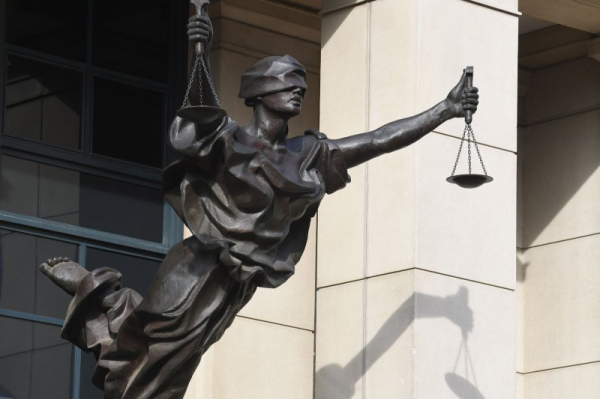
A statue of the Scales of Justice casts a shadow on the Albert V. Bryan U.S. Courthouse in Alexandria, Va., in 2018. File Photo by Mike Theiler/UPI | License Photo
Transparency International’s 2025 Corruption Perceptions Index, published in February 2026, found that the global average score had fallen to 42 out of 100, its lowest level in more than a decade.
More than two-thirds of the 182 countries measured scored below 50. Latin America’s persistent corruption scandals and weak systems of accountability are part of that broader decline.
Transparency International was even more direct in its assessment of the Americas.
The region, it said, has made no progress against corruption. Its average score matched the global average, while organized crime has increasingly penetrated politics and public institutions in countries such as Mexico, Colombia and Brazil.
That finding sits awkwardly beside another. Latinobarómetro’s most recent regional survey described democracy in Latin America as resilient, with support beginning to recover after a difficult decade.
Both things can be true at once. Many citizens still prefer democracy to any alternative, while doubting that their leaders and institutions serve them fairly.
That distinction matters. The greatest danger to democracy is not always its outright rejection. It is the gradual conviction that elections change little, that institutions protect the powerful, and that public office has become detached from the common good.
This frustration is not unique to Latin America. The 2025 Edelman Trust Barometer found that 61% of respondents worldwide held a moderate or high sense of grievance.
They believed that governments and businesses served narrow interests and allowed the wealthy to benefit unfairly from the system.
Four in 10 considered at least one form of hostile activism acceptable, including threats, deliberate disinformation or damage to property, with approval even higher among younger adults.
Circumstances differ from one country to another. Some societies protest corruption, others inequality, insecurity or inadequate public services. Yet beneath these different grievances lies a common frustration: institutions may still function on paper, but they no longer inspire trust.
Most analyses explain this unrest in political, economic or institutional terms. Those explanations are valid, but incomplete. Latin America’s crisis is fundamentally an ethical one.
This does not mean that poverty or institutional weakness are secondary concerns. Material hardship is real. But these failures become more corrosive when citizens believe they result from favoritism or dishonesty rather than misfortune or honest error.
Inequality wounds more deeply when privilege appears to determine who receives justice; institutional failure becomes explosive when no one accepts responsibility for it.
To describe this process, I propose the term “pandemethics,” combining the concepts of pandemic and ethics. It refers to a deterioration of moral and civic standards that spreads through society, crossing the boundaries between public and private life.
Like a virus, it does not remain confined to one institution. It moves through government, business, education and culture, growing wherever misconduct is rewarded and citizens begin to assume that ethical behavior places them at a disadvantage.
Pandemethics operates through three principal dynamics.
The first is cross-sector infection. When influence-peddling is tolerated in politics and favoritism becomes routine in public institutions, misconduct no longer appears exceptional.
It becomes an expected route to advancement. Even those who initially reject corruption may eventually feel compelled to participate simply to compete or survive.
The second is social fever. Citizens react to accumulated injustice through demonstrations and protest movements. Like the fever produced by a sick body, public unrest can signal that a society is attempting to defend itself against a deeper disorder.
Protest is not, in itself, evidence of democratic failure; it can be a legitimate demand for accountability. Violence and deliberate disinformation, however, are not extensions of that protest.
They erode the very trust it seeks to restore, which is precisely the risk Edelman’s hostile-activism findings point to.
The third dynamic is the corruption of principles themselves. This occurs when political actors invoke ideals they do not practice or use moral language to disguise the pursuit of power. In this environment, competence is subordinated to loyalty and public debate becomes a contest of slogans.
The problem is not ideology itself; democracies need competing ideas and vigorous disagreement.
It begins when ideas are treated not as convictions but as instruments for concealing private interests, and is visible whenever credible allegations are answered only with partisan counteraccusations rather than transparent investigation.
This helps explain why discontent so often turns to rage. When legal authority remains but moral authority disappears, institutions begin to feel empty. Citizens may obey them out of necessity without believing in their legitimacy.
None of this makes legal and institutional reform unnecessary. Independent courts, transparent public contracting, professional civil services and credible oversight remain indispensable.
But rules alone cannot restore democratic life. Every system depends on people willing to honor not only the letter of the law but also the responsibilities that accompany public power.
That standard applies unevenly today. Political parties tend to invoke integrity mainly against their opponents rather than within their own ranks; public appointments still often reward loyalty over competence; civic education rarely treats citizenship as carrying responsibilities as well as rights.
The same imbalance shows up beyond government: business leaders, journalists and civil society organizations often demand integrity exclusively from the state while excusing favoritism or dishonesty within their own institutions.
Latin America does not lack laws, elections or political promises. What it increasingly lacks is confidence that public words correspond to private conduct. Rebuilding that confidence will take institutional reform and economic opportunity.
But it will also take ethical consistency between what leaders promise and how they govern. Until that gap closes, even functioning institutions will struggle to earn the trust democracy needs to survive.
Carlos Cantero is a Chilean academic at the International University of La Rioja in Spain and the author of Digital Society: Reason and Emotion. An international lecturer, adviser and consultant, he focuses on adaptability in the digital society, ethics, social innovation and human development. The views and opinions expressed in this commentary are solely those of the author.
