



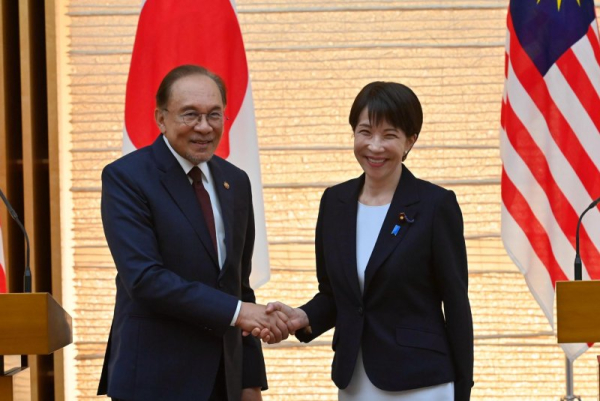
Japanese Prime Minister Sanae Takaichi (R) and Prime Minister Anwar Ibrahim (L) shake hands at the end a joint press announcement following their bilateral meeting at the Prime Minister’s Office in Tokyo, Japan,on June 10. Photo by David Mareuil/EPA
The June 10 summit in Tokyo between Japanese Prime Minister Sanae Takaichi and Malaysian Prime Minister Anwar Ibrahim demonstrated how Tokyo is steadily expanding practical, issue-based strategic partnerships across Southeast Asia amid growing geopolitical uncertainty.
Far from a routine diplomatic exercise ahead of the 70th anniversary of bilateral relations in 2027, the meeting reflected a broader regional reality: security, economic resilience, and maritime stability have become thoroughly interdependent. Rather than relying on purely declaratory diplomacy, Tokyo and Kuala Lumpur utilized the summit to institutionalize functional cooperation across maritime security, energy resilience, critical supply chains, and emerging technologies.
The South China Sea featured prominently in the joint statement, with both sides reaffirming their commitment to a rules-based regional order grounded in international law and the UN Convention on the Law of the Sea (UNCLOS).
While Malaysia traditionally maintains a cautious diplomatic posture toward Beijing, the language nevertheless reflected growing regional anxiety over rising maritime tensions and coercive behavior in contested waters. To translate these shared normative principles into operational capacity, the summit produced tangible advances in security coordination.
Both governments welcomed a new Memorandum of Cooperation (MOC) between the Japanese Coast Guard and the Malaysian Maritime Enforcement Agency, affirmed continued naval exercises between their respective fleets, and agreed to accelerate concrete projects under their existing defense equipment and technology transfer framework.
A primary instrument driving this regional capacity-building is Japan’s expanding use of Official Security Assistance (OSA). Since 2023, Tokyo has gradually increased its security footprint in Southeast Asia by supporting maritime surveillance and coast guard modernization.
Malaysia’s endorsement of expanding OSA cooperation highlights how ASEAN states increasingly view Japan as a stabilizing, non-threatening security partner. Crucially, Tokyo continues to frame this strategy in inclusive terms, repeatedly emphasizing the compatibility of its Free and Open Indo-Pacific (FOIP) vision with the ASEAN Outlook on the Indo-Pacific (AOIP).
This approach offers Southeast Asian governments a politically sustainable alternative: strengthening local deterrence and maritime capacity without forcing states into the rigid, binary pressures of alignment associated with formal anti-China containment structures.
The summit’s commitments to strengthen energy security carry profound strategic weight, driven by worsening geopolitical fragmentation and systemic vulnerabilities in the Middle East. Both leaders specifically discussed coordinating responses to ensure safe navigation through the Strait of Hormuz — a critical chokepoint for Japanese energy imports.
For resource-poor Japan, instability around Hormuz carries direct national security implications, elevating its energy trade with Malaysia from a standard commercial transaction to a vital calculation of supply security. With Malaysia currently accounting for roughly 15 percent of Japan’s LNG imports, Kuala Lumpur’s commitment to maintaining stable hydrocarbon exports provides Tokyo with an essential buffer against volatile global energy markets.
Beyond traditional energy flows, discussions expanded into the geoeconomic frontier, intensifying cooperation in fields central to modern Indo-Pacific strategic competition. The joint statement highlighted collaboration on critical minerals, rare earth resilience, semiconductors, artificial intelligence, and green transition technologies.
This shift reflects a wider transformation across the region: strategic influence is no longer defined solely by naval deployments or military balancing, but by the secure control of industrial logistics networks and technological ecosystems. Demonstrating an appetite for wider minilateral networking, the joint statement even pointed toward expanding cooperation with third-country partners like Australia and France on critical material resilience.
Ultimately, the Tokyo summit illustrates the institutionalization of flexible, functional frameworks that reinforce national resilience while preserving diplomatic maneuverability. Rather than replicating rigid, Cold War-style bloc architectures, regional actors are constructing overlapping partnerships that collectively strengthen the broader rules-based order.
For Southeast Asia, this model offers a sustainable path to preserve strategic autonomy; for Japan, it builds a robust, adaptable network of practical allies dedicated to protecting maritime stability and secure trade flows across an increasingly contested Indo-Pacific.
Erik Lenhart ([email protected]) holds an MA in political science from Charles University. He is a former Deputy Chief of Mission of the Slovak Republic in Tokyo and the author of the award-winning novel Daughters of the Empire. Michael Tkacik ([email protected]) holds a PhD from the University of Maryland and a JD from Duke University. He is a professor of government and director of the School of Honors at Stephen F. Austin State University, the University of Texas system. The views and opinions expressed in this commentary are solely those of the authors. This article is republished with permission from the South China Sea NewsWire. Read the original article.
