



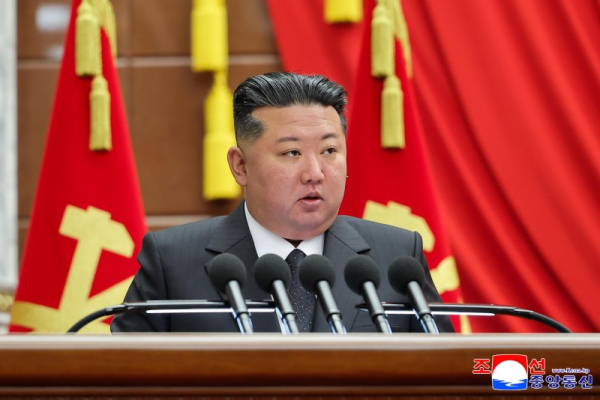
Kim Jong Un will view the U.S.-Iran agreement as a case study in coercion, timing, bargaining and regime survival. File Photo by KCNA/EPA
The author prefers to use the lowercase “n” to challenge the Kim family regime’s legitimacy.
The emerging U.S.-Iran agreement is not yet a durable peace. It is an interim political arrangement designed to halt fighting, reopen the Strait of Hormuz, ease economic pressure and create space for further nuclear negotiations. That distinction matters. The final terms remain uncertain. Implementation may falter. Verification may fail. Tehran and Washington may interpret the same text differently.
Kim Jong Un will study it anyway.
He will not view the agreement as a Middle East event. He will view it as a case study in coercion, timing, bargaining and regime survival. He will ask one question above all others: What did Iran do that forced Washington to negotiate?
The first lesson: Coercion creates attention
Iran used geography, missiles, proxies and the threat to global energy flows to create strategic urgency. The closure or disruption of the Strait of Hormuz imposed costs far beyond the battlefield. It affected oil prices, shipping, markets and domestic politics.
north Korea does not have Hormuz. It has Seoul. It has Japan within missile range. It has cyber capabilities, special operations forces, chemical weapons, long-range missiles, and nuclear weapons. Kim will see the same principle. A weaker power can impose costs that force a stronger power to bargain.
This is political warfare. The goal is not victory in a conventional military sense. The goal is to shape the adversary’s choices.
The second lesson: Nuclear weapons are leverage
Iran negotiated as a threshold nuclear state. north Korea would negotiate as an acknowledged nuclear weapons owner. Kim will see that difference as decisive.
He will likely argue that Iran was vulnerable because it had not achieved what Pyongyang claims to possess: a deliverable nuclear deterrent. His internal message will be simple. Nuclear weapons prevented north Korea from suffering Iran’s fate. They secured regime survival. They elevated north Korea from a poor isolated state into a permanent strategic problem for Washington.
That lesson will strengthen Kim’s determination never to denuclearize. He may negotiate. He may pause. He may freeze parts of a program. He may offer theatrical concessions. But he will not surrender the arsenal that he believes gives him status, deterrence and bargaining power.
The third lesson: Sanctions can be made negotiable
If Iran receives sanctions relief, access to frozen assets, oil export freedom or reconstruction support before permanent nuclear settlement, Pyongyang will see validation.
Kim does not seek reform. He seeks relief without change. He wants money for the elite, fuel for the military, technology for weapons and space for the regime to survive. He will study whether crisis diplomacy can convert pressure into concessions.
This is the danger of sequencing. If sanctions relief comes before irreversible nuclear steps, Pyongyang will conclude that pressure campaigns erode when crises become expensive enough.
The fourth lesson: Time favors the regime that endures
The Kim family regime has survived war, famine, sanctions, isolation, leadership transitions, diplomatic breakdowns and the collapse of its Soviet patron. Its strategy is not built on speed. It is built on endurance.
Kim will see Iran’s path as confirmation that time can be a weapon. A regime need not defeat the United States. It only has to survive long enough for Washington to face new elections, new crises, new budget pressures and new strategic distractions.
That is why Pyongyang watches American politics so closely. It knows democracies grow tired. It knows alliances debate. It knows pressure campaigns require patience that elected governments often lack.
The fifth lesson: Ambiguity is useful
Interim agreements create disputes over definitions, sequencing, verification, enforcement, sanctions, and compliance. Kim has exploited this space before.
He will seek front-loaded concessions and back-loaded obligations. He will delay inspections. He will dispute definitions. He will split Washington and Seoul. He will turn process into leverage.
For Pyongyang, negotiations are not a path to reconciliation. They are another battlefield. The objective is advantage.
The most dangerous possibility: Kim may seek talks
The conventional assessment is that the Iran agreement will make Kim avoid diplomacy and accelerate his nuclear program. That may be incomplete.
Kim may draw the opposite conclusion. If Iran can secure concessions without acknowledged nuclear weapons, then north Korea should be able to demand more because it possesses them.
That logic could bring Kim back to talks. Not because he seeks peace. Not because he accepts denuclearization. But because he may believe the diplomatic environment now favors extortion from strength. He may believe is in the seat of power. Trump and Putin went to Beijing. Xi then came to Pyongyang. Does Kim assess that he is actually the one who can call the shots now, especially with the backing of Xi and Putin?
His objectives would be clear: Sanctions relief (though less necessary only symbolic due to PRC and Russian support). Reduced allied exercises (though he will not seek elimination since he exploits them for domestic propaganda purposes). Political legitimacy. Economic benefits. Arms control in place of denuclearization. Ultimately, at least de facto recognition of north Korea as a permanent nuclear weapons state.
Timing matters. Kim may assess whether engaging Washington before the November 2026 midterm elections gives him leverage. He may believe POTUS wants diplomatic success, lower energy prices, market stability and no new Asian crisis. Whether that judgment is accurate matters less than whether Kim believes it.
What Kim will exploit
Kim will exploit the precedent of crisis diplomacy. He will exploit any perception that the United States rewards pressure. He will exploit alliance debate. He will exploit global distraction. He will exploit economic anxiety. He will exploit the idea that a hostile regime can create danger, survive escalation and then receive negotiations.
He will also exploit propaganda. The message to his elite will be stark: strength wins respect, concessions invite attack and nuclear weapons preserve sovereignty.
Policy implications
Washington and Seoul must not allow the Iran case to teach Pyongyang that nuclear-backed coercion pays. The alliance should reinforce deterrence, tighten sanctions enforcement, expose illicit finance and the regime’s cyber warfare, expand information and influence operations, keep human rights central and focus on solving the “Korea question.”
It must also make clear that north Korea is not Iran. north Korea is already nuclear armed. It is tied to Russia. It is protected by China. It wages political warfare against the ROK/U.S. alliance. It threatens Seoul, Tokyo, U.S. forces and increasingly the American homeland.
The danger is not only that Kim rejects diplomacy. The greater danger may be that he embraces diplomacy because he believes he can manipulate it better than Iran.
Conclusion
Kim will study the U.S.-Iran agreement coldly. He will not ask whether it is fair. He will ask whether coercion worked.
If Tehran emerges believing resistance produced concessions, Pyongyang may draw the same lesson with greater confidence. For Kim, the answer may be simple: stay nuclear, create pressure, wait for division and negotiate only from strength.
The strategic question is not whether Kim will learn from Iran. He will.
The question is whether Washington and Seoul will learn faster.
David Maxwell, executive director of the Korea Regional Review, is a retired U.S. Army Special Forces colonel who has spent more than 30 years in the Asia-Indo-Pacific region. He specializes in Northeast Asian security affairs and irregular, unconventional and political warfare. He is vice president of the Center for Asia Pacific Strategy and a senior fellow at the Global Peace Foundation, where he works on a free and unified Korea. After he retired, he became associate director of the Security Studies Program at Georgetown University. He is on the board of directors of the Committee for Human Rights in North Korea and the OSS Society and is the editor at large for the Small Wars Journal.
