



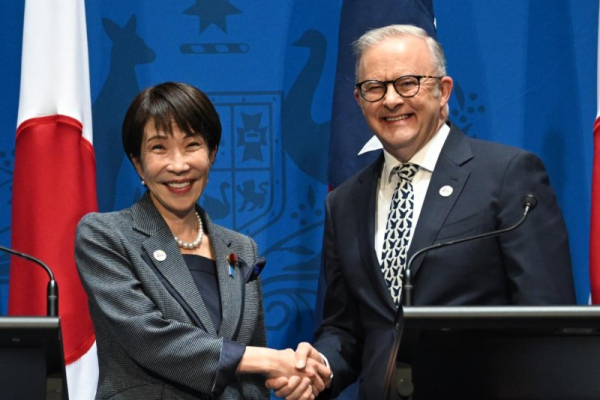
Australian Prime Minister Anthony Albanese (R) and Prime Minister of Japan Sanae Takaichi (L) shake hands during a joint press statement at Parliament in Canberra, Australia, on May 4. Photo by Lukas Coch/EPA
Japanese Prime Minister Sanae Takaichi’s early May visit to Canberra marks a significant milestone for Australia-Japan relations. It consolidates one of the Indo-Pacific’s most important middle-power partnerships, now evolving into a functional quasi-alliance spanning defense, economic security, and energy resilience.
The timing underscores the momentum. Takaichi arrived after outlining an updated Free and Open Indo-Pacific (FOIP) vision in Vietnam, reaffirming commitments to the rules-based order, as well as securing sea lines of communication and resilient supply chains. In Canberra, these principles gained concrete expression through a joint communique and aligned policy signals, reflecting shared threat perceptions and a growing willingness to act together.
Defense cooperation forms the core of this convergence. The landmark decision to procure and domestically co-produce Japanese-designed Mogami-class frigates represents a major step in trust and interoperability. Far more than a simple arms deal, it integrates defense industries and operational doctrines. Recent ministerial meetings between Japanese Defense Minister Shinjiro Koizumi and his Australian counterpart aim to elevate bilateral ties and bolster joint deterrence in contested waters.
This level of integration was unthinkable a decade ago. The partnership has moved well beyond its historical economic base. Analysts now routinely describe it as a “quasi-alliance,” rooted in shared democratic values, overlapping strategic interests, and close U.S. coordination. The frigate program, expanded joint exercises, and interoperability initiatives give this description real substance.
Yet the relationship’s most transformative element lies in comprehensive security — blending military preparedness with economic and resource resilience. Australia supplies a substantial portion of Japan’s energy, strategic raw materials, and food, creating deep interdependence that has become a strategic asset amid geopolitical fragmentation and supply-chain risks.
Energy security is a key pillar. Australia provides roughly 40% of Japan’s LNG imports. Against Middle East instability and potential Strait of Hormuz disruptions, both nations are building mechanisms for mutual assurance. Discussions during the visit reportedly included leveraging Japan’s strategic fuel reserves for market stability, signaling a shift toward institutionalized crisis management.
Parallel progress in critical minerals and rare earths strengthens this trajectory. Japan’s past reliance on China has prompted diversification, with Australia as a central partner. Joint investments aim to create secure supply chains supporting both economic stability and advanced defense technologies, directly aligning with FOIP goals.
These ties also facilitate broader minilateral cooperation. While Japan is not a formal AUKUS member, its defense-industrial collaboration with Australia, technological strengths, and shared outlook position it well for involvement in areas such as advanced technologies, maritime domain awareness, and undersea capabilities. Takaichi’s visit and Koizumi’s diplomacy suggest these options are being actively explored.
The partnership is not merely reactive. It represents a proactive effort to shape the regional order as U.S. reliability and the multilateral trading system face growing uncertainty. Canberra and Tokyo are building a networked architecture of like-minded partners to sustain openness and stability.
Economically, the agenda extends beyond current energy and minerals ties. Both countries are investing in future industries — hydrogen, ammonia, and green metals — that could redefine bilateral trade in coming decades, much as iron ore and LNG did previously. Success will demand sustained political commitment, investment, and regulatory alignment.
Takaichi’s visit represents a pivot point. The relationship has matured from transactional exchanges into strategic alignment across multiple domains: defense anchored by the frigate program, economic resilience through energy and resources, and a shared regional vision via FOIP.
For the wider Indo-Pacific, especially the South China Sea, the implications are substantial. A tighter Australia-Japan partnership enhances deterrence, bolsters supply-chain resilience, and supports an open maritime order. It demonstrates that middle powers can actively shape the strategic environment through sustained cooperation.
Ultimately, Takaichi’s trip highlights the emergence of a new partnership model — one combining alliance-style security cooperation with deep economic integration and technological collaboration. As geopolitical uncertainty grows, such arrangements may prove essential for regional stability.
The Australia-Japan quasi-alliance has come of age. The focus now shifts from whether it will deepen to how far it can extend — and which other partners might join.
Erik Lenhart ([email protected]) holds an MA in political science from Charles University. He is a former Deputy Chief of Mission of the Slovak Republic in Tokyo and the author of the award-winning novel Daughters of the Empire. Michael Tkacik ([email protected]) holds a PhD from the University of Maryland and a JD from Duke University. He is a professor of government and director of the School of Honors at Stephen F. Austin State University, the University of Texas system. This article is republished from the South China Sea NewsWire. Read the original article. The views and opinions expressed in this commentary are solely those of the authors.
