


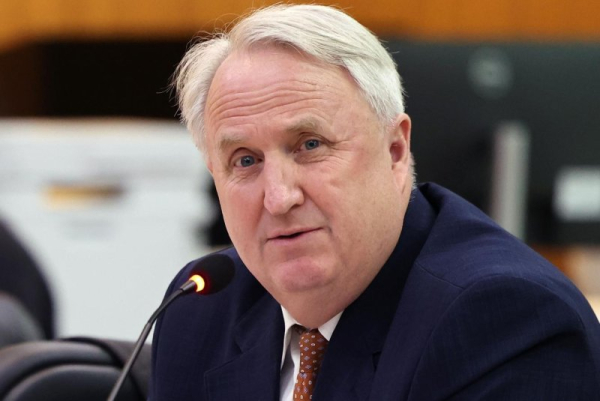
In Yo-han, former People Power Party lawmaker In Yo-han left as he departed the National Assembly after resigning on Dec. 10. File Photo by YONHAP/ EPA
“When politics is trapped in black-and-white logic, the people’s lives turn gray.”
That was the message former People Power Party lawmaker In Yo-han left as he departed the National Assembly after resigning on Dec. 10. His sudden exit, after serving as the ruling party’s innovation committee chair and a member of its supreme council, was striking on its own.
Political confrontation has grown so intense that lawmakers and Assembly staff alike describe it as the worst they have seen. On the National Assembly’s Science, ICT, Broadcasting and Communications Committee, verbal abuse has become routine, the column said, with lawmakers openly calling for fistfights. On the Legislation and Judiciary Committee, policy debate has been displaced by daily production of provocative short-form content aimed at each side’s supporters.
Veteran lawmakers in previous assemblies often clashed publicly but still worked behind the scenes to find workable compromises. The common assessment now, the column said, is that even minimal communication has disappeared.
One scene a reporter witnessed in the main National Assembly building corridor captured the shift. A senior opposition lawmaker from the same standing committee offered a cheerful greeting – “Going to the general meeting?” – but a first-term lawmaker from the ruling party passed by with an awkward expression, trailing off mid-sentence. In a legislature where opponents are treated only as targets to defeat, even a basic greeting can feel difficult.
The language lawmakers use can sound like a commander sending troops into battle. One senior Democratic Party lawmaker said, “A criminal has no right to choose his poison.” A People Power Party party affairs audit body said, “A charging ox must be stoned to death,” according to the column.
Against that backdrop, In, who had been tasked with party reform for about a year and a half, packed up and left. Party leadership, including Chairman Jang Dong-hyuk, urged him to stay, saying there was still work to do, but the column said In had reached a point of deep helplessness amid increasingly hardened factional politics.
What stood out was the tone of the Democratic Party’s farewell.
Park Soo-hyun, the party’s chief spokesperson, issued a written statement expressing gratitude and said In’s diagnosis should be taken seriously. Park said politics driven only by factions exhausts the public and said breaking the black-and-white, faction-first logic is essential for national unity, the column said.
Democratic Party lawmaker Park Sun-won also offered thanks, recalling In’s role as a young activist during the 1985 Seoul U.S. Cultural Center sit-in, when efforts were made to prevent clashes between student protesters and the United States, according to the column. Park has been a leading opposition attacker on issues linked to former President Yoon Suk-yeol’s martial law declaration, yet In had previously said he understood the sentiment behind that declaration, adding to the surprise.
From the Democratic Party’s perspective, the column argued, In was not an easy opponent. He had expressed understanding for the feelings behind martial law and had delivered harsh criticism of the Democratic Party, including a remark that he had seen politics worse than during the Chun Doo-hwan era.
That is why the Democratic Party’s respectful sendoff felt unusual, the column said. Seeing political rivals not as enemies but as colleagues working in the same space with similar concerns may be the kind of politics that has been forgotten.
– Reported by Asia Today; translated by UPI
© Asia Today. Unauthorized reproduction or redistribution prohibited.
