



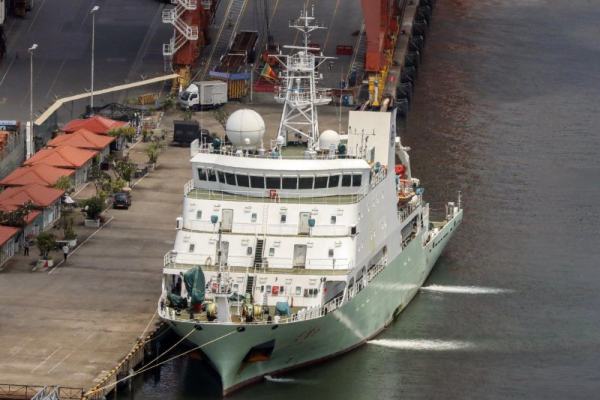
Even as Beijing campaigns to host the secretariat of the newly enacted High Seas Treaty, a Chinese deep-sea research vessel is once again raising questions about whether China’s actions match its rhetoric. File Photo by Chamila Karunarathne/EPA
China’s bid to position itself as a global ocean steward is entering a critical test — not in conference halls or treaty negotiations, but at sea.
Even as Beijing campaigns to host the secretariat of the newly enacted High Seas Treaty, a Chinese deep-sea research vessel is once again raising questions about whether China’s actions match its rhetoric. The Tan Suo Er Hao, one of China’s most advanced scientific platforms, appears to have conducted survey activity inside the Philippines’ exclusive economic zone (EEZ) in recent days without publicly confirmed consent — a move that cuts to the heart of competing narratives about science, sovereignty and trust.
The timing is striking. Since the High Seas Treaty, formally known as the Biodiversity Beyond National Jurisdiction (BBNJ) agreement, entered into force in January, China has stepped forward as a leading contender to host its secretariat. Officials and policy advisers have framed the bid as evidence of Beijing’s growing commitment to multilateral ocean governance, marine conservation and scientific cooperation.
Yet developments in the South China Sea and its approaches tell a more complicated story.
Open-source maritime tracking data show the research vessel Tan Suo Er Hao departed Sanya last month and sailed east toward the Philippine Rise, a resource-rich zone within the Philippines’ exclusive economic area. From March 21 to April 1, it operated along the margins before transiting the Luzon Strait and loitering about 50 nautical miles off the Batanes Islands.
As Beijing promoted its credentials as a responsible ocean steward at the United Nations, the vessel abruptly reversed course and is now returning to Sanya — a move that underscored the widening gap between diplomatic messaging and activity at sea.
Under the United Nations Convention on the Law of the Sea, coastal states exercise sovereign rights over marine scientific research in their EEZs. Article 246 is explicit: such research requires the “express consent” of the coastal state. While the provision is designed to facilitate cooperation rather than obstruct it, it also reflects a core principle — that scientific activity in national maritime zones cannot be divorced from questions of jurisdiction and trust.
This is where China’s dual-track approach becomes increasingly difficult to reconcile.
Beijing has invested heavily in ocean science. The Tan Suo Er Hao, operated by the Chinese Academy of Sciences’ Institute of Deep-Sea Science and Engineering, represents the cutting edge of that capability. Equipped with 13 onboard laboratories and paired with submersibles such as Fendouzhe and Shenhaiyongshi, it can probe the ocean’s deepest trenches, collect geological samples and map seabed resources with remarkable precision.
Chinese officials frequently highlight such capabilities as contributions to global knowledge — from understanding deep-sea ecosystems to advancing climate science. In multilateral forums, China has increasingly emphasized marine protected areas, biodiversity conservation and the concept of “ecological civilization” as pillars of its ocean policy.
On the other hand, these same capabilities carry strategic implications, particularly in contested or sensitive maritime spaces. Detailed seabed mapping, for instance, is not only valuable for scientific discovery but also for submarine navigation, undersea infrastructure planning and resource exploration. This dual-use character makes transparency and consent all the more essential.
For Southeast Asian states, including the Philippines, the issue is less about opposing scientific research than about ensuring it proceeds within agreed legal frameworks. Manila has previously objected to unauthorized surveys in its EEZ, viewing them as infringements on sovereign rights and potential precursors to broader strategic encroachment.
The concern is not hypothetical. Over the past decade, the South China Sea has seen an expansion of coast guard patrols, maritime militia activity and land reclamation — developments that have heightened sensitivity to any form of presence, even those framed as scientific.
Satellite analysis of Antelope Reef located in the western Paracel Islands shows rapid and renewed construction since January, with newly created land estimated between six and 15 kilometers, potentially making it China’s largest artificial island in the South China Sea. Strategically, these artificial islands have already enabled China to extend air, naval, and coast guard operations across the South China Sea. The reef lies along a key shipping lane that carries nearly one-third of global maritime trade.
Against this backdrop, China’s push to lead global ocean governance institutions faces an unavoidable question: can it separate its scientific ambitions from its geopolitical practices?
The High Seas Treaty itself is built on the premise of cooperation. It enables the creation of marine protected areas beyond national jurisdiction, establishes frameworks for sharing marine genetic resources and seeks to coordinate scientific research on a global scale. Its success depends not only on institutional design but also on trust among participating states.
Hosting the secretariat would place China at the center of that system — shaping agendas, facilitating research coordination and symbolically anchoring the treaty’s implementation. It would also offer Beijing an opportunity to demonstrate that its rise as a maritime power can align with collective stewardship.
But leadership in this domain is not conferred by capability alone. It is earned through adherence to rules, respect for partners and a willingness to operate transparently, especially in regions where mistrust runs deep.
Incidents such as the current voyage of the Tan Suo Er Hao risk undercutting that effort. Even if framed as routine scientific activity, operating within another state’s EEZ without clear consent sends a conflicting signal — one that reinforces perceptions of unilateralism rather than cooperation.
For China, the path forward is not closed. In fact, it is clearly defined.
Establishing joint research corridors, inviting regional scientists aboard survey missions and formalizing data-sharing agreements could transform scientific expeditions into platforms for confidence-building. Models exist elsewhere: the Mediterranean Action Plan and Arctic scientific cooperation frameworks have shown how shared environmental challenges can create space for collaboration even among geopolitical rivals.
The South China Sea, with its stressed fisheries, degraded coral reefs and mounting climate pressures, presents a compelling case for similar approaches. Marine science, if conducted transparently and collaboratively, could serve as a rare area of common ground.
But that requires consistency between words and actions.
As the High Seas Treaty moves from negotiation to implementation, the stakes are rising. The question is no longer whether China can lead in ocean science — it clearly can. The question is whether it is prepared to lead in a way that builds trust rather than erodes it.
For now, the answer may lie not in Beijing’s policy statements, but in the wake of a research vessel operating far from home — and well within someone else’s waters.
James Borton is a non-resident senior fellow at Johns Hopkins SAIS Foreign Policy Institute and the author of Harvesting the Waves: How Blue Parks Shape Policy, Politics, and Peacebuilding in the South China Sea. Borton is the Editor-in-Chief of the South China Sea NewsWire. This article is republished from the South China Sea NewsWire. Read the original article. The views and opinions expressed in this commentary are solely those of the author.
