



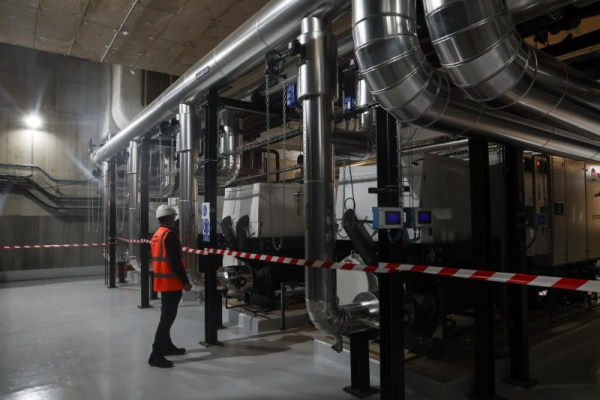
A worker stands inside the geothermal energy plant in Saint Denis, France, in 2023. File Photo by Mohammed Badra/EPA
When the World Bank approved a $150 million loan to El Salvador in March 2025 to expand geothermal electricity production, it was investing in more than a single country’s power grid. It was validating a broader regional proposition: Central America holds one of the world’s most overlooked clean energy advantages, and much of the infrastructure needed to capitalize on it already exists.
A resource barely tapped
Central America sits atop one of the most geothermally active corridors on earth. The volcanic arc running from Guatemala to Panama includes 75 active and dormant volcanoes, more than 1,300 thermal water sources, and an estimated 3,000 to 5,000 megawatts of viable geothermal potential, according to the Central American Integration System (SICA). Yet only around 650 megawatts are currently in operation.
The gap is not geological. It is political, financial, and institutional.
El Salvador demonstrates what is possible. Geothermal energy accounts for approximately 21 percent of the country’s net electricity supply, ranking it among the world’s leaders in geothermal use. State-owned operator LaGeo manages two producing fields, with additional sites under development. The March 2025 World Bank financing will fund a new 25-megawatt plant at the Chinameca field, along with exploratory drilling that could unlock up to 40 additional megawatts from domestic, carbon-free heat.
Why geothermal matters now
The disruption of European gas supplies following Russia’s invasion of Ukraine, compounded by supply chain fragility across critical minerals and fossil fuels, has placed a premium on domestic, dispatchable energy. Not all renewables fill that role equally.
Solar and wind are vital but intermittent, dependent on weather conditions that cannot be scheduled. Hydropower, long the backbone of Central American electricity, is increasingly exposed to climate variability. Prolonged droughts and altered precipitation patterns have already produced shortfalls in countries that once relied on steady river flows.
Geothermal avoids many of those vulnerabilities. It typically runs at full output more than 90 percent of the time and so can generate electricity around the clock, regardless of season or weather. In the vocabulary of grid planning, it is “firm” power, the kind that helps hold a system together when variable sources cannot.
A grid already built for integration
Central America has a structural advantage most regions take decades to achieve: a fully operational regional electricity market backed by shared physical infrastructure.
Through the Central American Electrical Interconnection System (SIEPAC), six countries are linked by approximately 1,800 kilometers of high-voltage transmission lines running the length of the isthmus. The system, supported by the Inter-American Development Bank and finalized in 2014, enables electricity to move across borders as routine commerce. In 2022, SIEPAC facilitated more than 3,000 gigawatt-hours of cross-border electricity trade, according to the Energy for Growth Hub.
The grid does not ask where the electricity was generated. A drought affecting hydropower in one country can be balanced by geothermal or wind from another. SIEPAC is also the first regional electricity market of its kind in Latin America, built around shared rules, a regional regulator, and a dedicated operating entity. Plans are underway to extend its interconnections northward to Mexico and southward to Colombia.
The case for scaling geothermal regionally
The combination of geothermal reliability and SIEPAC’s reach points to an opportunity the region has not yet fully seized. Expanded geothermal generation, fed into a grid already equipped to distribute it, would help stabilize solar and wind as those sources grow. It would also reduce dependence on imported diesel and fuel oil, whose costs are set by markets beyond any Central American government’s control.
For the region’s growing manufacturing and nearshoring sectors, reliable clean power is part of the competitiveness equation.
There is also a local dimension. The World Bank’s El Salvador project will use geothermal heat directly for agricultural processing, drying and preserving foods in communities near the Chinameca field. Geothermal is among the few energy sources that can support economic activity near the production site, not just in distant industrial centers.
The barrier that remains
Exploratory drilling can cost $20 million to $30 million per well, with no guarantee of finding a viable resource. Private capital rarely enters at that stage without risk mitigation. The result is that countries with clear geothermal potential have left it largely undeveloped, while fossil fuel options filled the gap.
Risk-sharing mechanisms exist. Germany’s KfW development bank has supported geothermal exploration in the region through contingency financing structures. The Inter-American Development Bank, World Bank, and Japan International Cooperation Agency have also provided concessional financing for geothermal projects in Central America and beyond. What has been missing is not the tools, but the scale and political will to deploy them regionally rather than country by country.
SICA’s energy coordination unit is working to harmonize regulatory frameworks for geothermal development across member states, and Germany’s GIZ is supporting direct-use geothermal applications in industry. These are steps. They are not yet a strategy.
What a strategy would look like
Central America already holds the natural resources, transmission infrastructure, and institutional framework for regional energy governance. What it still requires is alignment: a deliberate decision by governments, development lenders, and regional bodies to treat expanded geothermal generation as a shared priority rather than a project-by-project national exercise.
That means risk-sharing mechanisms for early-stage exploration funded at a regional scale, regulatory harmonization that enables cross-border geothermal trade over SIEPAC, and political recognition that energy independence is not merely a sector objective. It is a foundation of economic sovereignty.
The World Bank’s March 2025 commitment to El Salvador is an encouraging signal. Whether it catalyzes a regional approach or remains an isolated national project will help determine whether Central America captures its geological inheritance or continues to leave it underground.
Olinda Salguero is a Guatemalan leader in regional integration and peacebuilding in Latin America. She served for five years as Chief of Staff to the Secretary-General of the Central American Integration System (SICA) and is the President of the Esquipulas Foundation for Peace, Democracy, Development and Integration. Forbes has recognized her three times as one of the most influential women in Central America. The views and opinions expressed here are solely those of the author.
