



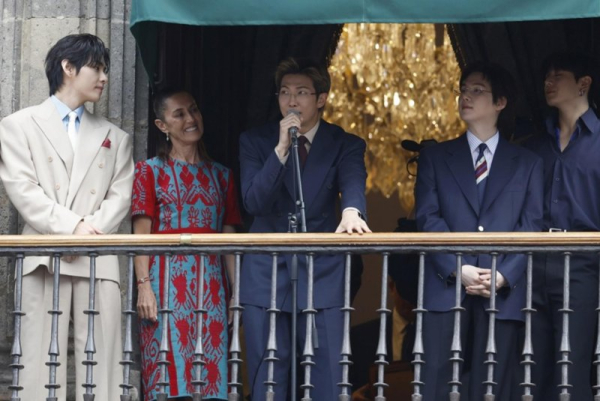
Mexican President Claudia Sheinbaum (2-L) reacts alongside members of the South Korean K-pop group BTS during a visit to the National Palace in Mexico City on May 6. Photo by Sashenka Gutierrez/EPA
On May 20th, as BTS conducted the American leg of its world tour, the U.S. Senate Foreign Relations Committee was holding a confirmation hearing for Michelle Park Steel, the nominee for U.S. Ambassador to South Korea. With sensitive bilateral issues and North Korea policy on the agenda, the atmosphere was tense.
Then Senator Bill Hagerty — widely regarded as one of President Trump’s closest congressional allies — turned to the nominee and mentioned that his daughters were looking forward to attending a BTS concert. American media reported that laughter broke out in the hearing room.
Why would the daughters of one of America’s most prominent politicians want to attend a BTS concert? They were surely not hoping to obtain tickets through the soon-to-be ambassador to Seoul. Yet in Hagerty’s offhand remark, one could sense something genuine: the pull that BTS exerts not on his generation, but on his daughters’. What is it they are seeking?
The answer came, unexpectedly, from Mexican President Claudia Sheinbaum. Standing before the Mexican ARMY — BTS’s fan club — assembled in front of the National Palace, she took the microphone and offered her reading of the phenomenon. “Friendship and peace, love, and a humanistic message of beauty,” she said, “have captivated the younger generation.”
The day before the concert, Sheinbaum had invited BTS to the palace for those who could not secure tickets, opening a side balcony normally closed to the public and personally introducing the members to the crowd below. The announcement promised nothing more than a brief appearance — yet fifty thousand young people rushed to be there.
Mexican television crews could barely contain their astonishment, calling it “a global phenomenon unfolding live.” Cameras captured fans in the Zócalo saying, “I nearly died getting here,” and “Just seeing BTS from a distance leaves me speechless.”
One broadcaster showed a fan holding a sign in Korean that read: You saved my life. That energy transformed the concerts into something beyond performance — a national festival surpassing, by one commentator’s account, even a World Cup match. The fervor extended beyond the venue; crowds without tickets gathered outside, surrendering themselves to the music.
This was no isolated spectacle. Of the thirty-four cities on this year’s world tour, only seven have hosted concerts so far — yet the same intensity has greeted BTS at every stop. Merchandise lines stretched a full kilometer. Food the members were seen eating spread by word of mouth and boosted local economies.
El Paso, a border city touring acts rarely visit, declared a “BTS Weekend” and imposed traffic controls days before the show. The same scenes played out in Tampa. When Suga entered San Francisco’s Bay to Breakers race on the morning of the group’s second Stanford show — registering as Min Yunki and completing the 12-kilometer course among thirty thousand runners before taking the stage that evening — commentators marveled that race, nationality, and gender had dissolved; music had made them one.
What is the longing within today’s young generation that finds its answer in BTS? The lyrics offer a key.
Consider “So What,” released in 2018:
Somebody call me right one / Somebody call me wrong — I don’t care. What about you? / So what? Let go. / Hidden in that sigh are so many worries / Stop overthinking – you already know it all / At the midpoint of this road, in the moment you want to give up / Shout louder: So what, what, what?
Or the album opener from their fifth studio album, released this year — “Body to Body” — which has drawn fans into a mass sing-along of “Arirang,” the ancient Korean folk song, at every concert stop:
Guns, knives, keyboards — put all that away / Life is short, ditch the hate / It’s bigger in real life / Why get hung on saving face, drop it / Hop in / Come a little closer, skin to skin / Arirang, arirang, arariyo / Crossing over Arirang Pass / The one who left me behind / Will not make it ten li before their feet give out.
Here one can sense what young people are reaching for. It is precisely what President Sheinbaum named: peace, friendship, love, and the beauty of the human. Because that longing already lives within them, fans in the Tokyo Dome could sing a Korean folk song without hesitation.
The history of colonizer and colonized does not exist in the grammar of the world’s young generation. What does exist is loneliness with nowhere to settle, and the need to be comforted. BTS’s music offers that comfort. The young people of this world are one another’s companions; BTS’s music is the thread connecting them.
One might object that this is simply the nature of pop fandom — that mass enthusiasm proves nothing beyond commercial appeal. The objection deserves a direct answer. What distinguishes BTS from ordinary celebrity culture is not the scale of the crowds but their behavior.
Fans without tickets stand outside for hours not to glimpse a star, but to be near the music. A president opens a palace balcony because she reads genuine social meaning in the gathering. A Japanese audience sings a Korean folk song freighted with colonial memory, without discomfort, because that history does not define the encounter for them.
These are not consumers pursuing entertainment. They are people seeking what they cannot find elsewhere: a shared language of consolation in a world of anxiety, instability, and conflict. BTS did not manufacture that longing. They simply had the lyrical honesty to name it — and the world’s young responded.
The older generation owes them something. Instead of indulging in war games and money feasts, it must build a world of peace and consolation — filled not with fear, but with the humanistic beauty that young people are already reaching for.
In their passion for BTS, the youth of the world are shouting exactly that message at the adults in the room. Is this not the new order that the daughters of a U.S. Senate Foreign Relations Committee member — and ARMY fans the world over — are trying to build through BTS?
Nohsok Choi is the former chief editor of the Kyunghyang Shinmun and former Paris correspondent. He currently serves as president of the Kyunghyang Shinmun Alumni Association, President of the Korean Media & Culture Forum, and CEO of the YouTube channel One World TV. The views expressed in this commentary are his own.
