



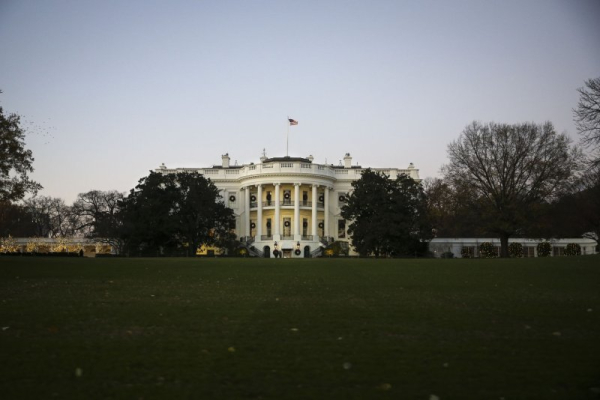
The South Lawn of the White House is seen as President Donald Trump and first lady Melania Trump participate in the 2018 National Christmas Tree lighting ceremony at the Ellipse near the White House in Washington, DC on November 28, 2018. Photo by Oliver Contreras/UPI | License Photo
On July 4, the United States will commemorate 250 years since the Continental Congress adopted the Declaration of Independence in Philadelphia.
The declaration announced a revolutionary principle: human beings possess rights that do not come from government. Political authority is legitimate only when it protects those rights and rests on the consent of the governed.
The American Revolution influenced Latin America’s independence leaders, although not as uniformly as the French Revolution or the ideas of European Enlightenment thinkers such as Jean-Jacques Rousseau. Some admired the constitutional order created in the United States. Others doubted that it could be reproduced in societies with different histories and political conditions. The great liberators were aware of the American experience, but they interpreted its lessons in distinct ways.
The Spanish American wars of independence lasted roughly from 1809 to 1824, more than three decades after the United States declared its independence. By then, Latin American leaders could study the U.S. Declaration of Independence and Constitution. Their challenge, however, was different.
The United States emerged from 13 colonies with experience in elected assemblies and local government. Spanish America inherited a more centralized colonial system. Its territories were separated by vast distances, and its independence wars were exceptionally destructive. These conditions help explain why admiration for the American Revolution did not always lead Latin American leaders to embrace the U.S. constitutional model.
Francisco de Miranda, born in Caracas in 1750, occupied a unique place in the revolutionary history of the Americas. As an officer in the Spanish army, he fought in the 1781 Siege of Pensacola and later met George Washington, Alexander Hamilton and Thomas Jefferson. He also participated in the French Revolution, rising to the rank of general, and was nearly executed during the Jacobin Terror.
That experience revealed an essential difference between the two revolutions. A republic could proclaim liberty, yet still descend into violence when political power ceased to recognize legal limits. Miranda drew a clear conclusion: he admired representative government, freedom of the press, religious liberty and an independent judiciary.
Simón Bolívar had a more ambivalent view of the United States. In his 1819 Address at Angostura, he acknowledged the success of the U.S. constitutional system, yet rejected the idea that it could simply be copied in Spanish America.
Laws and institutions, he argued, had to correspond to the conditions of each society. Geography, customs and political experience all mattered. Bolívar feared that a weak federal government would be unable to hold together territories already divided by war and regional rivalries.
His concerns were not unfounded. The independence struggle had weakened institutions throughout Spanish America. Military commanders exercised enormous power, while conflicts among provinces made national unity difficult.
Bolívar’s search for stability gradually led him toward centralized authority, exposing a contradiction in his legacy. He liberated nations from Spanish rule, but grew increasingly doubtful that political liberty could survive without a strong executive.
Near the end of his life, his skepticism extended to the United States itself. In a 1829 letter to British diplomat Patrick Campbell, he warned that the United States appeared destined to bring misery to the Americas in the name of liberty. His statement reflected a growing fear that the new power in the north might eventually dominate the republics to the south.
Manuel Belgrano, one of the principal leaders of Argentine independence, was among the strongest Latin American admirers of George Washington. He regarded Washington as a model of public morality and was especially impressed that the victorious general did not convert military success into permanent personal rule.
Belgrano translated Washington’s Farewell Address into Spanish and published it in Buenos Aires, urging his government and fellow citizens to read and study it.
For Belgrano, Washington’s greatest contribution was not defeating a colonial power. It was demonstrating that a national leader could willingly give up authority — an example especially meaningful in Latin America, where the wars of independence elevated military commanders who sometimes found it difficult to return power to civilian institutions.
José Gervasio Artigas, Uruguay’s national hero, was perhaps the Latin American independence leader whose political program most closely resembled the federal and republican principles of the United States.
The Instructions of the Year XIII, given to delegates representing the Eastern Province at the 1813 assembly in Buenos Aires, called for independence and a confederation among the provinces, defended civil and religious liberty, and demanded a separation of governmental powers.
Artigas did not want Spanish officials replaced by a new centralized elite based in Buenos Aires. He believed the provinces should retain substantial autonomy within a common political association. His federal project was defeated, and he spent the final decades of his life in exile in Paraguay. Even so, his ideas became a lasting part of Uruguay’s political traditions.
The American founding contained profound contradictions. A declaration proclaiming equality and natural rights coexisted with slavery. Indigenous peoples remained outside the political community, and women were denied participation in public life. Yet those principles eventually provided powerful arguments for challenging slavery and expanding civil rights.
Latin America’s independence movements contained their own contradictions. They ended Spanish rule, but independence did not automatically create stable republics.
Colonial inequality survived, regional conflicts continued, and military leaders frequently dominated political life. The new republics began under different institutional and social conditions, and suffered long wars that devastated their economies and weakened public authority.
Miranda valued liberty under law. Belgrano admired Washington’s republican virtue. Artigas defended federalism against centralization. Bolívar, confronting disorder, struggled with the tension between freedom and authority.
Their experiences demonstrate that declaring independence is easier than building a republic. Constitutions alone cannot restrain power; they must be supported by citizens and leaders who respect their limits.
Two hundred fifty years after the Declaration of Independence, that lesson belongs to the entire hemisphere.
Osvaldo Silva Serqueira is a Chilean journalist and communications specialist who serves as director of Legacy of the Americas, a hemispheric initiative promoting civic and ethical renewal. He holds a master’s degree in neuromarketing from the University of La Frontera and a master’s degree in psychology from Universidad Isabel I in Spain. The views expressed are solely those of the author.
