

From Stockholm’s sound to strategic steel.


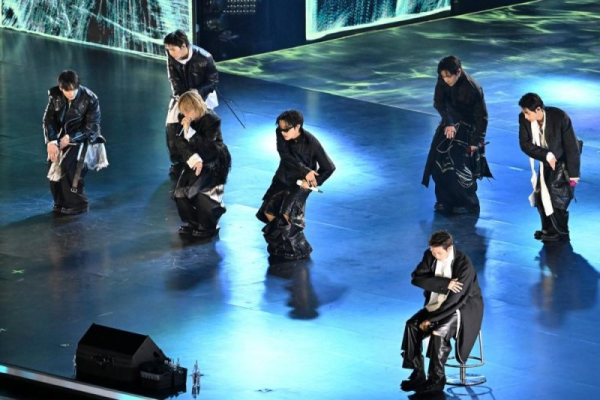
One of the defining features of K-pop production is speed. Songs are written, tested, refined and released in cycles that would be unthinkable in traditional Western music industries. Modern conflict operates on similar timelines. Photo by Yonhap/EPA/Pool
In Stockholm, creativity travels quietly. You will not see crowds gathering outside anonymous studios, yet inside them, Swedish songwriters have helped shape one of the most globally dominant cultural phenomena of the 21st century: K-pop.
The faces are Korean, the language is Korean, but much of the melodic architecture, the hooks, the rhythm, the structure, originates in Sweden.
That same model of specialization, trust and integration offers a useful analogy for how South Korea, Sweden, NATO and the United States should think about defense cooperation in an era defined not by mass, but by complexity.
Swedish songwriters did not succeed in K-pop by replacing Korean artists. They succeeded by doing what they do best: constructing melodies that transcend language. Korean agencies, in turn, layered identity, performance and narrative.
The defense industrial base faces a similar challenge. No single nation, not even the United States, can dominate every domain of modern warfare. The systems are too complex, the supply chains too fragile and the timelines too compressed.
South Korea has emerged as a global leader in rapid, scalable defense manufacturing. Sweden, anchored by firms like Saab, excels in advanced systems design, survivability and integration under austere conditions.
The United States remains unmatched in global command, control, intelligence and power projection. Individually, each is strong but together, they can be decisive. The lesson from Stockholm is straightforward: Success comes not from duplication, but from specialization combined with seamless integration.
K-pop’s global success did not emerge from isolated effort. It was built through songwriting camps, structured environments where Swedish composers and Korean producers worked side by side, rapidly iterating and refining output.
Collaboration is often limited to procurement or licensing agreements. These are transactional. They do not produce shared understanding, nor do they generate innovation at speed. A more effective approach would mirror the songwriting camp model: sustained, co-located collaboration between engineers, operators and strategists.
Imagine joint development environments in which Korean production engineers, Swedish systems designers and American operational planners work together from concept to deployment — not as vendors, but as partners.
This is not theoretical. NATO’s increasing emphasis on interoperability and collective capability development already points in this direction. Sweden’s accession to NATO creates new opportunities to formalize such collaboration, while South Korea, though not a member, remains one of NATO’s most capable and aligned partners in the Indo-Pacific.
One of the defining features of K-pop production is speed. Songs are written, tested, refined and released in cycles that would be unthinkable in traditional Western music industries. Modern conflict operates on similar timelines.
The war in Ukraine has exposed a fundamental truth: Industrial capacity, not just technological superiority, determines sustainability in war. Ammunition, spare parts and replacement systems are consumed at rates that far exceed peacetime assumptions.
South Korea understands this reality. Its defense industry is built for scale and speed. Sweden understands another dimension: how to design systems that are resilient, adaptable and survivable under pressure.
The United States brings the ability to integrate these capabilities into a global operational framework. Individually, these strengths are significant. Combined, they offer something more valuable: strategic agility.
The Swedish-K-pop partnership works because of trust. Swedish composers trust that their work will be respected and properly credited. Korean producers trust the quality and consistency of Swedish output.
Defense cooperation requires a deeper level of trust — one that extends into sensitive technologies, operational concepts and national security priorities. This is where the analogy becomes harder, but also more important. Trust cannot be improvised during crisis. It must be built deliberately, over time, through transparency, shared standards and repeated collaboration.
The United States plays a central role here. Its alliance network provides the backbone for trust-based cooperation. However, that system is under strain. Partners are increasingly expected to contribute more, produce more and assume greater responsibility for regional security.
This is not a weakness. It is an adjustment to reality. For South Korea and Sweden, the opportunity lies in aligning more closely, not just with the United States, but with each other, within this evolving framework.
It is easy to dismiss the connection between pop music and defense cooperation as superficial. One is entertainment; the other is existential. But both operate under the same fundamental constraint: complexity. Success in complex systems depends on the ability to integrate diverse capabilities into a coherent whole. In music, that produces global hits. In defense, it produces deterrence.
The Swedish contribution to K-pop is largely invisible to the public. Yet, without it, the final product would be fundamentally different.
The same may soon be true for defense. Future military capability will not be defined by where a system is built, but by how effectively it integrates components, technologies and concepts from multiple partners. National identity will remain visible on the surface. Underneath, the architecture will be multinational.
If there is a single lesson from Stockholm, it is that proximity matters. Ideas move faster when people work together in the same space. For defense cooperation, this suggests a clear path: Establish joint development hubs linking South Korean industry, Swedish innovation centers and U.S. operational commands
Expand trilateral exercises beyond military units to include engineers and defense industrial planners, and most of all, prioritize interoperability at the design stage, not as an afterthought. These are practical steps. But they reflect a shift in mindset, from cooperation as coordination to cooperation as integration.
In a quiet studio in Stockholm, a melody is written. Months later, it is performed on a global stage by Korean artists, consumed by millions and embedded in cultures far from its origin. No single country owns the result. Yet, each plays an essential role. Defense cooperation in the 21st century should follow a similar pattern.
The question is not whether nations will work together. That is already happening. The question is whether they will do so with the level of precision, trust and integration that defines success in other complex systems. Stockholm already has provided one answer. It is time to apply it where it matters most.
Republic of Korea Lt. Gen. (Ret.) In-Bum Chun served 38 years in the South Korean Army and retired in 2016. He commanded combat units from platoon to the division level, and his final position was commanding general of ROK Special Warfare Command. He served in Iraq and Afghanistan. He is president of the Korea-U.S. Alliance Foundation (Army Chapter), a senior fellow with the Association of the United States Army. a distinguished military fellow with the Institute for Security & Development Policy (Sweden) and an adjunct researcher with Waseda University. Chun advises many organizations, including the National Institute for Strategic Studies, National Bureau of Asian Research, Korean Counterterrorism Center and the city of Seognam, and is an active YouTuber in Korea. He also advocates for animal rights.
