

A meditation for the changing of the year.

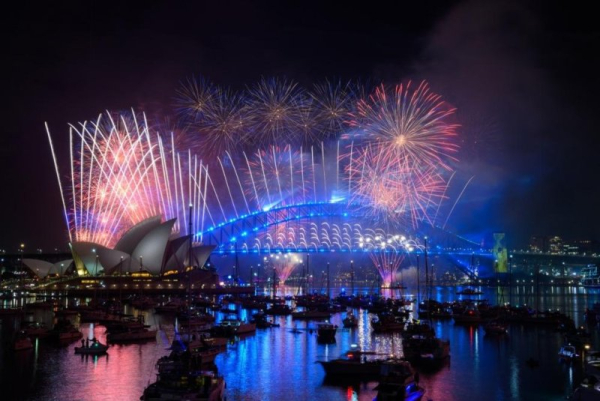
Fireworks are seen over Sydney Harbour during the New Year’s Eve midnight display at Mrs Macquaries Point in Sydney on Thursday. From a Paschal perspective, New Year’s Eve, carries deep symbolic meaning. Photo by Dan Humbrechts/EPA
At the end of the year, celebrations of different meanings overlap and intertwine in what are often called the “Paschal festivities.”
The concept of Pascha predates modern religions and worldviews, emerging from humanity’s earliest awareness of the cycles and transformations of nature and the cosmos. Long before formal belief systems, it expressed a shared human consciousness of change.
The word Pascha comes from the Latin Pascha, itself derived from the Hebrew Pesach. Its original, primordial meaning is “passage.”
At its core lies the idea of transition: a change in natural cycles, a shift in spiritual state, or a transformation in cultural trajectory. It is a duality deeply rooted in human history, with death giving way to birth, darkness yielding to light, cold to warmth, and the sun’s descent followed by its renewed rising.
In historical time, this idea of passage became central to religious traditions. Judaism adopted it in remembrance of the Exodus from Egypt, while Christianity later reinterpreted it to symbolize Christ’s passage from death to resurrection.
Christmas, by contrast, emphasizes birth and hope and marks the beginning of a new era. Christian tradition holds that Jesus was born on the night of Dec. 24, celebrated as Christmas Eve, with Christmas Day observed on Dec. 25.
From a Paschal perspective, Dec. 31, or New Year’s Eve, also carries deep symbolic meaning. It reflects the cyclical nature of the cosmos, expressed today through a universal calendar and social custom. It marks the end of one cycle and the beginning of another, the closing of a cosmic year and the opening of a new natural rhythm. It is a moment of initiation, a time for reflection, gratitude, forgiveness and hope.
Across cultures, the end of the calendar year is celebrated with gatherings, rituals and traditions that express renewal and expectation. Welcoming the new year carries a festive spirit, filled with promises of change and confidence in what lies ahead.
For this reason, we wish one another a “Happy Pascha,” a joyful closing of one cycle and the opening of another, whether cosmic, familial, spiritual or cultural. May hope and fraternity guide our desires, aspirations and actions. May the Christic Spirit, a spirit of love and elevated consciousness, take form within each of us. Blessings to you and to those you hold dear.
Carlos Cantero is a Chilean geographer who holds a master’s degree and a doctorate in sociology. He is an academic at the International University of La Rioja, Spain. An international lecturer, adviser and consultant, his work focuses on adaptability to the digital society, ethics, social innovation and human development.
