


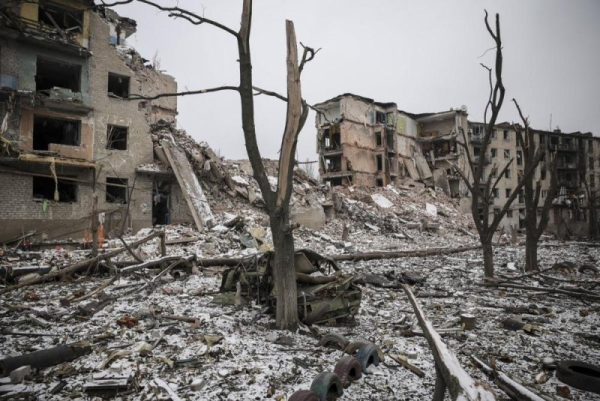
Destruction is shown in Kostyantynivka town in the Donetsk region on Wednesday amid the ongoing Russian invasion. Photo by Mechanized Brigade Service/EPA
To his credit, President Donald Trump is very serious about ending the war in Ukraine. He has pushed diplomacy to its limits.
However, the best of intentions do not always bring success. In Ukraine, two seemingly immovable objects are blocking any peace agreement.
One is Russian President Vladimir Putin. The other is Ukrainian President Volodymyr Zelensky. Putin cannot back down and believes that it is in the best interests of the Trump administration to place Russia at a higher priority than Ukraine for the long term. In terms of realpolitik, Putin is correct.
If Trump can improve relations with Russia, as well as shift the burden of European defense to Europe, would that not be a win-win? The flaw, however, is that no one in Europe trusts Putin. And frankly, without substantial U.S. presence, there would be no NATO. That reason is clear.
No united states of Europe exists today. Nor will one exist in the future. And a pillar of Europe — the United Kingdom — is no longer in the European Union. Hence, this combined Putin-Trump vision is a mirage.
Zelensky is trapped in that the Ukrainian people, having given up Crimea, are in no mood to let go of land in the east to Russia. Nor do a vast majority of Ukrainians trust Putin. Most believe that at some future date, after the Russian army recovers from its stunning losses — and if Putin is still alive and in charge — the rest of Ukraine will be fair game.
After the latest talks in Berlin, Zelensky seems resigned to forgo NATO membership if a deal can be struck. In return, Zelensky needs a firm, ironclad commitment from the United States to guarantee Ukrainian sovereignty. Ukraine is well aware of the failed 1994 Budapest Memorandum that assured Ukraine’s borders and of the Minsk Agreements, as well.
From Zelensky’s view, as Trump will leave office in 2029, the only satisfactory arrangement will be a mutual defense treaty with the United States that, unlike NATO’s Article 5 that “an attack and one shall be considered as attack on all,” does more than only “considers” it an attack on all. But will Congress or the White House be prepared to make that commitment? Probably not.
Similarly, since NATO membership is off the table, will a coalition of the willing of NATO and European Union states give ironclad guarantees that another Russian attack or invasion will be met by force? That, too, is unlikely. So where does that leave Ukraine?
The answer is that Ukraine is very vulnerable. One reason why is that Steve Witkoff and Jared Kushner are the negotiators. One wonders why the Secretary of State Mario Rubio is a bit player. The could be because a lack of experience plays to carrying out the Trump vision.
It would be hard to imagine that a secretary of state, such as Henry Kissinger, would allow such critical negotiations to be carried out by diplomatic novices, no matter how much confidence the president places in them.
Thus, barring some extraordinary event, it would seem Ukraine’s fate is sealed. Of course, if the administration did want to impose, from Ukraine’s perspective, a more fair peace, it could do so. Three actions would be needed.
The first is to transfer Tomahawk cruise missiles and launchers to Ukraine. These have the range and accuracy to hit vital targets deep in Russia. As this step would be very escalatory, the narrative would be that Ukraine could not use these weapons if negotiations were successful — obvious pressure on Putin.
Second, Russian assets held abroad could be confiscated. So far, huge opposition has existed, citing what this precedent could mean in future circumstances. However, this too, would put further pressure on Putin to negotiate.
Third, the president could sign the sanctions bill approved by a large majority of members of Congress. Trump could withhold executing the law if Putin did agree to a peace arrangement.
The most likely compromise is to hold an in-place cease-fire with long term negotiations to work out a solution. Ukraine’s army would be capped at a number sufficient to make Russian aggression less likely. And Europe would agree to supply arms and aid for Ukraine to rebuild its military and its shattered country.
Putin would not like this. But the threat of Tomahawks, confiscation of assets and sanctions might be sufficient to change his mind. And he could still have a de facto agreement with Trump to improve relations.
But don’t bet on any of that. It may take even greater sacrifices by Ukrainians to convince Putin that the war is unwinnable. And that may prove to be a Pyrrhic victory.
Harlan Ullman is UPI’s Arnaud de Borchgrave Distinguished Columnist, senior adviser at Washington’s Atlantic Council, chairman of a private company and principal author of the doctrine of shock and awe. His next book, co-written with Field Marshal The Lord David Richards, former U.K. chief of defense and due out next year, is Who Thinks Best Wins: Preventing Strategic Catastrophe. The writer can be reached on X @harlankullman.
