



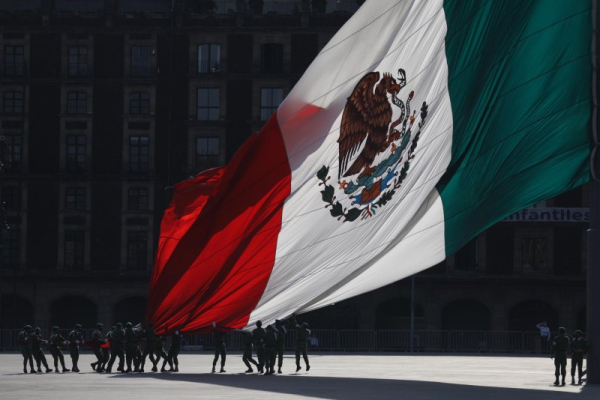
Mexico recently moved to postpone its next judicial elections from 2027 to 2028 and revise the rules governing candidate selection. File Photo by Sashenka Gutierrez/EPA
Mexico recently moved to postpone its next judicial elections from 2027 to 2028 and revise the rules governing candidate selection. Critics say the changes could deepen the ruling party’s influence over the courts.
The controversy comes one year after Mexico began electing judges by popular vote, an unprecedented system that reflects the uneven development of democratic institutions across Latin America.
Since the encounter between Europe and the Americas began transforming the region in 1492, the region has moved uneasily between civilization and barbarism: producing cultural achievements admired the world over, from Mayan stelae to the kinetic art of Julio Le Parc and Carlos Cruz-Diez, while also refining methods of authoritarian control drawn from the Soviet Union and East Germany.
A region built on rents
For centuries, much of Latin America has relied on extracting rents rather than creating new wealth, a model that genuine competition threatens since it reduces the privileges of those who benefit from protected markets and political access.
A few countries have built more inclusive economies around the growth of the middle class: Chile, Uruguay and Costa Rica stand out, and Argentina did so during parts of its past. Elsewhere, public spending and elite consumption still drive economic activity, and informality remains widespread.
According to the International Labor Organization, informal employment across Latin America and the Caribbean stood at 46.7% in the first half of 2025, meaning nearly one worker in two operates outside the formal economy and its protections.
That burden falls especially heavily on Indigenous communities and other historically excluded groups. It is not only a social injustice; it also weakens the institutional foundations modern economies and liberal democracy require.
Many countries in the region have held elections without establishing full democracy. School enrollment has expanded, but educational quality often remains poor, and health systems exist on paper while failing to deliver reliable public care. Liberal democracy requires more than voting: it depends on a real separation of powers, an active civil society and justice applied equally.
Informality weakens democracy
The relationship between informality and democracy is direct. The larger the informal economy, the harder it becomes to sustain institutions governed by stable rules. Workers and businesses outside the formal economy contribute less regularly to the tax system, limiting the state’s capacity to provide public goods.
When services are weak, citizens become more dependent on patronage networks or leaders who promise personal protection. The result is a vicious cycle: informality weakens institutions, and weak institutions encourage a more personalized politics that allows informality to persist.
That pattern is beginning to face resistance. New political movements are trying to return initiative to civil society and build republican institutions capable of supporting economic progress. This does not mean the region is moving in one direction; democratic advances remain uneven and reversible. But the coming decades may still produce stronger liberal democracies beyond the region’s familiar examples.
Signs of change
Brazil’s federal structure and the autonomy of its state governments provide important counterweights to centralized power. Its Supreme Court has also taken an increasingly assertive role: in September, it convicted former President Jair Bolsonaro of orchestrating a plot to overturn his 2022 election defeat, sentencing him to more than 27 years in prison, a verdict that remains politically contested.
In Paraguay, democracy has advanced gradually since Gen. Andres Rodriguez overthrew Alfredo Stroessner’s long dictatorship in 1989. Panama has combined sustained economic growth with the expansion of its middle class, and while it still faces serious governance problems, its democratic institutions have continued to develop.
Civil society has shown resilience under far more difficult conditions in Venezuela, where Maria Corina Machado became the leading symbol of resistance to Nicolas Maduro’s authoritarian rule, challenging it from hiding for more than a year before winning the Nobel Peace Prize in October.
Her movement demonstrated that civic opposition can survive even when repression closes most formal political channels. That demonstration was tested in January, when U.S. forces captured Maduro in a raid on Caracas and flew him to New York to face narco-terrorism charges, leaving Vice President Delcy Rodriguez as interim president under what Washington calls a managed transition.
Machado has since announced plans to run for president and return to Venezuela by year’s end. Whatever shape the transition takes, Venezuela’s experience shows authoritarian systems are not immune to sustained public pressure.
Chile offers a different example. Its repeated constitutional debates have been divisive and inconclusive, but fundamental questions about representation and institutional legitimacy have remained in the public arena rather than being settled through authoritarian rule.
Mexico moves in the opposite direction
Latin America’s transformation also faces forces that seek to halt institutional progress, and Mexico offers the clearest example. The governments of Carlos Salinas de Gortari and Ernesto Zedillo opened the economy and advanced political liberalization, despite serious shortcomings of their own.
Andres Manuel Lopez Obrador began reversing that evolution with a 2024 constitutional overhaul that set in motion the gradual replacement of thousands of judges through popular elections, and the process has continued under President Claudia Sheinbaum.
Supporters say the reforms will make the judiciary more democratic and accountable. Critics, including judges’ associations, argue the new system weakens professional standards and gives the ruling Morena party greater influence over the courts, concerns the latest proposed changes have not resolved.
Mexico’s weak economic growth makes the institutional problem more serious: the country has gained enormous opportunities through trade with the United States and Canada, yet performance has remained disappointing.
Organized crime presents an even greater danger. Criminal groups extract vast rents from illicit activity, and weak institutions have let them penetrate local politics, law enforcement and the courts.
Mexico’s direction matters far beyond its borders, given its size and influence, and if it continues weakening institutional checks, regional progress may slow. A broader transformation is far from assured.
Latin America still contains powerful interests that benefit from privilege and informality, and weak government allows both to endure. Yet citizens across much of the continent are demanding accountable institutions and greater opportunity, a pressure visible in elections and civic movements throughout the region. Mexico may follow a different timetable, but it cannot remain isolated from the same forces for change.
Beatrice Rangel is the Managing Director for AMLA Consulting, responsible for negotiating and implementing corporate investment strategies and acquisitions in Latin America and the Caribbean. She is also a former Executive Fellow with the University of Pennsylvania’s Wharton School and holds an MA in Development Economics from Boston University and an MPA from Harvard’s Kennedy School of Government.
