



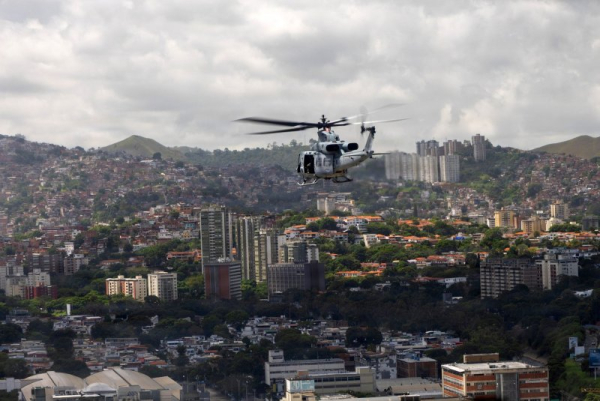
The CSIS published an analysis in the spring asking: Could Russia and China coordinate to challenge U.S. influence in Latin America and the Caribbean? Photo via U.S. Marine Corps/UPI | License Photo
This spring, the Center for Strategic and International Studies published an analysis asking a question that would have sounded strange a decade ago: Could Russia and China coordinate to challenge U.S. influence in Latin America and the Caribbean?
The report drew on a tabletop exercise based on a hypothetical Venezuela crisis and concluded that Moscow and Beijing pursue very different playbooks in the region, even when their interests overlap.
That kind of analysis belongs to a vocabulary many Latin American intellectuals were never taught. For much of the 20th century, the region’s political economists were trained to read international trade through the language of imperialism.
The argument was powerful and simple: capitalist economies, driven by their need for raw materials and markets, would inevitably seek domination abroad. Lenin’s Imperialism, the Highest Stage of Capitalism, gave that idea its most influential form.
In Latin America, it helped inspire Dependency Theory, which trained generations of economists and diplomats to see foreign capital as an extension of conquest.
That tradition cannot be dismissed so easily. Latin America’s history includes real exploitation and foreign intervention. To deny that would be historically unserious.
But it is equally unserious to treat all trade and investment as disguised imperialism. That habit has left parts of the region without the vocabulary to describe two authoritarian powers with distinct, sometimes rival ambitions in the same hemisphere, neither of which can be fully explained by a theory built for 1916.
Joseph Schumpeter challenged the economic theory of imperialism more than a century ago. In Imperialism and Social Classes, published in 1919, he argued that imperialism was not the natural expression of capitalism but a residue of older warrior states and aristocratic habits.
Modern capitalism, in his view, was more likely to weaken imperial impulses than to require them. Raymond Aron later brought historical depth to the argument, warning against reducing international conflict to a single economic cause.
The decades after 1980 further complicated the old theories. China began opening its markets in 1978. The Berlin Wall fell in 1989. The Soviet Union collapsed in 1991.
According to World Bank estimates, less than 9% of the world’s population lived in extreme poverty in 2019, before the COVID-19 shock interrupted that progress. Those gains did not come from colonial conquest. They came from commerce and the gradual integration of more people into the global economy.
Globalization was not flawless. It created both winners and losers, and Latin America knows those costs well. It also helped empower China, an authoritarian state whose rise cannot be understood simply as a story of liberalization.
But the answer to globalization’s defects is not to revive a theory that treats economic exchange itself as the enemy. The more useful task is distinguishing between open commerce and political domination.
That distinction matters more now because geopolitics has returned with force. Russia’s full-scale invasion of Ukraine in 2022, following the annexation of Crimea in 2014, was not primarily a war to secure markets.
It was a war of territory and imperial ambition, reflecting a worldview in which borders remain negotiable when great powers claim historic rights over smaller neighbors.
This creates a challenge for Latin America’s political language, which largely reflects the conflicts of the last century. The United States is often seen as the region’s dominant imperial power, while Russia and China are viewed as counterbalances to Washington rather than as nations with their own ambitions.
As the CSIS analysis indicates, this mindset prevents the region from understanding how the world truly works: not one imperial center facing opposition, but multiple powers pursuing different, sometimes conflicting strategies in the same hemisphere.
The region’s sovereignty is not strengthened by romanticizing authoritarian powers, nor is it weakened by trading with China, Europe and the United States at once, provided the region does not pretend all three share the same political values. Criticism of Western mistakes need not excuse aggression when it originates in Moscow.
The region’s confidence in peaceful exchange rests on a simple logic: commerce can make war less attractive by giving nations something better to gain from cooperation than from conquest.
In a functioning global economy, it is usually cheaper to buy resources than to seize them — one of the civilizing insights of commerce, though not one that eliminates conflict on its own.
The tragedy of Ukraine is that this logic failed against an older imperial instinct. The lesson is not that trade was naive. It is that trade alone cannot restrain rulers who think in terms of destiny and territorial restoration.
For a region navigating renewed great-power rivalry and its own inherited theories, the task is to avoid two errors at once: assuming markets solve everything and assuming capitalism explains every war.
Dependency Theory helped Latin America ask important questions about power. But it is a poor guide to a moment when Washington, Moscow and Beijing are each pursuing distinct strategies in the same hemisphere.
Latin America needs a vocabulary that can defend sovereignty without romanticizing authoritarian power, and welcome commerce without mistaking it for a complete theory of peace.
Juan Pedro Arocena is a Uruguayan writer and researcher on ideological influences in the West. He is the author of Gramsci: su influencia en el Uruguay and a member of the teaching faculty of the Legacy of the Americas Academy of Advanced Studies, where he teaches in the module “History and Philosophy of the Humanist Roots of the West.”
