


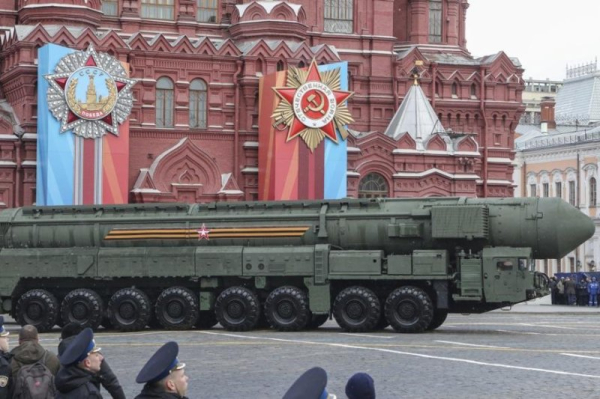
A Russian ‘Yars’ intercontinental ballistic missile launcher is displayed in the Victory Day military parade in Moscow in May 2024. File Photo by Maxim Shpenkov/EPA
The party is over regarding strategic nuclear arms control.
It is almost inevitable that a new strategic nuclear arms race will be beginning or already is underway. With the expiration of the 2010 New START Treaty last week, limits on the 1,550 deployable nuclear warheads in 700 air-, sea- and land-based launching systems have been lifted.
Both the United States and Russia were allowed 100 non-deployable launchers. The United States has approximately 5,200 deployed and stored nuclear weapons. Russia has about 5,500.
On Friday, Undersecretary of State for Arms Control and International Security Thomas G. DiNanno delivered key statements at the Conference on Disarmament in Geneva, Switzerland.
DiNanno said the New START Treaty was no longer relevant in 2026 because of the expansion of nuclear weapons by “other powers.” He accused China of holding secret, low-yield tests in 2020 in violation of the Comprehensive Nuclear-Test-Ban Treaty, and employing “decoupling” techniques to hide these detonations.
Proclaiming an “America First” arms strategy, DiNanno called for a new, comprehensive, verifiable and enforceable arms control regime that included more than just Russia and the United States in bilateral talks.
This was an obvious reference to China that thus far refused to consider entering any nuclear arms task, while still developing its own arsenal thought to consist of about 600 warheads, with half having strategic — long-range — capability. That’s a long way from Mao Zedong’s comment that “a few atom bombs are enough.”
And the undersecretary cited Friday as the end of “U.S. unilateral restraint,” implying a possible arms buildup. Finally, he implied the Trump administration was seeking a “new, improved and modernized nuclear weapons treaty.”
None of this was a surprise. The United States had been preparing for the end of New START. While the administration’s Strategic Posture Review has not been released, the One Big Beautiful Bill Act signed into law by President Donald Trump in July contained about $15 billion for modernizing the nuclear triad.
That included $4.5 billion for more B-21 bombers; $2.5 billion for the Sentinel intercontinental ballistic missile; $2 billion for a sea-based cruise missile that could be nuclear armed; and $4 billion for the National Nuclear Safety Administration for refurbishing weapons and infrastructure.
Trident missiles carried aboard the Ohio class and the new Columbia class nuclear ballistic submarines can accommodate 12 warheads, although they reportedly have eight. More B-21’s means more capacity for nuclear delivery systems. By all accounts, the prospect for another nuclear arms race may be upon us. That will be exacerbated by at least two other factors.
The first is that during the Cold War, two scorpions inhabited the same bottle: the United States and Russia. Today, there are more smaller scorpions: India, Israel, Pakistan and North Korea possess nuclear weapons. There is one growing scorpion: China. And Britain and France have capable submarine nuclear forces.
Beyond that, many states can become armed with nuclear weapons in a relatively short time. Germany, Japan, Korea and Australia are among them. Saudi Arabia has a treaty with Pakistan that could lead to its acquiring nuclear weapons. And while Iran denies any intention of building the bomb, few in the United States believe that.
All this is very bad news. China is adamant about refusing talks on nuclear arms control. Russia, meanwhile, has numerical superiority in tactical or short-range nuclear weapons. And to some degree, any nuclear weapon can be considered tactical given that its use could trigger a strategic response. And where are the incentives for arms control?
The second factor that compounds the problems in reaching sensible and verifiable arms control agreements is the Golden Dome, the Trump administration’s plan to put an impenetrable shield around and over the continental United States.
The Reagan administration tried that and failed with the Strategic Defense Initiative, pejoratively known as “Star Wars.” SDI failed for many reasons due to the immaturity of missile defense technology and the inability to defend against air-breathing bombers, missiles and hypersonic weapons.
The only response for China, North Korea and Russia to Golden Dome would be more warheads from low-flying hypersonic missiles, bombers and, for Russia, nuclear-tipped, nuclear powered torpedoes, such as Poseidon. As for the possibility of proliferation, none of this is good news. And the Trump administration has rid itself of its best arms control experts.
What to do? Negotiators Steve Witkoff and Jared Kushner are not the answers. And the critical problem is: Who then?
Harlan Ullman is senior adviser at Washington’s Atlantic Council, chairman of a private company and principal author of the doctrine of shock and awe. His next book, co-written with Field Marshal The Lord David Richards, former U.K. chief of defense and due out next year, is Who Thinks Best Wins: How Decisive Strategic Thinking Will Prevent Global Chaos. The writer can be reached on X @harlankullman.
